


You have full access to this article via your institution.
Hello Nature readers, would you like to get this Briefing in your inbox free every day? Sign up here.

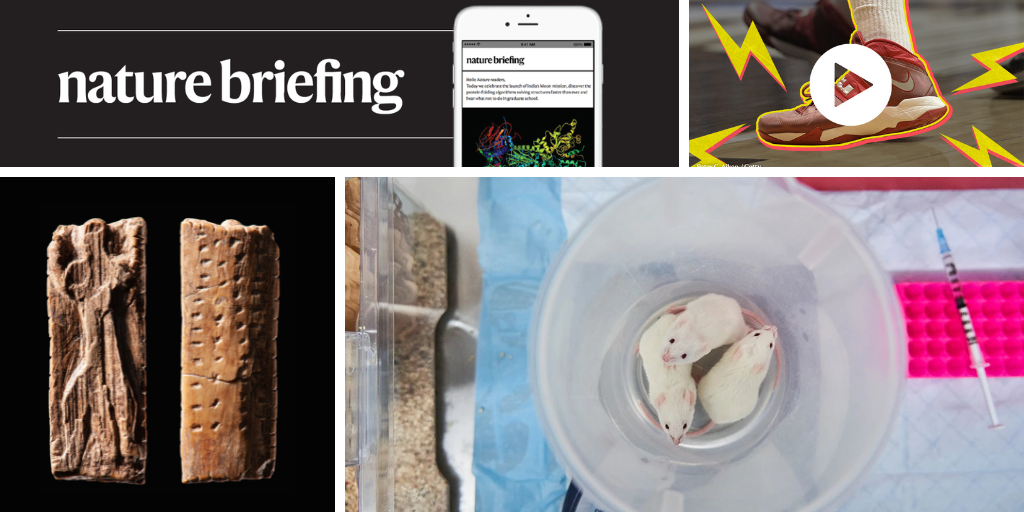
The Adorant figurine from Geißenklösterle Cave, in what is now Germany, is approximately 38,000 years old and bears a lion-human figure on one side and multiple sequences of notches and dots on the other. (Landesmuseum Württemberg/Hendrik Zwietasch, CC BY 4.0)
A series of notches carved on a piece of mammoth ivory roughly 40,000 years ago could be an early ancestor of cuneiform, one of the oldest-known forms of written language. “These sign sequences go beyond decoration that was aesthetically pleasing to particular individuals,” says linguist Christian Bentz. He co-authored a new study of the object and more than 200 other Stone Age artifacts that bear these signs. The study found statistical patterns in the Stone-Age marks that are similar to early proto-cuneform — but quite different to the information-dense writing systems of today.
A new publishing initiative aims to connect policymakers with clear evidence to inform fresh policies using ‘pop-up’ journals — those that publish articles focused on a single question for a short period of time before closing submissions. Backed by around US$1 million in funding, the Pop-Up Journal Initiative could help policy-relevant research cut through the flood of papers published every day. But some experts worry that convincing researchers to publish in a pop-up, rather than a well-known journal, might be difficult.
Fresh evidence from rocks in China is contributing to debate about what caused the ‘Great Unconformity’ — a one-billion-year gap in the geological record that exists all over the world. Theories abound: it might have been caused by abrasive worldwide glaciers during a period of ‘Snowball Earth’, or by erosion after the break-up of the supercontinent Rodinia. Tantalizingly, the period precedes a sudden proliferation of life on Earth, known as the Cambrian explosion. But new evidence suggests that most of the erosion that caused the gap happened long before all of that. “If the pronounced erosion happened earlier than the Snowball Earth glaciation and the Rodinia continental assembly, that’s a different story,” says geologist and study co-author Liang Duan.
Features & opinion
Rapid advances in alternative scientific methods are accelerating some countries’ plans to phase animal testing out of research. These ‘new approach methodologies’ (NAMs) include devices known as organs-on-chips, 3D tissue cultures called organoids and computational models, such as artificial-intelligence systems. NAMs can be better at mimicking human biology than animal models, but they’re a long way from replacing animal procedures completely, say scientists. Some biological systems are too complex and unpredictable to study without animals, and many NAMs have yet to satisfy regulators that they accurately and reproducibly represent the system they model.
Peer-reviewing a paper and smell something fishy? Research-integrity sleuths share their top tips for spotting a suspect paper:
• Check the references — fishy papers often cite studies that are unrelated, or even entirely fake.
• Confirm that the authors’ affiliations are correct, and that senior authors have an established publication record.
• Keep an eye out for AI prompts or ‘tortured phrases’ — bizarre sentences that overuse synonyms of scientific terms — in the text.
• Make use of tools such as the Collection of Open Science Integrity Guides (COSIG), which can walk you through the basics of identifying scientific-integrity issues.
It’s not just shoes that squeak when they slide over a hard surface. Bicycle brakes, rubber tyres, even some biomedical implants such as artificial hips sometimes squeal as soft and hard surfaces come into contact with each other. To better understand the cause, a team of researchers used high-speed photography to record a rubber block sliding across a hard acrylic sheet. They found pulses more commonly associated with the dynamics of earthquakes, and tiny sparks initiating those pulses.
The cherry on top of a great science programme is a great acronym to describe it. Today my hat’s off to the researchers at the University of British Columbia Okanagan, in Canada, who are working with wild horses to help Indigenous youth heal and reconnect with cultural traditions in the Youth, Elders, Ecology, Horses, and Health (YEEHAH) project.
I’d love to hear the best project acronyms you’ve spotted — plus any feedback on this newsletter — at [email protected].
Thanks for reading,
Flora Graham, senior editor, Nature Briefing
With contributions by Jacob Smith
• Nature Briefing: Careers — insights, advice and award-winning journalism to help you optimize your working life
• Nature Briefing: Microbiology — the most abundant living entities on our planet — microorganisms — and the role they play in health, the environment and food systems
• Nature Briefing: Anthropocene — climate change, biodiversity, sustainability and geoengineering
• Nature Briefing: AI & Robotics — 100% written by humans, of course
• Nature Briefing: Cancer — a weekly newsletter written with cancer researchers in mind
• Nature Briefing: Translational Research — covers biotechnology, drug discovery and pharma

