


You have full access to this article via your institution.
Hello Nature readers, would you like to get this Briefing in your inbox free every day? Sign up here.

Greenland is a major place of climate research.Credit: Lukasz Larsson Warzecha/Getty
In response to threats by US President Donald Trump to somehow acquire Greenland (Kalaallit Nunaat), US scientists have drafted what they call a statement in solidarity with the island, open to any US-based researchers who have conducted research there. “A lot of people in the US — not just scientists — are very upset about the rhetoric directed towards Greenland. But scientists who work there feel it very personally,” says palaeoclimatologist Yarrow Axford, who is one of the creators of the initiative. “We want to let our colleagues and friends in Greenland know we’re thinking about them right now, and that we stand with them.”
Read more: UK glaciologist Martin Siegert writes that Greenland is indispensable to global climate science (The Conversation | 7 min read)
Scientists have identified a neural circuit that seems to act as a ‘motivation brake’, dampening the drive to begin a difficult or unpleasant task. When the team selectively suppressed this circuit in macaque monkeys (Macaca fuscata), the animals were more willing to start a potentially unpleasant job. If confirmed in humans, the findings could shift how clinicians approach the debilitating lack of motivation associated with depression. But any easing of the motivational brake will require care to prevent inadvertent overwork and burnout, says neuroscientist and study co-author Ken-ichi Amemori.
Reference: Current Biology paper
Last week, the US Congress published a spending bill that effectively axes NASA’s Mars Sample Return (MSR) programme, which was supposed to ferry Martian material collected by the Perseverance rover to Earth. Among the MSR projects that the bill brings to a halt is the chemical analysis of a rock sample that contains compounds that could be a fingerprint of ancient microbial life. There might be other ways to get the samples to Earth, such as the involvement of private aerospace companies, but “the programme — as we know it — is dead”, says Casey Dreier, chief of space policy at the Planetary Society, a non-profit organization.
Popular large language models (LLMs) often reproduce harmful stereotypes about Indian castes — hereditary groups traditionally associated with specific occupations and social status. Researchers used a custom-designed tool to detect ‘caste bias’ in LLMs and found that every model they tested exhibited some bias. GPT-4o and GPT-3.5, created by OpenAI, had some of the highest bias scores. Information on minority groups might be less likely to appear in prestigious journals or other outlets, and might be written in local languages, which could result in it being filtered out of AI training data, says Agrima Seth, who studies cultural biases in LLMs.
Reference: arXiv preprint 1, preprint 2 & preprint 3 (not peer reviewed)
Features & opinion
Anxiety, depression, suicidal ideation and self-harm have all increased among undergraduates in the past decade, note mental-health researchers Lauro Miranda Demenech and Anne Duffy. Yet globally, only a fraction of students who would benefit from help actually get it — with inequities for disadvantaged and at-risk groups. Demenech and Duffy offer advice for universities on how to make efficient use of scant resources to best support the students in their care — such as with mental-health literacy courses that count towards qualifications.

Source: The Healthy Minds Network
The success of the volunteer-written online encyclopedia Wikipedia is built on trust, says founder Jimmy Wales — and he hopes to bring that approach to bear on a new form of social media that aims to prioritize trusted content. “We have a lot of experience with people who disagree about a fundamental issue, but can come together to work productively,” says Wales. “We still have to consider engagement, because no one will use the platform if it’s boring. But can we reward people for creating thoughtful dialogue?”
Former academics who have diversified into farming, launched their own business, joined a non-profit or pursue independent research say that there is life after academia. Now is “the time to be bold, to be brave, to embrace your passions”, says immunologist Luz Cumba Garcia, who lost her global-health job in the United States and is now a self-employed policy advisor.
Where I work

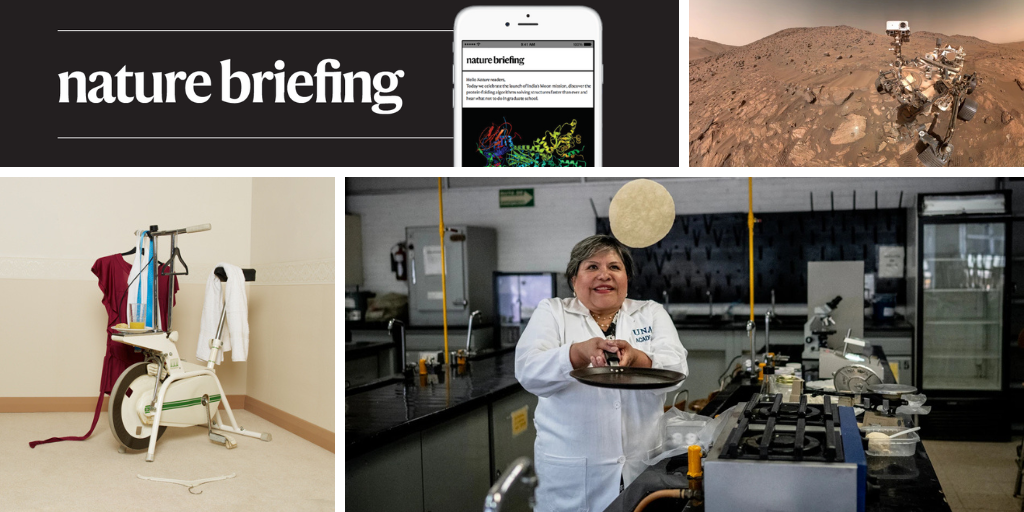
Raquel Gómez-Pliego is a food scientist at the National Autonomous University of Mexico in Cuautitlán Izcalli. Credit: Carl de Souza/AFP/Getty
Food scientist Raquel Gómez-Pliego hopes to make the iconic tortilla even better. “The ingredients for the tortilla I was frying in this photo have been fermented to include probiotics and prebiotics for gut health,” she says. “Improving a staple food that people already eat daily is a powerful public-health strategy.”
On Friday, Leif Penguinson visited the Barron River in Australia. And Leif was not alone! There was also a feathered friend in the image: an azure kingfisher (Alcedo azurea). Did you find the penguin (and the kingfisher)? When you’re ready, here’s the answer.
Thanks for reading,
Flora Graham, senior editor, Nature Briefing
With contributions by Jacob Smith
• Nature Briefing: Careers — insights, advice and award-winning journalism to help you optimize your working life
• Nature Briefing: Microbiology — the most abundant living entities on our planet — microorganisms — and the role they play in health, the environment and food systems
• Nature Briefing: Anthropocene — climate change, biodiversity, sustainability and geoengineering
• Nature Briefing: AI & Robotics — 100% written by humans, of course
• Nature Briefing: Cancer — a weekly newsletter written with cancer researchers in mind
• Nature Briefing: Translational Research — covers biotechnology, drug discovery and pharma


