


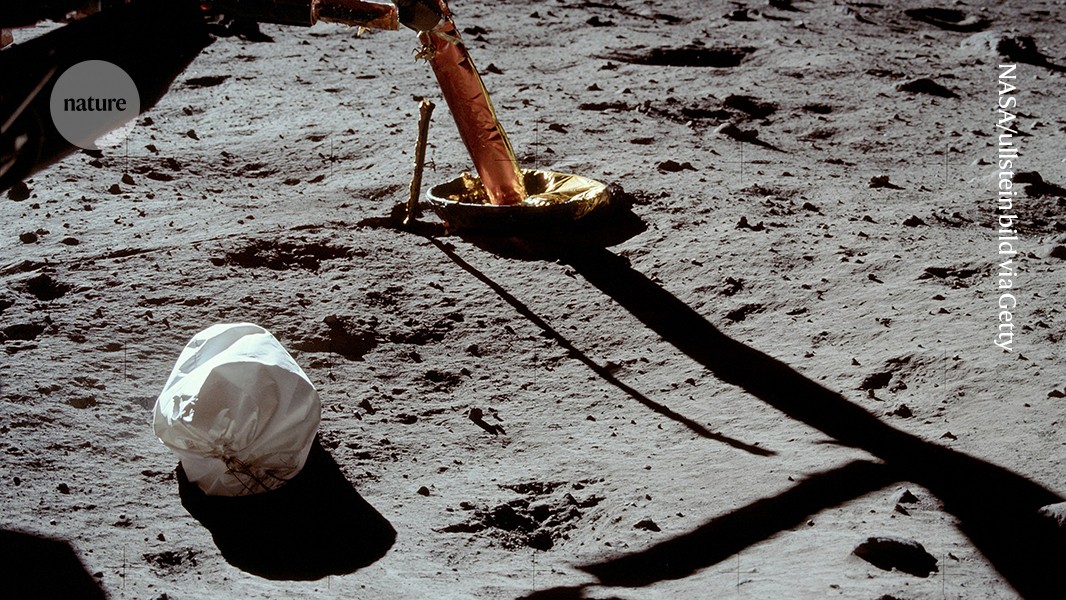

A bag of human waste was captured in the first photograph taken on the Moon.Credit: NASA/ullstein bild via Getty
On 1 April, four humans left Earth to swing around the Moon for the first time in more than 50 years. Many people will be watching during the ten-day mission. Flags will perhaps be waving. The word historic might well be on many lips. What almost no one will be talking about is stewardship.
Humanity doesn’t have a great track record from our limited interactions with other worlds so far. Between 1969 and 1972, Apollo astronauts left 96 bags of human waste — urine, faeces and vomit — on the lunar surface, to shed weight so that the lunar module could lift off with a cargo of Moon rocks. The first photograph Neil Armstrong took after setting foot on the Moon captured one of those bags. Astrobiologists now want to retrieve them, worried about possible biological contamination of the Moon’s surface.
Lift off! Artemis II mission sends humans to the Moon — opening a new era of exploration
But who decided it was acceptable to leave them there? The Outer Space Treaty of 1967, which is still the legal instrument governing human activity beyond Earth, prohibits national appropriation of celestial bodies. It says nothing about environmental responsibility — and nothing about who gets to make these decisions on behalf of humanity.
I am a space environmentalist. For more than two decades, I have developed scientific frameworks for understanding the carrying capacity of Earth’s orbit (its ability to sustain safe operations and traffic). This shell of space around our planet is quietly filling with debris and dead satellites, the wreckage of ambition without accountability. I have watched space being treated like Earth’s land and seas: as an open frontier, exploited without limits, governed too late and only after irreversible harm has been done. We can and must make different choices about the Moon.
Artemis is not just a return to the Moon. NASA and its international partners speak openly about permanent lunar bases, resource extraction and sustained habitation, and about using the Moon as a launchpad for Mars. NASA administrator Jared Isaacman has said that the lunar surface will “look like a junkyard” for about ten years. Private companies are already positioning for lunar mining. Governments are competing for strategic terrain.

Artemis II mission is about to fly humans to the Moon — here’s the science they’ll do
What’s lacking is any serious debate about what stewardship of another world requires. The Moon meets every criterion for designation as a site of outstanding universal value. Its ancient geology is an irreplaceable scientific archive. The craters at the lunar south pole, the main target of the Artemis programme, contain water ice that is both a record of the early Solar System and a resource that, once extracted or contaminated, cannot be restored. The Apollo landing sites are the physical record of humanity’s first steps beyond our own planet. The World Heritage framework, established by the United Nations cultural organization UNESCO, was designed precisely for places such as this — but only on Earth.
The Artemis Accords, signed so far by 61 nations, including the United States, encourage responsible behaviour for civil space exploration and use. But they are non-binding, and key spacefaring powers, such as Russia and China, have not signed up. The accords do not establish enforceable environmental standards. And they were written without meaningful participation by historically exploited nations, by Indigenous communities or by the billions of people who have no space programme but who share the night sky.

