


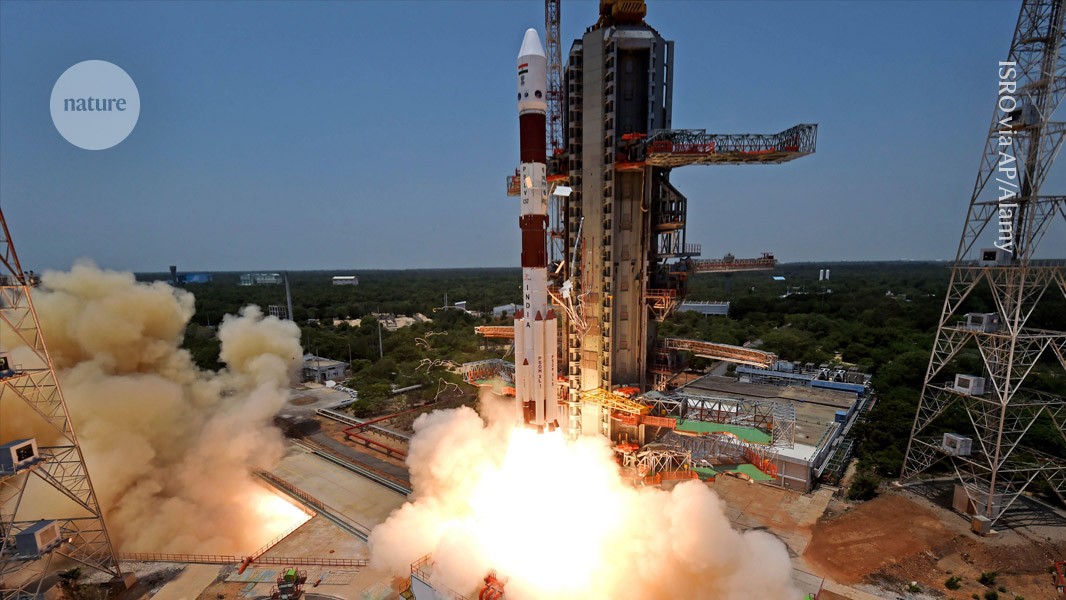
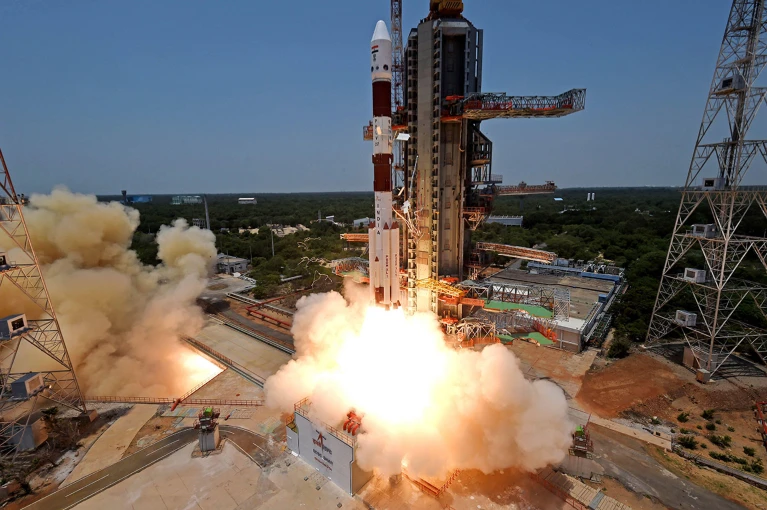
India’s Aditya-L1 spacecraft launched in 2023. Next year, it will observe the Sun during its peak activity phase.Credit: Indian Space Research Organisation via AP/Alamy
AI for science
Research powered by artificial intelligence made leaps this year, and it is here to stay. AI ‘agents’ that integrate several large language models (LLMs) to carry out complex, multi-step processes are likely to be more widely used, some with little human oversight. The coming year might even bring the first consequential scientific advances made by AI. But heavier use could also expose serious failures in some systems. Researchers have already reported errors that AI agents are prone to, such as the deletion of data.
Next year will also bring techniques that move beyond LLMs, which are expensive to train. Newer approaches focus on designing small-scale AI models that learn from a limited pool of data and can specialize in solving specific reasoning puzzles. These systems do not generate text, but process mathematical representations of information. This year, one such tiny AI model beat massive LLMs at a logic test.
Gene-editing momentum
Next year could see the launch of two clinical trials to develop personalized gene therapies for children with rare genetic disorders. The efforts expand on the treatment of KJ Muldoon, a baby boy with a rare metabolic disorder who received a CRIPSR therapy tailored to correct his specific disease-causing mutation.
The team that treated Muldoon plans to seek approval from the US Food and Drug Administration (FDA) to run a clinical trial in Philadelphia that will test gene-editing therapies in more children with rare metabolic disorders. These conditions are caused by variants in seven genes that can be addressed with the same type of gene editing as was used in Muldoon’s therapy. Another team hopes to begin a similar trial for genetic disorders of the immune system next year.

Artemis II crew members Victor Glover, Reid Wiseman, Christina Koch and Jeremy Hansen with the Orion crew module.Credit: NASA
Massive trial
A UK clinical trial of a single blood test that detects around 50 types of cancer before symptoms begin is expected to report results next year. The test screens for bits of DNA that cancer cells release into the blood, and can home in on the tissue type or organ that the signal comes from. The trial involved more than 140,000 participants, and if the results are promising, UK health authorities plan to roll out the tool across hospitals.
In April, the biggest regulatory update to clinical trials in the United Kingdom in two decades will come into force. Under the new rules, researchers can seek ethics and regulatory approval in one application. But the law also mandates that all trials involving medicines be publicly registered before recruiting their first participant and that a summary of results be published within 12 months of the end of the trial. The goal is to speed up research, boost the diversity of trial participants and reduce the time it takes for promising treatments to reach the people who need them.
Meanwhile, changes proposed by the FDA this month that would require a single clinical trial, rather than two, for new drugs to be approved will continue to unfold in 2026.
Heavy lunar traffic
Next year is set to be another busy one for Moon missions. NASA’s Artemis II will send four astronauts to fly around the Moon aboard the Orion spacecraft. The ten-day flight is the first crewed lunar mission since the 1970s and will help to prepare for subsequent missions to land on the Moon.
China is also preparing to launch the next in its series of lunar probes, Chang’e-7, in August. The mission will use a hopper spacecraft with shock-absorbing capabilities. It aims to arrive near the south pole — a rock- and crater-strewn region known for being challenging to land on. India’s Chandrayaan-3 in 2023 was the first spacecraft to successfully touch down near the lunar south pole. If it achieves a successful landing, Chang’e-7 will hunt for water ice and study moonquakes.

The payload module of ESA’s PLATO spacecraft — due to launch in 2026 — undergoes tests in a thermal vacuum chamber.Credit: ESA-Remedia
Martian moons and beyond
Researchers are also turning their eyes to Mars, with Japan planning to launch its Martian Moons eXploration (MMX) mission to visit the red planet’s two moons, Phobos and Deimos. The spaceship will collect samples of Phobos’s surface and return them to Earth in 2031, which has never been done before.
The European Space Agency is planning to launch its planet-hunting satellite PLATO towards the end of next year. Equipped with 26 cameras, PLATO will monitor more than 200,000 bright stars and identify ‘Earth twin’ planets with temperatures that allow liquid water to form.
India’s first solar mission, Aditya-L1, will observe the Sun during solar maximum, the peak of a roughly 11-year activity cycle, marked by the highest rates of sunspots, flares and solar storms. The satellite has been sitting in a halo orbit, which allows continuous observation of the Sun, about 1.5 million kilometres from Earth, since last year. Its data will help researchers to build a better picture of the Sun’s surface during the solar maximum.
Drill, baby, drill
Next year, China’s ocean-drilling ship Meng Xiang is expected to embark on its first scientific expedition. The vessel is designed to drill up to 11 kilometres through oceanic crust into Earth’s mantle and collect samples. The work will help researchers to learn about how the ocean floor forms and what drives its tectonic activity.

The Meng Xiang, China’s deep-ocean drilling vessel, is designed to drill through Earth’s crust into the mantle.Credit: Liu Dawei/Xinhua via Alamy

