


You have full access to this article via your institution.
Hello Nature readers, would you like to get this Briefing in your inbox free every day? Sign up here.

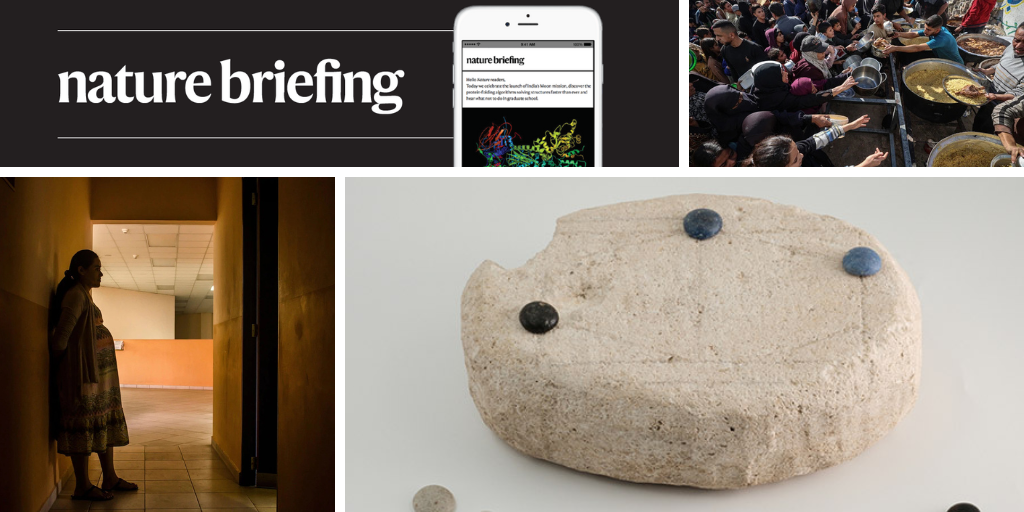
The limestone object, about 21 centimetres wide and shown here with stone counters, caught archaeoludologist Walter Crist’s eye in the Het Romeins Museum in Heerlen. To crack its rules, Crist and his colleagues applied an AI-powered game system that contains the mechanics of thousands of games, past and present, from around the globe. (Het Romeins Museum)
Researchers say they have figured out the rules of an ancient Roman board game. The team simulated thousands of turns based on more than 100 games that could be played on the linked lines inscribed on a stone found in the Roman settlement of Coriovallum, now Heerlen in the Netherlands. One set of rules best matched the wear-and-tear on the stone: a blocking game they’ve nicknamed Ludus Coriovalli (‘the game from Coriovallum’).
Scientific American | 7 min read
Play a digital version of Ludus Coriovalli
Young chacma baboons (Papio ursinus) vie for their mother’s attention more often when she’s grooming one of their siblings than when she’s free, which suggests that they get jealous of one another. Researchers found that the monkeys were more likely to interrupt their mother if she was grooming a younger sibling or one of the same sex. Their tactics included tantrums, attempts to physically come between their mother and sibling, and even tricks to lure their sibling away from their mother and take their place.
The New York Times | 5 min read
Reference: Proceedings of the Royal Society B paper
The black hole at the centre of our Galaxy might actually be a huge blob of dark matter, suggest astrophysicists. A super-dense core of subatomic particles called fermions, spreading out into a vast, diffuse cloud, would match up with observations (and a direct image captured in 2022) equally as well as a black hole, they say. If the Milky Way really is permeated by a cloud of fermionic dark matter — and we’d need better observations to confirm it for sure — it could help to answer outstanding questions about how the whole galaxy behaves.
Reference: Monthly Notices of the Royal Astronomical Society paper
Features & opinion
The safety and effectiveness of many drugs that might benefit people when they’re pregnant remain uncertain because the treatments have never been tested in that group. One analysis found that fewer than 1% of US drug trials explicitly included pregnant people, for example. The researchers trying to change the status quo are busting myths about trial participants, fighting to secure insurance and considering how to fund the specialized expertise and infrastructure needed to monitor the health of mother and baby in such trials.
Peace has long been considered a byproduct of economic development — but that is not necessarily so, says economics researcher Rabah Arezki. His studies have shown that conflict has long-lasting effects on development goals, whereas “a burst of economic development (including that through aid) barely affects conflict intensity”. He calls on the aid industry to shift to a ‘peace first’ approach. “Peace-building requires investment in scientific approaches for assessing the risk of conflicts before they happen,” he writes. “Diplomacy, mediation and preventive security have higher long-term returns than previously recognized.”
Lab handbooks, which lay out a research group’s ethos and practical guidelines, can head off confusion and conflicts before they begin. And there’s no need to start from scratch: the Starting Aware Fair & Equitable (SAFE) Labs handbook is one of a growing number of resources to help you create your own.
Reference: SAFE Labs handbook
Happy International Day of Women and Girls in Science! The Nature Awards Inspiring Women in Science are now open. The awards celebrate and support the achievements of women in science; of all those who work to encourage girls and young women to engage with science, technology, engineering and mathematics; and of those who work to support women to stay in those careers around the world. Find out more, apply or recommend a friend or colleague here.
Thanks for reading,
Flora Graham, senior editor, Nature Briefing
With contributions by Jacob Smith
• Nature Briefing: Careers — insights, advice and award-winning journalism to help you optimize your working life
• Nature Briefing: Microbiology — the most abundant living entities on our planet — microorganisms — and the role they play in health, the environment and food systems
• Nature Briefing: Anthropocene — climate change, biodiversity, sustainability and geoengineering
• Nature Briefing: AI & Robotics — 100% written by humans, of course
• Nature Briefing: Cancer — a weekly newsletter written with cancer researchers in mind
• Nature Briefing: Translational Research — covers biotechnology, drug discovery and pharma

