


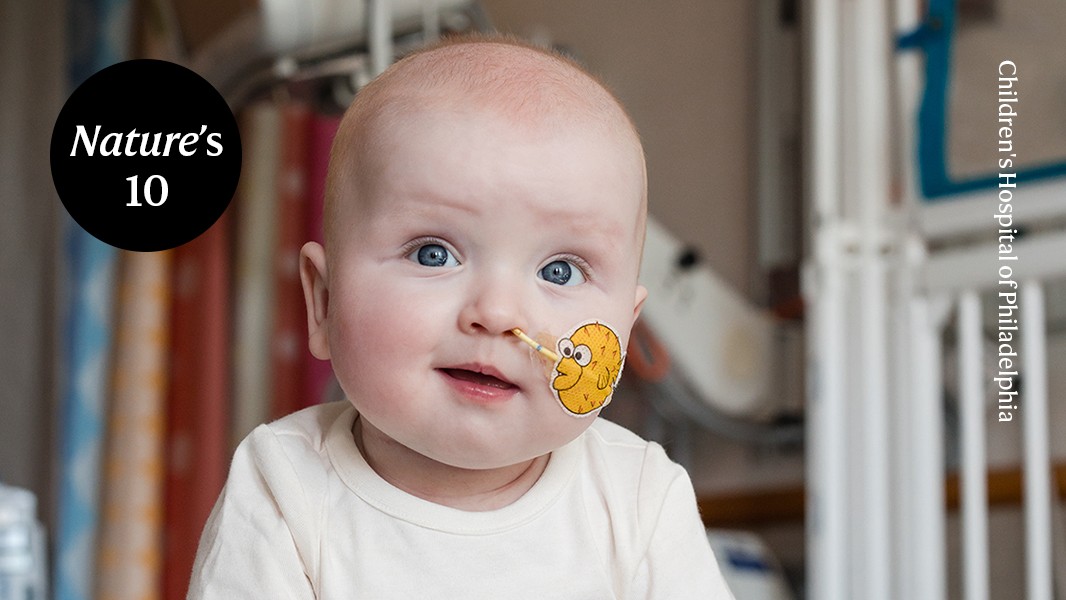
To the research team working to save him, KJ Muldoon was first known only as Patient Eta.
But within months, KJ’s name — and megawatt, chubby-cheeked smile — would be splashed across newspapers and broadcasts around the world as the first known person to receive a personalized CRISPR-based genome-editing therapy.
Soon after KJ was born in August 2024, doctors noticed that he was sleeping too much and eating too little. After a bevy of tests, they found that KJ has an ultra-rare genetic condition, called carbamoyl-phosphate synthetase 1 (CPS1) deficiency, that impairs the body’s ability to process protein.
When the body breaks down proteins, it produces ammonia — a toxic substance that is usually processed by enzymes in the liver and excreted in urine. CPS1 deficiency compromises one of these enzymes, causing ammonia to accumulate in the blood, which can eventually damage the brain. The condition can be treated with a liver transplant, but about half of all babies with CPS1 deficiency die in early infancy.
One of KJ’s doctors, paediatrician Rebecca Ahrens-Nicklas at the Children’s Hospital of Philadelphia in Pennsylvania, wondered whether there might be another solution — correcting the faulty enzyme in his liver. She and Kiran Musunuru, a cardiologist at the Perelman School of Medicine at the University of Pennsylvania in Philadelphia, had a bold plan to treat children with rare genetic disorders using gene-editing therapies tailored to unique DNA sequences. KJ could be their first candidate.
Previous gene-editing therapies were designed to treat many people. The first approved CRISPR therapy, called Casgevy, could potentially treat tens of thousands of people with one of two blood disorders. By contrast, KJ’s therapy would work only for him.
The team used an offshoot of CRISPR genome editing, called base editing, to target the problematic mutation — one faulty DNA letter out of the three billion in the human genome — and correct it (K. Musunuru et al. N. Engl. J. Med. 392, 2235–2243; 2025). Such a hyper-personalized editing therapy had never been made so quickly; KJ might only have a few months before ammonia overwhelmed his small body.
In the end, it took a large team of researchers in academia and industry to make it happen. While KJ charmed everyone he met at the hospital, Musunuru and his lab members shielded themselves from learning any personal details about him, even his name. “There were certain go or no-go points where key decisions had to be made,” Musunuru says. “We had to be objective with respect to the data.”
Manufacturing companies worked around the clock to make the gene-editing components needed to treat KJ. “We estimated that it would take 18 months,” says Sandy Ottensmann, a vice-president at Integrated DNA Technologies in Coralville, Iowa. “We did it in six.”
On 25 February, KJ received the first of three infusions. His tolerance for protein in his diet has increased, but he still needs medication and regular monitoring to ensure that his ammonia levels stay in check.

