


You have full access to this article via your institution.
Hello Nature readers, would you like to get this Briefing in your inbox free every day? Sign up here.

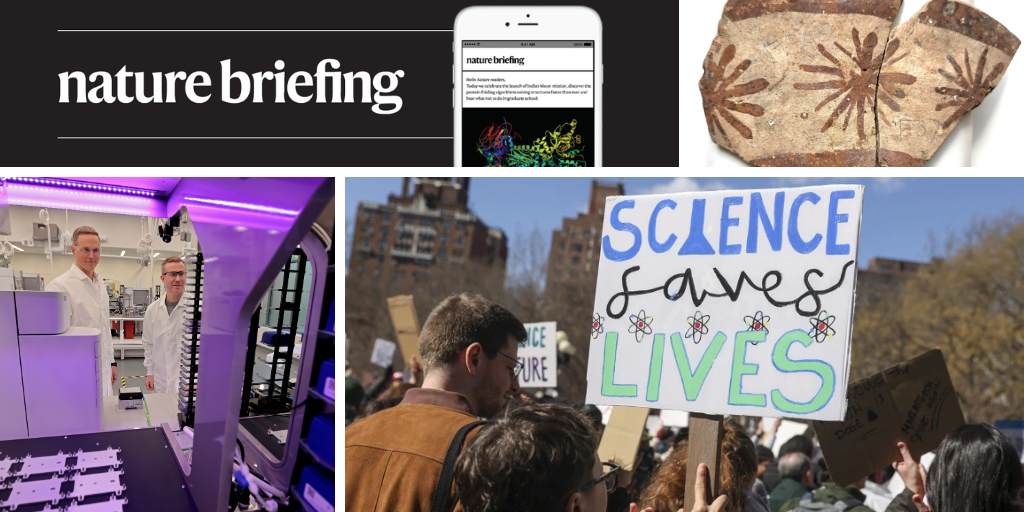
The mathematically patterned pottery shards were made in Mesopotamia some 8,000 years ago.Credit: Yosef Garfinkel
Pottery made by people of the Halafian culture, who inhabited northern Mesopotamia between around 6200 and 5500 BC, is painted with flowers that have 4, 8, 16 or 32 petals, and some show arrangements of 64 flowers. These patterns show a clear understanding of symmetry and spatial division long before written numbers came into use around 3400 BC, argue scientists in a new study. The skill might have helped the Halafian people with tasks such as sharing harvests or dividing communal fields, the authors say.
Reference: Journal of World Prehistory paper
Researchers have engineered a time capsule for cells, capable of collecting and storing messenger RNA (mRNA), the molecular product of gene transcription. These ‘TimeVaults’ are made by modifying mysterious cell structures called vaults to recognize and store mRNA. The researchers could trigger the ‘record’ button of the TimeVaults by treating cells with a drug and stop it by withdrawing the drug. “I anticipate that TimeVaults will allow us to observe facets of biology previously inaccessible to us,” says biological engineer Randall Platt.
In the year since US President Donald Trump returned to office, some of his administration’s actions — including firing thousands of government scientists, cancelling billions of dollars in grants and blocking funding for elite universities — have foundered. Many are tied up in the courts, and Trump’s proposals to slash federal science budgets are still pending before a sceptical US Congress. But there is undoubtedly more disruption to come. Here’s what US scientists and their global collaborators can expect in 2026:
• Science advocates are hopeful that the most extreme cuts sought by Trump will be avoided when Congress finalizes the federal budget soon.
• The budget could also save universities billions of dollars by heading off the administration’s efforts to reduce overhead, or ‘indirect’, costs on federal grants.
• Policy changes last year will make the Trump administration’s priorities central to which research projects will be funded — and give political appointees power over several key steps.
• Elite universities are likely to face more interference as the Trump administration seeks to correct what it sees as a liberal bias on campuses.
• The number of international students is set to decline, “which would be viewed as policy success in this administration, but be devastating for many universities”, says higher-education researcher Chris Glass.
Question of the week
More than half of Gen Z workers in the United States now have a second job to help make ends meet, or to pursue creative or entrepreneurial goals. Meanwhile many PhD students say that their stipends don’t meet their living costs. Nature wants to know whether you have, or had, a side gig during your PhD studies — please take our poll.
Click here if you’re a PhD to tell us what’s up with you
Features & opinion
At one time or another in their lives, sea turtles occupy the entire ocean realm, from beaches to the high seas. Their adolescence, spent far from shore, was known as their ‘lost years’, when little could be observed about their progress. Now advances in tracking technology are giving scientists a fresh view of these mighty migrators. “The more tags we put out, the more we saw turtles doing things we weren’t expecting,” says marine scientist Kate Mansfield. For example, far from the blissed-out drifters portrayed in Finding Nemo, young animals are active swimmers.
A combat robot’s long service finally comes to an end in the latest short story for Nature’s Futures series.
A study of 42 million papers in the natural sciences found that researchers who use AI methods publish more papers, garner more citations and become project leaders earlier than those who do not adopt AI research tools. However, those scientists who conduct ‘AI-augmented’ research do so on a more confined set of topics and engage less with other scientists. “It seemed clear that it was really compressing or kind of automating existing scientific fields, rather than generating new questions that lead to fermentive discussion.” says data scientist and study co-author James Evans.
Nature Podcast | 22 min listen
Subscribe to the Nature Podcast on Apple Podcasts, Spotify or YouTube Music, or use the RSS feed.
This week, Leif Penguinson has stayed down under. Our penguin protagonist has moved north to Port Douglas, Queensland to explore the coastal fig trees on the Coral Sea. Can you find the penguin?
The answer will be in Monday’s e-mail, all thanks to Briefing photo editor and penguin wrangler Tom Houghton. (Apologies if you saw my accidental spoiler earlier this week.)
This newsletter is always evolving — tell us what you think! Please send your feedback to [email protected].
Thanks for reading,
Flora Graham, senior editor, Nature Briefing
With contributions by Jacob Smith
• Nature Briefing: Careers — insights, advice and award-winning journalism to help you optimize your working life
• Nature Briefing: Microbiology — the most abundant living entities on our planet — microorganisms — and the role they play in health, the environment and food systems
• Nature Briefing: Anthropocene — climate change, biodiversity, sustainability and geoengineering
• Nature Briefing: AI & Robotics — 100% written by humans, of course
• Nature Briefing: Cancer — a weekly newsletter written with cancer researchers in mind
• Nature Briefing: Translational Research — covers biotechnology, drug discovery and pharma


