


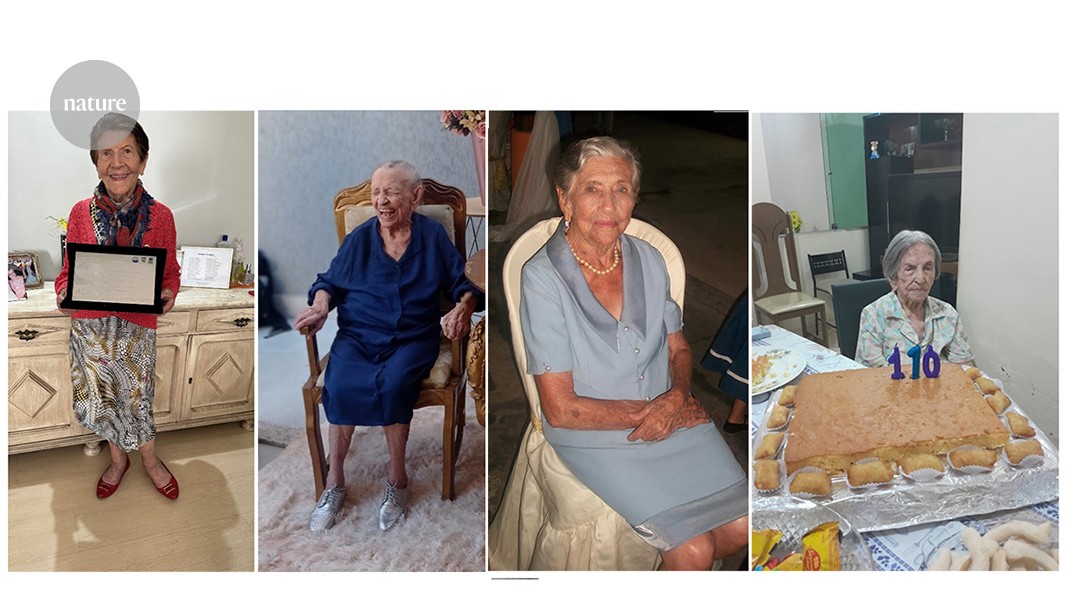

From left to right: Laura Oliveira, aged 106; her sister Fidelcina, 104; their sister Maria, 101; and their aunt Geny, 110.
They are a remarkable group: a 106-year-old woman who won her first swimming competition at age 100. A 107-year-old man who still holds a job. A chocolate-loving nun who lived to be 116.
These three are some of the oldest members of a group of centenarians in Brazil who are providing scientific clues about the limits of human longevity. Participants in the DNA Longevo (Portuguese for Long-lived DNA) study are still being recruited, but scientists have already sequenced the genomes of more than 160 centenarians. Twenty participants are ‘supercentenarians’ — those who reached the age of 110.
Early data show that the supercentenarians did not have especially healthy diets or exercise routines or access to high-end medicine for most of their lives. The secret to their long lives might instead lie in their genomes. In a preliminary report1 published this month, researchers hypothesize that the participants’ genetic diversity could have a role in their resilience.
“We know that Brazil has a highly mixed population, and that may contribute to their longevity,” says geneticist Mayana Zatz, who leads the project at the Human Genome and Stem Cell Research Center at the University of São Paulo.
Long-lived diversity
Many of the participants have ancestries that are some mixture of European, African and Native American heritage. By contrast, most studies investigating the health of centenarians have focused on populations that are more genetically homogeneous, so the current work helps to fill a gap in the field, notes Paola Sebastiani, a biostatistician at Tufts University in Boston, Massachusetts, who has worked on several other longevity studies. “In the United States, it has been very difficult to recruit a large number of centenarians from different genetic backgrounds,” she says.
Another aspect that sets the Brazilian cohort apart is that participants have managed to stay relatively healthy despite limited access to medical care. Many live in small villages, far from medical centres, Zatz says.
“This is suggesting that healthy ageing was driven by something else, not because they’ve had access to the latest targeted therapy or very early screening,” says Manel Esteller, a physician specializing in genetics at the University of Barcelona in Spain. “In Europe, the United States or Japan, where most other centenarian studies have been done, you have comparatively more-advanced medical assistance.”
Defying the odds
Participants include a nun, Sister Inah Canabarro Lucas, who was recognized as the oldest person in the world when she died last April, at the age of 116. Like others in the cohort, she did not restrict her sugar or fat consumption. “She loved chocolate. We once visited her at Easter and brought her some, and she was radiant,” Zatz recalls.
Another remarkable case is a 106-year-old woman who took up swimming at age 70 and won her first competition three decades later. Longevity runs in the family: she has two younger sisters over 100 and a 110-year-old aunt. “These families are especially valuable because genetics clearly plays a major role. And the sisters live in different places, so it isn’t simply a matter of sharing the same environment,” Zatz says.
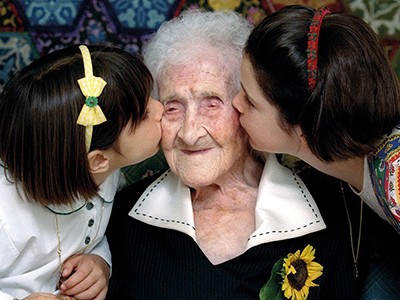
Does the human lifespan have a limit?
One volunteer, a 107-year-old man, is thought to be the oldest person to hold a formal job in Brazil. He works at a supermarket organizing shopping carts. “When we went to meet him at the market, we walked right past him. He was moving quickly from one side to the other, completely different to the image we usually have of centenarians,” says Mateus de Castro, a researcher specializing in gerontology and cell biology at the University of São Paulo.
Most participants are still mentally sharp, Zatz says, adding that they understand the study’s purpose and consent to participate, and that many say they are glad to contribute. “There have been times when participants even become emotional, knowing that having their blood drawn could help others in some way,” she says. For participants who aren’t cognitively healthy, researchers obtain consent from their families.

