


Source aircraft and engines
The A321neo Airbus A321neo-251NX (serial no. 7877) was equipped with two CFM LEAP-1A engines. The CFM LEAP-1A35 turbofan engine has a maximum rated thrust of 143.1 kN, a maximum overall pressure ratio of 38.5 and a bypass ratio of 10.5; see Unique Identification Number 01P20CM135 for its emission certification data29.
The CFM LEAP-1A features a lean-burn combustor or staged combustor with a rich-burn pilot stage and a lean-burn main stage28. The lean-burn mode is operated during take-off, climb and cruise phases. Both the central pilot injector and the annular main injector ring inject fuel into the combustion chamber, resulting in wide areas of lean fuel-to-air ratios and a more homogeneous temperature distribution in the combustor. The annular main injector is switched off for descent and taxi phases (rich-burn mode) to avoid combustor instability. Operating conditions typical for cruise were selected for the flight tests, and the T30 temperature at the combustor inlet was fixed for the different measurement points to allow comparability between lean-burn and rich-burn conditions. As the combustor normally operates in lean-burn conditions at cruise, engine steering control adjustments were made by the manufacturer to enable controlled operation in the forced rich-burn mode at cruise.
Falcon instrumentation
Contrail ice particles, aerosols and trace gases were measured with a set of well-characterized instruments that have been deployed aboard aircraft in previous campaigns21,27,39,51. Temperature and other meteorological data were measured with the meteorological measurement system on Falcon52. In the following, we describe the instruments and data evaluation used for this study in more detail.
Contrail ice particle instrument
Contrail ice particles in the size range between 0.6 µm and 50 µm diameter were measured with the Cloud and Aerosol Spectrometer (CAS)39,53,54, mounted in the inner left underwing pylon of the DLR Falcon. When the Falcon aircraft flies through contrails, ice particles pass through the instrument and scatter light from a laser beam (λ = 658 nm) in a sample area of 0.22 ± 0.04 mm2. By detecting the scattered light intensity, ice particle number concentrations as well as PSDs can be determined using Mie scattering theory and following the calibration method in ref. 55. Ice particle number concentrations are corrected for coincidence effects using an empirically derived correction function described in ref. 39. Shattering effects56,57 were not observed and, therefore, no correction was performed. The overall ice particle number concentration uncertainty is determined by uncertainties in the use of total air speed for the sample air speed, by the sample area uncertainty and by the concentration-dependent counting uncertainty. This amounts to an overall ice particle number concentration uncertainty of ±20% for the presented measurements.
Aerosol instruments
Total and non-volatile particle number concentrations were measured using condensation particle counters (CPC) TSI models 3010 and 3768a (TSI), which are modified and optimized for airborne applications. The CPCs show different lower size cut-offs of 5 nm diameter for total particles and 14 nm diameter for non-volatile particles5. Aerosol instruments retrieved the sample air through a forward-facing, near-isokinetic inlet. To determine non-volatile particle concentrations, three CPCs were operated behind a heated inlet line of a thermal denuder at 250 °C, removing volatile components. The sample flow could be diluted by about a factor of 30 using an inline dilution system to prevent saturation of the particle counters. CPC data were corrected for reduced detection efficiencies at low pressures and for particle losses in the thermodenuder5.
Uncertainties in particle number concentration measurements are mainly caused by uncertainties of the low-pressure correction functions, which amount to 7–13% at ambient pressures of 250–350 hPa and may vary slightly between the two CPCs. In the emission index uncertainty analysis, additional contributions arise from aerosol and CO2 background variability, the uncertainty of the CO2 measurement, and of the hydrogen-to-carbon ratio of the fuel. Inlet effects are negligible owing to the small particle sizes (<0.1 µm). Overall, the uncertainty of the particle emission index in the near-field at 300 hPa amounts to about 10%. Further details on particle measurement uncertainties are provided in refs. 5,33.
Trace gas instruments
Carbon dioxide (CO2) was measured using a high-frequency (10 Hz) non-dispersive infrared gas analyser (LI-7000, LI-COR biosciences) aboard the Falcon. Furthermore, a specifically adapted cavity ring down spectrometer G2401-m (Picarro), well-known for its stable instrument performance, was used to monitor and cross-check CO2 background values58. The sample air was passed to both instruments by backwards-facing inlets mounted on the upper part of the fuselage of the Falcon. The LI-7000 was modified in-house for aircraft deployment and makes use of the absorption of infrared radiation by CO2 molecules inside a measurement cell. By comparing the signal with that from a reference cell containing zero air, the absolute absorption and CO2 mixing ratio is derived. An occurring temperature drift of the instrument with time is compensated for by frequent zero measurements every 30 min during the flight. In the post-processing, the CO2 mixing ratio is corrected for water vapour dilution to report dry-air mole fractions. The accuracy of the LI-7000 CO2 measurement is 0.2 ppm, thereby taking account of the reproducibility of the calibration standards (0.18 ppm; using NOAA standards traceable to the WMO CO2 calibration scale), the precision (0.08 ppm) and the uncertainty of water vapour dilution correction (0.1 ppm) (for more details, see ref. 58).
Reactive nitrogen (NOy) was measured using a chemiluminescence detector (CLD TR 780, ECO PHYSICS)58. Using a heated gold converter (T = 290 °C) with hydrogen (H2) as a reducing agent, reactive nitrogen species NOy (NO + NO2 + HNO3 + PAN and others) are converted to NO molecules, which subsequently go through the chemiluminescence reaction with O3. Owing to the measurement range of the instrument of up to 1,000 ppbv, a dilution system was integrated to measure higher concentrations in the exhaust plumes. Thereby, zero air was added to the sample air at a ratio of 1:4 before the measurement. The detection limit of the CLD TR 780 is 0.55 ppbv at a time resolution of 1 Hz (ref. 58).
Water vapour (H2O) mixing ratios were measured with the water vapour mass spectrometer AIMS-H2O (refs. 59,60) with a frequency of 2.5 Hz by sampling air through a backwards-facing inlet at the upper fuselage of the Falcon. The relative humidity over ice (RHi) as a relevant parameter for contrail persistence has been calculated from measurements of the water vapour mixing ratio, static air temperature and static pressure. For the calculation in this study, the ice saturation pressure formulation from equation 7 in ref. 61 was used. The uncertainty in RHi is estimated to be around 15% by error propagation of the uncertainty in water vapour mixing ratios (8–12%) and temperature (0.5 K). Uncertainty in static pressure has only a minor contribution to the RHi uncertainty.
Meteorological dataset
The aircraft is equipped with basic instrumentation that measures pressure, temperature, air flow, wind speed and humidity at data rates of up to 100 Hz. The quality of the measurement depends not only on a proper lab calibration of the sensors but also on an accurate parameterization of the aerodynamic effects in the vicinity of the aircraft fuselage. These effects were determined by in-flight calibration methods, including the trailing cone method and manoeuvres62.
The NEOFUELS/VOLCAN campaign
Fifteen flights were performed with the Falcon behind the A321neo over the Atlantic and the Mediterranean in March 2023. For the six emission flights, the A321neo and the DLR Falcon entered a two-aircraft formation with a constant air speed of 0.59 Mach at an altitude of 9–10 km. Starting at a close distance of about 40 m to the right-hand engine of the leading aircraft, the Falcon repeatedly entered the emission plume of the A321neo from below, acquiring plume emission data for 45 s, followed by a 30-s sequence of background data, with five repetitions at the same engine setting to obtain good data statistics. As the Falcon was pushed back by the exhaust plume during the sampling sequences, the distance of the Falcon from the engine exit plane increased. To avoid entrainment of the wing-tip vortices, the Falcon descended below the plume at about 250 m distance and increased speed to catch up with the Airbus. This measurement sequence was repeated several times under different engine conditions or for different fuels in most sampling sequences, except one probing the right engine. Contrails are not yet fully developed at these close distances, and therefore contrails were probed in the far field at distances of 6–29 km behind the A321neo aircraft flying at a mean typical cruise speed of 0.78 Mach with both engines operating at the same combustor inlet temperature T30, combustor settings and powered by the same fuel.
Engine emission measurements and evaluation
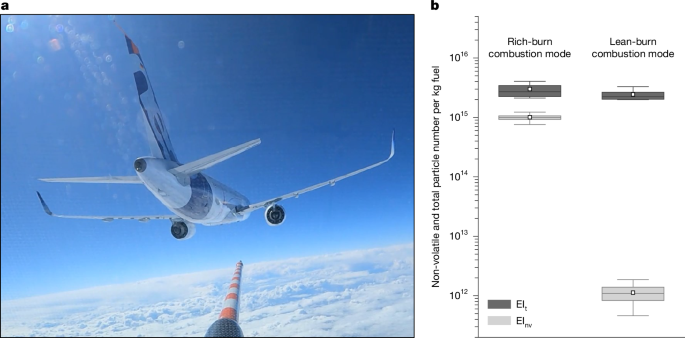
A time series of data collected by the DLR Falcon during a near-field emission measurements flight on 7 March 2023 is shown in Extended Data Fig. 1. Encounters of 0.2–1.4-s-old A321neo LEAP-1A exhaust plumes are evident by repeated sequences with large enhancements in total particles, CO2, H2O and NOy concentrations, and temperatures above background levels. Smaller fluctuations in the flight altitude indicate direct pilot manoeuvres in the exhaust plume with the auto-pilot switched off. Here, the pilots split aircraft control, and one pilot steered and kept the Falcon in the exhaust, whereas the other operated the thrust. A sequence of five plume encounters at the same engine power and combustor settings is followed by a break of few minutes to measure ambient conditions and to allow the change of engine power settings with respect to T30 combustor inlet temperature, combustion mode or fuel. Several orders of magnitude enhancements in total particle concentrations (d > 5 nm) are measured in all plume sequences, whereas distinct different features are observed in the non-volatile particles. Similar to total particles, large peaks are observed in non-volatile particle concentrations in the exhaust in the forced rich-burn mode, whereas non-volatile particle concentrations are close to background levels in the lean-burn combustion mode at similar T30 combustor inlet temperature settings.
Calculation of emissions indices
To conduct valid comparisons of particle number concentrations independent of dilution level, particle number concentration enhancements ΔX need to be compared with the mixing ratio enhancement of a tracer such as CO2 (ΔCO2). By assuming homogeneous mixing of particles and trace gases, the resulting ratio ΔX/ΔCO2 serves to gauge the level of plume/contrail dilution4. The amount of emitted CO2 per mass of burned fuel is a fuel property, depending on the ratio of hydrogen to carbon atoms in the fuel, and is described by the CO2 emission index \({\mathrm{EI}}_{{\mathrm{CO}}_{2}}\). With the ratio of molar mass of air (Mair) to molar mass of CO2 (\({M}_{{\mathrm{CO}}_{2}}\)) and density of air (ρair), an emission index for species X can be calculated as4
$${\mathrm{EI}}_{X}=\left(\frac{\Delta X}{\Delta {\mathrm{CO}}_{2}}\right)\,\bullet \,\left(\frac{{{\rm{M}}}_{\mathrm{air}}}{{{\rm{M}}}_{{\mathrm{CO}}_{2}}\,\bullet \,{\rho }_{\mathrm{air}}}\right)\,\bullet \,{\mathrm{EI}}_{{\mathrm{CO}}_{2}}$$
Here, density of air and particle concentration enhancement ΔX are given at standard temperature and pressure for the aerosol measurements and at ambient conditions for ice particle measurements. For non-volatile and total particles, EIX describes the number of emitted particles per mass of fuel burned, EInv that of non-volatile particles and EIt that of total particles, including volatiles and non-volatiles. Ice particles are not directly emitted by the engine and form on emitted or freshly nucleated aerosols in the young plume; they are labelled EIice for consistency with EInv and EIt.
Contrail encounters are evaluated only when ice particle and trace gas measurements are conducted approximately simultaneously. Therefore, correlations of ice particle concentration and CO2 mixing ratio time series are calculated, and contrail encounters are rejected if the resulting correlation is lower than 0.6, similar to the method in refs. 27,39. Uncertainties in aerosol/ice particle measurement, CO2 and aerosol particle background determination, CO2 measurement and ambient condition measurements are propagated to determine an EI uncertainty for every plume–contrail encounter. This results in average EInv and EIt uncertainties of 10 ± 5% and an average EIice uncertainty of 38 ± 16%.
In contrast to emission measurements performed in ice-free conditions at close distance, contrails were probed 6–29 km further downstream. At those distances, the contrail is in a relatively stable state if ambient conditions are supersaturated with respect to ice, so that valid comparisons of combustion modes can be performed. Contrail ages are determined from the GPS positions of the two aircraft and using wind field measurements onboard the preceding aircraft to determine contrail drift39. Ambient conditions, as well as fuel properties, and an assumed overall propulsion efficiency of 0.36 (ref. 63) enable calculation of the Schmidt–Appleman contrail formation threshold TSA (ref. 50). The difference in the ambient temperature to the formation threshold ΔTSA ranged between −4.5 K and −19.0 K for the shown contrail encounters. Extended Data Tables 2–4 show the engine and ambient conditions for contrail data shown in Figs. 2–4. As volatile and non-volatile particle emission data during the contrail sampling events could have been spoiled by the presence of contrail ice crystals, the engine particle emission data for Figs. 2, 3 and 4 were taken from near-field emission measurements at the same engine conditions in terms of engine inlet temperature T30, and the same fuels. Slightly different engine conditions or fuel contaminations also explain the lower EInv for Jet A-1 compared with engine emission data shown in Fig. 1 and Extended Data Table 1.
Contrail particle size distributions
Apart from the changes dependent on fuel and engine mode in contrail ice particle numbers, we investigate variations in contrail PSDs. To this end, PSDs of single contrail encounters formed on emissions from Jet A-1 and the HEFA-blend are shown in lean-burn and rich-burn combustion modes in Extended Data Fig. 2 for ambient measurement conditions given in Extended Data Table 2.
The contrail PSDs for each fuel type and engine mode may exhibit a slight dependence on initial ice crystal numbers because of changes in fuel type and combustion mode. Lower initial ice crystal numbers, for example, for the HEFA-blend compared with Jet A-1 in the forced rich-burn mode, can lead to slightly larger ice crystal diameters, as the water vapour emitted by the engines is distributed onto fewer ice crystals for the HEFA-blend. A similar trend has been observed in ref. 21 for a semi-synthetic jet fuel compared with Jet A-1 in a contrail analysis for similar ambient conditions, contrail age and at a similar difference to the emission altitude. Changes in water vapour and RHi during ice crystal growth may also affect microphysical and optical contrail properties, which may have an effect on the radiative forcing of the contrail.
Aerosol and contrail microphysics model
The ACM model in ref. 3 is further developed and improved for this study. The ACM model is a parcel model of jet plume aerosol and ice microphysics developed in the late 1990s (refs. 43,64,65), with the volatile particle formation module improved with algorithms and thermodynamic data developed in the past two decades40,42, and the contrail microphysics module improved with a new soot activation scheme3,31. Thereby, the fraction of fuel sulfur oxidized to sulfuric acid during combustion assumed by ACM is 3% (ref. 3). The ACM model captures the dependence of contrail ice particles formed on emitted non-volatile soot particles and can explain less-than-unity fractions of soot particles forming contrail ice particles3 as observed for low-sulfur fuels during ECLIF campaigns21,27. A recent study can also explain observed higher contrail ice crystal numbers than soot particle emissions, through additional activation of volatile sulfate aerosol in the soot-rich mode33. More importantly, previous ACM simulations have predicted that the number of contrail ice particles formed when soot emission is very low (that is, in the soot-poor regime) can be comparable to those of the soot-rich regime because of the activation of volatile particles2,3,31. More details of the ACM model can be found in ref. 3.
For the present study, the model has been improved to simulate the competition between nucleation and condensation of sulfuric acid, as well as organic and lubrication oil vapours, with individual nucleation and condensation rates assigned to each species. The ACM explicitly calculates the nucleation and condensation of lubrication oil vapours with an emission index (EIoil) of 120 mg kg−1 fuel. EIoil is informed by oil consumption data released by the engine manufacturer of 110–140 mg kg−1 fuel for the tested LEAP-1A engine, comparable to recent ground measurements41,47 for different engines of 110 mg kg−1. EIoil is also adjusted to our near-field particle emission measurements behind the left and the right engine39 (Fig. 4). About 6–7% of EIoil may lead to new particle formation, corresponding to the ULVOC fraction of lubrication oil reported in ref. 40, and the rest is assumed to condense on pre-existing aerosol.
Also, the nucleation of low-volatile organic hydrocarbons from incomplete fuel combustion is considered, with an emission index EIorg of 50–66 mg kg−1 fuel estimated from ground to cruise projections. However, only a fraction of those organic vapours emitted by the engines—containing smaller organic molecules than lubrication oil vapours41,47—may lead to new particle formation. Therefore, the assumed EIorg in the ACM simulation is lower, around 5 mg kg−1 fuel. In the model, EIorg may add to new particle formation with nucleation rates in the range of sulfuric acid nucleation, and different from the nucleation rates of the very low-volatile lubrication oils, or may condense on existing aerosol.
Owing to an overnight leakage between the two tank systems, the original 100% HEFA-SPK was contaminated and blended with Jet A-1 for the data shown in Fig. 2, which may have changed the FSC of the Jet A-1 to 192 ppmm and led to the HEFA-SPK blend with 75 ppmm sulfur. In the rich-burn combustion mode, the model simulates a decrease in soot and contrail ice particles in agreement with emission and contrail observations for low-aromatic fuels and RQL engines21,27,39. Slightly lower EInv than EIice for the forced rich-burn mode in our study might point to an additional activation of smaller soot particles, below the detection limit of the particle counter, or of volatile aerosols contributing to ice nucleation, which are not yet completely covered by the model. In the lean-burn combustion mode, the model simulates a decrease in contrail ice crystal numbers for fuels with a lower sulfur content and for increasing ambient temperatures, generally consistent with the observations within the experimental and model uncertainties. Existing deviations from the observations might point to additional factors or processes not yet covered by the model.
Sensitivity study for organic vapours
The Modèle Microphysique pour Effluents (MoMiE) is a microphysical model first developed at ONERA by Sorokin et al.66 and Vancassel et al.67 for typical kerosene fuels, and then adapted to simulate the combustion of SAF34. The model accounts for heterogeneous nucleation on soot particles and homogeneous nucleation of volatile particles composed of sulfur and organic species68. The model further differentiates between two types of organic species: water-soluble organic compounds that can nucleate to form a new volatile aerosol distribution and water-insoluble organic compounds that can condense on soot and volatile particles69. The processes of coagulation, condensation and freezing70, as well as the effects of ion recombination by considering positive organic clusters and negative sulfates71,72, are included. Plume dilution is calculated using the analytic formula in ref. 50.
The MoMiE simulations span a range of initial soot particle number emission indices and consider three fuel types: Jet A-1, HEFA-blend and 100% HEFA-SPK (Table 1, Extended Data Table 2 and Extended Data Fig. 3). In all simulations, soot particles are represented by a lognormal size distribution with 35 nm median diameter and a standard deviation of 1.6 (ref. 3). The emission index of the insoluble organic compounds from condensing oil vapours, EIoil, is fixed to 120 mg kg−1 fuel, in line with data from the engine manufacturer for this engine model. EIoil does not produce new particles in this model, but can condense on existing soot and volatile particles. Ground to cruise extrapolations suggest EIorg in the range of 50–66 mg kg−1 fuel, and the model assumes about 10% to be converted into volatile aerosol, which is activated to ice. Extended Data Fig. 3 provides simulation results for Jet A-1, HEFA-blend and HEFA-SPK scenarios with different fuel sulfur contents (192 ppm, 75 ppm and 3 ppm, respectively, by mass of fuel sulfur; Table 1) simulated for average ambient conditions of 218 K and 110% relative humidity with respect to ice, compared with the observations of Jet A-1 and HEFA-blend (Extended Data Table 2). Extended Data Fig. 3 shows the influence of initially soluble organic compounds on new particle formation, complementing sulfuric acid-driven particle nucleation. The simulated ice particle numbers are sensitive to low-volatile organic vapours in the low-soot regime. Increasing water-soluble organic vapour concentrations enhances contrail ice crystal numbers in the low-soot regime for both measurement cases and yields a better agreement with the observations for the Jet A-1 case. In the rich-burn combustion mode, the presence of organics has a smaller influence on ice particles, and soot particles are the main contrail ice nuclei.

