


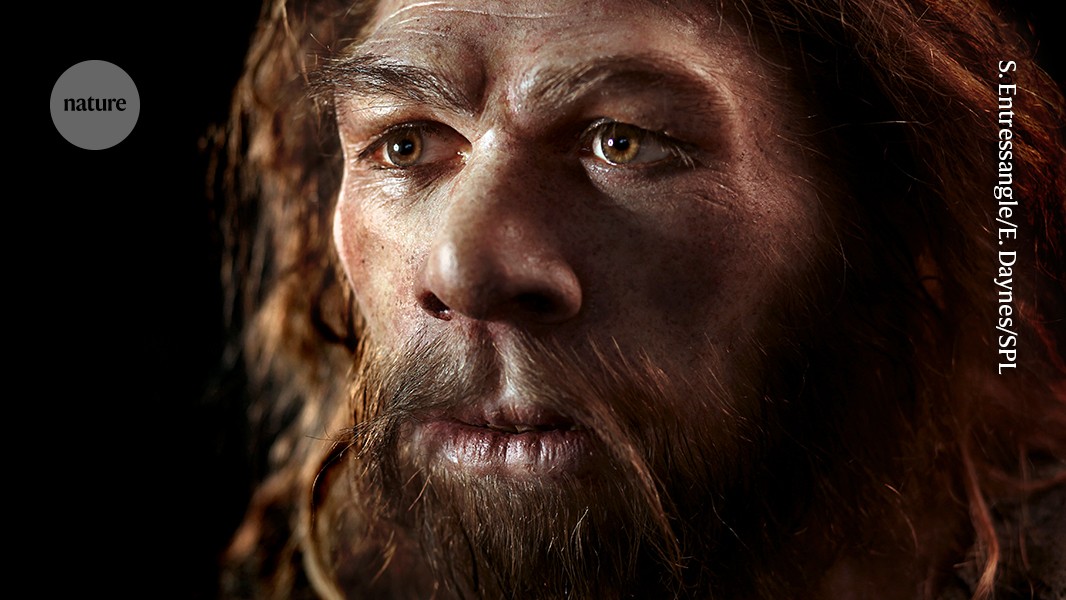

It is unclear why male Neanderthals (artist’s impression) paired off with female Homo sapiens more than the opposite.Credit: S. Entressangle/E. Daynes/SPL
Prehistoric sexual proclivities helped to shape the human genome, according to a study1 of genetic material from three female Neanderthal specimens. The analysis suggests that female Homo sapiens and male Neanderthals (Homo neanderthalensis) mated more often than did male H. sapiens and female Neanderthals.
The findings show how behaviour can shape human evolution, says study co-author Alexander Platt, an evolutionary geneticist at the University of Pennsylvania in Philadelphia. Human geneticists have often taken a “bizarrely clinical approach” when looking at ancient genomes. But “these are all people, and we know that people have bias, and we know people have preferences”, he says.
The study was published in Science on 26 February.
Genetic desert
Determining how people behaved in the past is a tall order. In recent years, some studies2,3 have used genetics to uncover how historical events such as colonization and slavery have shaped the genomes of people living today. But this approach rarely extends past modern history.
Modern humans can have up to 4% Neanderthal DNA. But this genetic material is not distributed equally. Some parts of the H. sapiens genome, including most of the X chromosome, lack any Neanderthal ancestry. These regions are known as ‘Neanderthal deserts’.
Mum’s a Neanderthal, Dad’s a Denisovan: First discovery of an ancient-human hybrid
There are two main theories for the existence of these deserts. The first holds that Neanderthal genetic variants were disadvantageous for both anatomically modern humans and for Neanderthals themselves and were thus quickly purged from the human population.
The second holds that the Neanderthal versions of certain genes were disadvantageous to modern humans but worked perfectly well for Neanderthals, and vice versa. If this were the case, then Neanderthals with some human ancestry would be expected to have their own DNA deserts devoid of human ancestry.
Most studies on Neanderthal DNA deserts examine modern human genomes. But Platt and his team wanted to look at the flip side of the story and see how human DNA was integrated into Neanderthals’ genomes. They analysed the genomes of three female Neanderthals who lived 122,000, 80,000 and 52,000 years ago. All had distant human ancestry.
The team found human DNA deserts across most of the genome — with one glaring exception. The Neanderthal X chromosome had, on average, 62% more human DNA than non-sex chromosomes. This DNA didn’t seem to confer any advantage, because most of it was located in non-protein-coding parts of the genome.

