


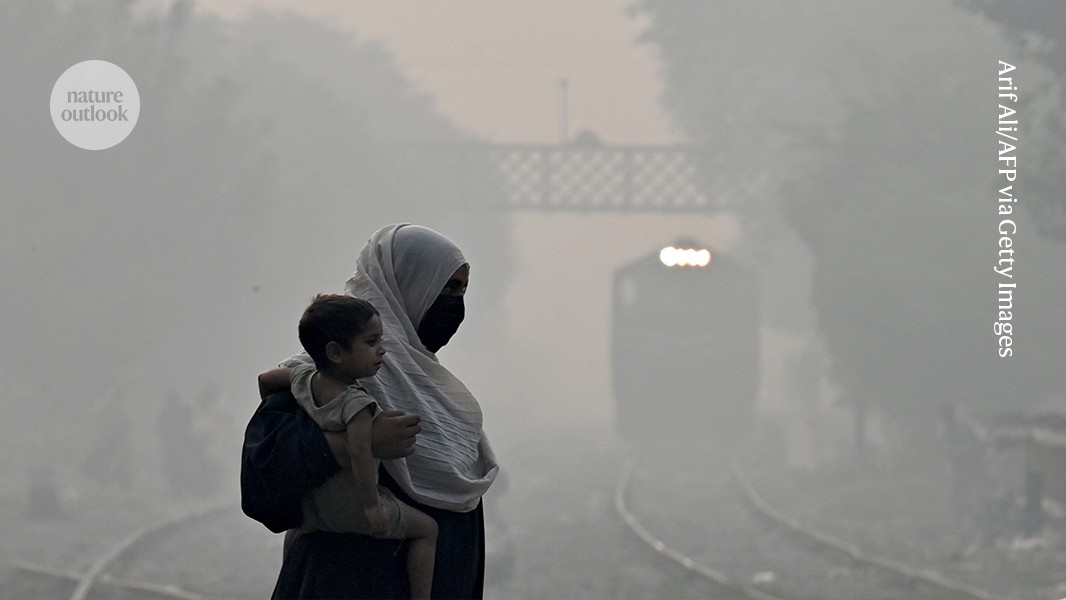

Heavy smog caused by pollution covers Lahore in Pakistan.Credit: Arif Ali/AFP via Getty Images
Next-generation air-quality analysis
Air pollution is the fifth-leading risk to health globally, according to the World Health Organization (WHO). Exposure to particulate matter alone is linked to 4.2 million deaths, annually. The situation is set to worsen in the coming years, as wildfires and other climate-change-driven phenomena affect air quality.
Nature Outlook: Lung health
One challenge to controlling air pollution is a lack of reliable and timely data. Artificial intelligence is increasingly being used to understand and make predictions about air pollution. To understand the breadth of research on this subject, a team of scientists at the University of Southern Queensland in Toowoomba, Australia, conducted a systematic review of 65 studies.
Sreeni Chadalavada and colleagues found that research on AI and air pollution surged after 2021. For some tasks, such as predicting concentrations of coarse particulate matter, machine-learning systems can achieve 98% accuracy. The models are also gaining popularity for analyses that require an understanding of complex space and time patterns. Examples include how pollution disperses over a city, changes across seasons and interacts with variables such as traffic and weather. Most AI models track several pollutants at once, and the strongest models combine data from multiple sources, such as ground sensors, weather monitors, satellite imagery and traffic. The most common limitations to using these models are uneven data quality, programs that do not transfer well across regions, a hesitancy to trust results owing to models’ ‘black box’ nature and steep energy costs. The authors predict that if AI models can be improved, they could provide earlier pollution warnings, more accurate forecasts and better guidance for city planners and public-health officials.
Environ. Model. Softw. 185, 106312 (2025)
Swapping cancer for breathlessness
New cancer therapies are extending lives but increasingly having an unwanted side effect: chronic breathlessness. Jing-Xing Li and Wen-Chien Cheng from the China Medical University Hospital in Taichung City argue that this “sobering paradox in oncology” is creating a hidden group of people who survive cancer, only to be left with another life-threatening condition: drug-induced interstitial lung disease (ILD). This underrecognized condition occurs when cancer therapies trigger inflammation and scarring in the lungs.
Li and Cheng present the condition as a growing challenge in oncology. No definitive diagnostic test exists, and no standardized treatment guidelines are available. The symptoms, such as breathlessness, are non-specific, meaning that diagnoses are made by a process of elimination. Many cancer treatments can cause drug-induced ILD, further complicating matters.
People with the condition often require supplementary oxygen, and some cases are fatal. Often, people must discontinue or interrupt their cancer treatment, leaving them vulnerable to disease progression. To improve outcomes, Li and Cheng call for a shift from reactive management to proactive monitoring and care. They propose conducting high-resolution computed tomography scans and lung-function tests to assist with detecting abnormalities; ensuring closer, scheduled monitoring of individuals during high-risk treatments; and treating suspected cases of drug-induced ILD with steroids. They also point to the potential of emerging tools, such as wearable sensors and AI-based medical-image analysis, to monitor people and predict risk. Early intervention, they argue, will “prevent irreversible harm”.
Nature Rev. Clin. Oncol. 22, 703–705 (2025)
Symptoms of long COVID
Millions of people who have contracted SARS-CoV-2 have experienced symptoms for many months after initial infection. In one pooled observational analysis of 1.2 million individuals from 22 countries, researchers found that 6% of people reported respiratory problems, persistent fatigue or cognitive issues three months after infection. Another review of 194 global studies reported that 45% of people who had experienced COVID-19 had at least one unresolved symptom four months later.
Because these observational review studies lack controls, Kamlesh Khunti at the University of Leicester, UK, and colleagues conducted a systematic literature review to identify studies between January 2022 and August 2024 that included people who had been infected with SARS-CoV-2 and others who had not — the controls. The researchers narrowed in on 50 studies, totalling around 14.6 million people.
They found that people who had been infected with SARS-CoV-2 had a greater risk of 39 of 40 symptoms compared with the control group. The most common effects were loss of smell, loss of taste, poor concentration, impaired memory and hair loss. People who were hospitalized had a higher risk of developing long-term symptoms.
Nature Commun. 16, 4249 (2025)
Plastic in the wind
Plastic is increasingly necessary for modern life, but it’s also a growing source of pollution. Plastic waste releases chemicals and breaks up into micro- and nanoscale-sized fragments that can enter the body and affect health. Inhalation is one route of exposure.
Most airborne micro- and nanoplastics (MNPs) that are inhaled originate on land. Another important, but overlooked, contributor could be sewage that makes its way into the ocean and is aerated by sea spray, according to Lauren Biermann, David Moffat and colleagues at the University of Plymouth, UK.
The authors analysed sewage spills in Plymouth from 2022 and 2023 alongside meteorological and satellite data. They defined winds exceeding 6.5 metres per second — the point at which white caps and sea spray typically occur — as the threshold for aeration of MNPs. They found 178 days of sewage spills coinciding with winds of that speed, totalling about 1,600 hours or around 10% of the two-year study period. They also found that sewage plumes at the water’s surface can extend more than 6 kilometres beyond the shore, suggesting there are ample opportunities for particles to be aerated. Although the research is theoretical, it highlights a potential pathway for MNPs to find their way into the air — and into people’s lungs.
Fibrosis survival clues
Pulmonary fibrosis can have various causes, including autoimmune diseases and environmental exposures. In idiopathic pulmonary fibrosis (IPF), however, the cause is typically unknown. It’s also unclear why some people who are diagnosed with IPF decline faster than others.
Researchers led by Carlos Flores at Our Lady of Candelaria University Hospital in Santa Cruz, Spain, have identified rare, protein-altering variants in genes that are associated with pulmonary fibrosis that correlate with lower survival in people with IPF.
The researchers used whole genome sequences from 888 people with IPF in the United States to identify 131 rare genetic variants associated with the disease. The team then sourced further data from 472 people with IPF in an independent UK registry, and tested how the risk variants that they had identified — along with 19 more common, previously known risk variants for IPF — related to survival.
The researchers found that people with IPF who carried rare genetic variants in known fibrosis genes tended to die sooner than those who did not — especially if they also had fewer of the more common risk variants. By contrast, there were more survivors among those with more common risk variants and no rare ones. Together, the findings suggest that different genetic pathways might drive subtypes of IPF, and that genetic screening for variants could improve predictions of disease progression.
Lancet Respir. Med. 13, 495–504 (2025)
Wildfire smoke and respiratory health
Over the past decade, intense wildfires have worsened air quality. Evidence suggests that there is a link between exposure to wildfire smoke during early childhood and a shorter time to first use of a respiratory medication. Building on this, Radhika Dhingra at the University of North Carolina at Chapel Hill and colleagues set out to study whether exposure to wildfire smoke during gestation and the first months after birth was associated with early-life use of prescription medications for respiratory conditions.
The team used nationwide health insurance claims to track three years of medication for about 35,000 babies born between 2010 and 2014 in the western United States. The researchers tracked whether each child was exposed to wildfire smoke during specific developmental windows —including the three trimesters of pregnancy and the first and second 12 weeks after birth. They compared children with different exposures to wildfire smoke in a given window with peers in the same city who were not exposed. They found that about 10% of children in the cohort had prolonged use of a medication for a respiratory condition. The risk increased with exposure. For example, children exposed to 7 days of wildfire smoke in the first 12 weeks after birth had a 12% higher risk of needing medication compared with children who had not been exposed.

