


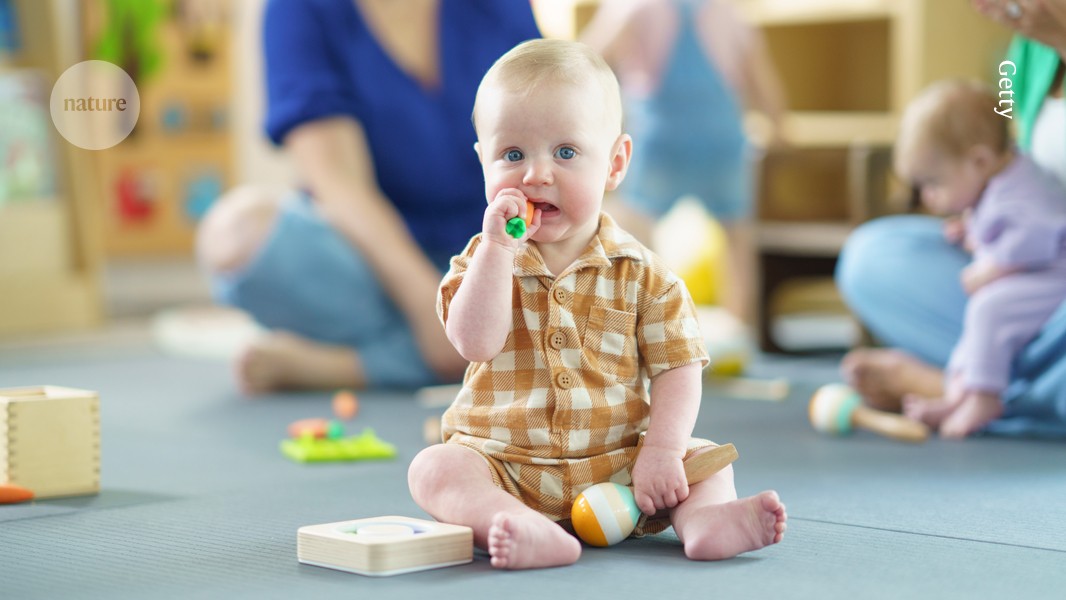

Infants’ microbiomes are strongly affected by what they eat and who they come into contact with.Credit: Getty
A large proportion of a baby’s developing microbiota comes from their peers at nursery, even after just one month of attendance, an analysis has found.
The study, published today in Nature1, analysed the gut microbiomes of infants during their first year of nursery. The amount of microorganisms that were transmitted between babies grew throughout the year. After four months, the babies at a nursery already shared 15–20% of their microbial species.
“That was higher than the proportion of all the microbes that they had acquired from birth until that point from the family,” says Nicola Segata, a microbiologist at the University of Trento in Italy.
Some of the changes in the children’s microbiomes will be due to the diet they had at the nurseries, but the study shows that the transmission of microbial strains between babies is extensive during the first year of nursery, and points to social interactions at this stage being key to building a diverse, healthy microbiome, adds Segata.
Bug transmission
While a fetus is still in the uterus, its microbiome is thought to be non-existent in healthy pregnancies2, but it starts to develop quickly after birth3, mainly through microbial transmission from the mother. Research has shown that people who live together start to share microbial strains. But, how the developing microbiota changes over the first few years of life hasn’t been well studied.
To fill the knowledge gap, Segata and his colleagues examined the microbiomes of 43 babies with a median age of 10 months at the start of the study. They followed them before, during, and after they attended their first year of nursery in Trento, Italy.
“We enrolled babies that were meeting for the first time, on the first day of the day care,” says Segata. “This is a time window in which their gut is much more prone to acquire strains from other babies and from adults, because the immune system isn’t yet well trained.”
‘Poo milkshake’ boosts the microbiome of c-section babies
The team analysed faecal sample from the babies, as well as 10 nursery staff and individuals who lived in the same homes as the children: 39 mothers, 30 fathers, 7 siblings, 3 dogs and 2 cats.
Once the infants started nursery, the researchers continued to take samples every week until the Christmas break, and for some infants this continued until July. All participants had follow-up samples taken in July and a year after the start of the study.
Microbial richness
The analysis revealed extensive baby-to-baby microbiome transmission just one month after the infants started nursery, which continued to grow over the nursery year. If a baby had a sibling, they received more microbes from the sibling than they did from their parents, they tended to have a more diverse microbiota overall, and they acquired fewer bacterial strains from nursery peers.
The study also mapped transmission of individual microbial species between individuals. Segata gives an example of what happened with a strain of bacteria called Akkermansia muciniphila. “We have an example of a strain jumping from a mother to the infant. The baby at the day care then transmitted it to another baby, who transmitted it to both its parents.”

