


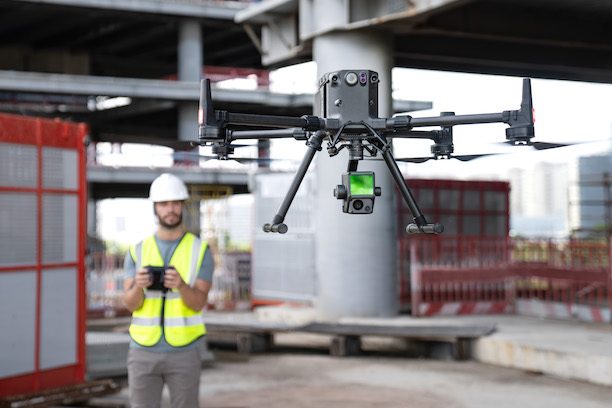
U.S. lawmakers are expanding their efforts to limit the use of Chinese-manufactured drones, shifting focus from federal agencies and spectrum access to the contractors that build and maintain some of the nation’s most sensitive infrastructure. In letters sent December 18, Senators Maggie Hassan and Gary Peters pressed major U.S. construction firms about their relationships with DJI and their continued use of Chinese-made drones on government-related projects.
The letters were sent to Hensel Phelps, Brasfield & Gorrie, and the Bechtel Corporation, all of which perform work at homeland security, defense, nuclear, and border security facilities. While federal agencies have long been prohibited from purchasing or operating DJI drones, the Senators’ inquiry signals a broader enforcement approach that treats contractors as a critical point of leverage.
“The U.S. government considers the use of Chinese-made drones generally — and DJI drones specifically — a threat to national security and prohibits their use by federal agencies or contractors,” the Senators wrote. “The use of these types of drones at sensitive and secure facilities creates the potential to provide a pathway for the transfer of important national security-related information to the Chinese government.”
From agency bans to contractor accountability
Congressional efforts to restrict Chinese drones have steadily intensified over the past several years. Actions have included a 2019 prohibition on Department of Defense purchases, DJI’s placement on the Commerce Department’s Entity List, executive branch guidance discouraging agency use of foreign-adversary drones, and statutory restrictions tied to government contracts. More recently, the FY25 National Defense Authorization Act aims to limit DJI’s access to FCC bandwidth, adding another pressure point.
What is new is the emphasis on contractors themselves. Large construction firms often operate extensive drone fleets across multiple projects and agencies, making them influential buyers and standard-setters. Limiting DJI use by contractors could have a broader market impact than agency-only bans, especially where contractors deploy drones on behalf of multiple federal customers.
DJI’s deep roots in construction operations
The Senators’ letters detail how deeply DJI drones have been embedded in U.S. construction workflows. Large contractors were among the earliest adopters of drone technology, a market DJI has long dominated. Bechtel, which has built nuclear weapons laboratories and missile bases, established a drone program early and co-hosted a DJI webinar in 2017. Hensel Phelps, a contractor at nuclear facilities and ports of entry, was the first construction company approved to fly drones over populated areas, and a 2020 interview with a company executive remains available on DJI’s website. Brasfield & Gorrie was featured in a DJI case study highlighting drone data collection capabilities.
This history underscores why lawmakers are concerned about legacy use. Drones used for surveying, mapping, and inspection can collect highly detailed imagery and spatial data. As the letter notes, “detailed information about the design of secure facilities is often sensitive and can be classified if it shows undisclosed security features or potential vulnerabilities.”
DJI has consistently disputed claims that its products pose a national security risk and has pointed to third-party audits intended to demonstrate data security. Nonetheless, U.S. government agencies have continued to warn about potential risks tied to Chinese-manufactured drones.
CISA, FBI, and documented compliance concerns
The Senators cite a January 2024 joint bulletin from the Cybersecurity and Infrastructure Security Agency and the FBI outlining three key vulnerabilities associated with Chinese-made drones. These include data transfer and storage pathways, firmware and patching risks that could introduce unknown data collection features, and network-connected drones that create “the potential for data collection and transmission of a broader type – for example, sensitive imagery, surveying data, facility layouts.”
The letter also points to documented cases where DJI drones were allegedly used on government-related projects despite existing prohibitions. The GSA Office of Inspector General reported instances of DJI drones being used at ports of entry as recently as 2022 and 2025. Corporate marketing and social media posts from contractors have also featured DJI drones in recent years, raising further questions about compliance.
Uneven impact across the drone industry
While the letters focus on large contractors, the broader implications extend to the commercial drone ecosystem. Smaller drone service providers have long expressed concern that maintaining an NDAA-compliant fleet is costly and difficult. Many argue that U.S.-manufactured alternatives do not yet match DJI drones in price, functionality, or the maturity of their software and payload ecosystems.
For large contractors, transitioning away from DJI may be expensive but manageable. Smaller operators, however, often lack the capital to replace fleets quickly and fear being pushed out of government-adjacent work if enforcement accelerates faster than the availability of competitive alternatives.
What comes next
The Senators are requesting extensive documentation, including drone inventories, waivers, cybersecurity policies, data storage practices, and internal audits. The scope of the inquiry suggests heightened oversight not only of prime contractors but also of subcontractors and their drone operations.
By targeting contractors directly, lawmakers appear to be testing a more forceful approach to limiting DJI’s presence in sensitive environments. Whether the market can adapt quickly enough, without disrupting critical infrastructure work or sidelining smaller providers, remains an open question for the U.S. drone industry.
Read more:

Miriam McNabb is the Editor-in-Chief of DRONELIFE and CEO of JobForDrones, a professional drone services marketplace, and a fascinated observer of the emerging drone industry and the regulatory environment for drones. Miriam has penned over 3,000 articles focused on the commercial drone space and is an international speaker and recognized figure in the industry. Miriam has a degree from the University of Chicago and over 20 years of experience in high tech sales and marketing for new technologies.
For drone industry consulting or writing, Email Miriam.
TWITTER:@spaldingbarker
Subscribe to DroneLife here.

