


Holly Newson 00:00
Welcome to Working Scientist, a Nature Careers podcast.
I’m Holly Newson, and in this series, you’ll hear from authors who can help you in your career.
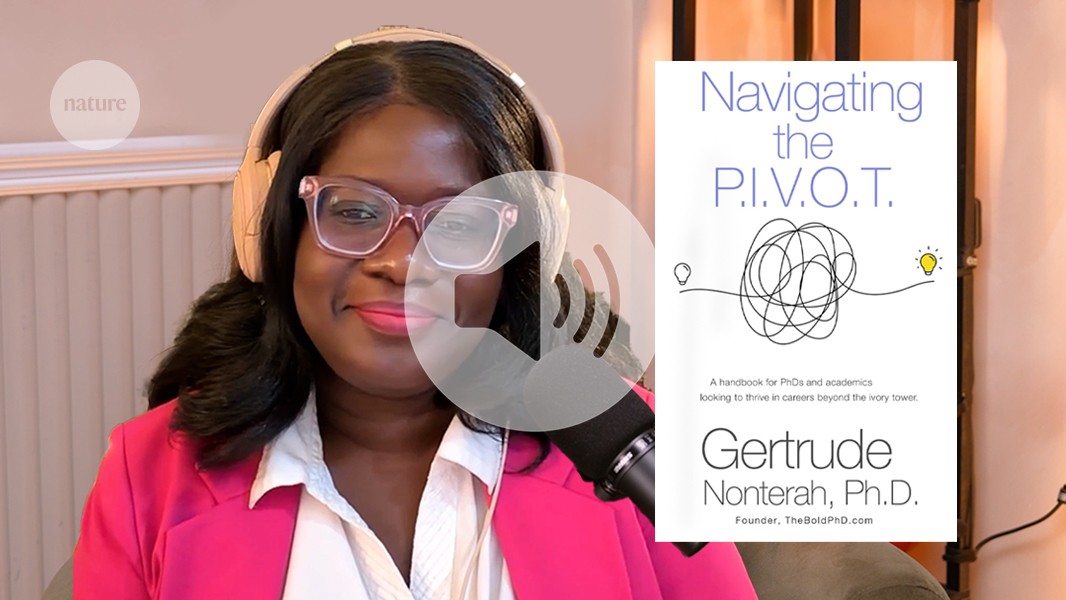
In this episode, I’m joined by Gertrude Nonterah, a science communicator with a PhD in microbiology and immunology, who founded and runs The Bold PhD, helping academics transition to other careers.
And she’s the author of Navigating The Pivot. A Handbook for PhDs and Academics Looking to Thrive in Careers Beyond the Ivory Tower.
Gertrude, thank you so much for joining me.
Gertrude Nonterah 00:34
Thank you so much, Holly, for having me.
Holly Newson 00:37
So to start off with, I wanted to know: why is it useful for academics to have some sort of a guide when they’re looking to transition careers?
Gertrude Nonterah 00:46
Right, to answer your question, I want to take a step back to my own experience.
So about eight years ago, I was a postdoc in a lab.
And unfortunately we were laid off because of a funding situation. And when we were, I was thrust into this world, you know, of looking for jobs again.
And I didn’t really, I didn’t anticipate how difficult it was going to be, especially trying to apply for jobs outside of academia.
But until that point, I spent about a decade in academia.
And applications, they were not going so well.
So I began to apply outside of academia. And I was hitting a wall. I was really hitting a wall.
And it took me a lot of trial and error to figure out how to write a proper resume for industry, how to present my work for industry versus academia.
And I was, like, there was some content on the internet about this. But I just felt, based on how difficult it had been for me, and all the things I’d had to learn by trial and error, I said: ‘You know what? Let me just help people who are coming up behind me who may want industry jobs or jobs outside of academia. But because they’ve been embroiled in the academic world, don’t really know how to talk about their work beyond academic circles.’
And so I began to do that.
So that’s how The Bold PhD was born.
And I began to get a great response to that. And so, really, the book was a culmination of all the questions people have asked me over the years.
And just putting all of those answers in a book to help people who are looking for careers outside of academia.
And even people who are in academia could benefit from this, actually.
But mainly my focus was on people looking for careers outside of academia, because I never want them to go through what I went through.
Holly Newson 02:36
Yeah. And when you see people starting that journey trying to maybe transition careers, what do you see that people struggle with the most?
Gertrude Nonterah 02:47
Oh, that’s such a good question.
I think one of the biggest things, it’s getting better, but one of the biggest things people struggled with was articulating how their research, or how the skills that they’ve gained within academia, translates to work outside of academia.
It’s not as simple as that. Because there’s no one-to-one mapping of, ‘oh, this experience is equivalent to this experience,’ right?
However, based on the job descriptions out there, based on what companies say about themselves, academics can really begin to frame their skills and frame their experiences in light of what those employers need.
And so that’s been the biggest hurdle I’ve seen academics have to cross.
Because they’ve been used to explaining what the data means. They’ve been used to their research topic being, like, the hot topic.
But industry doesn’t care. They don’t care that you’re, you know, you published.
They don’t care that you’ve necessarily published in Nature, right?
It’s great. Our science. They don’t really care. They care about how can you help us solve problems? And so really helping academics think of themselves as, I’m a problem-solver out of the, you know, out of academia, but not an academic trying to fit into industry. I hope that makes sense.
Holly Newson 04:08
Yeah, so in the book, you say that it’s important to be a problem-solver rather than a jobseeker.
So people might be seeking jobs.
So what is that…explain a bit more about the difference between being a job seeker and being a problem solver.
Gertrude Nonterah 04:22
Yes, because I made this mistake myself. I kept on throwing my CV, I had my academic CV, which was four pages.
It was beautiful. I had presented at conferences.
I had published papers. And I kept on sending them to different employers, thinking that they would deduce from my CV that I was a smart person.
I was potentially, like, somebody that they wanted to hire.
But that’s where I began to see a lot of difficulty was nobody was responding to any of my academic series, especially for industry jobs. Nobody was responding.
However, I had just I had read something, and I updated my resume. I updated it into (you know, I’m in the US, so sometimes I’ll use resume and CV interchangeably). But bear with me.
So I updated the CV, the academic CV, which was much longer into…and I boiled it down into a one-page resume.
And this one page resume really highlighted the skills I wanted my future employer to see. I wanted them to see me in that role, right? So that was my, my goal.
So that’s what I mean by presenting yourself as a problem-solver.
Yes, you are job-seeking, but ultimately what you want to do is, when a recruiter or a hiring manager picks up your resume, they can begin to imagine that, ‘Oh, I think this person is going to be great for this role, based on what I’ve been presented.’
But when you submit an academic CV that lists all the amazing work, (and I don’t downplay that), all the amazing work you’ve done within academia, they can’t see you as that person. They can’t envision you as that person, or as that problem-solver who will contribute to the role.
They see you as, ‘Okay, this person is really educated, but I don’t see anything here that says you can solve my problems.’ And so they pass on.
And that’s how I know. I struggled for years. And once I’ve gotten people, I’ve talked to people, coach people, and gotten them to update their resume this way, so that they begin to frame themselves in the minds of these hiring managers. There’s an immediate shift.
Holly Newson 06:29
So what sort of skills are the most transferable?
Maybe, because obviously, we’re talking in a general sense, rather than about a specific person from academia into industry.
And how can people identify for themselves, like, what’s going to be really useful to point out here?
Gerrude Nonterah 06:47
So if you have a PhD, then likely you’re very good at research, right?
And so looking for information is a power skill you have, right?
Answering questions, right? Usually for any PhD or academic, you have a question that you set forth to answer with your dissertation.
That is a really valuable skill.
Being able to communicate your results is also a valuable skill, right?
So you collect all this amazing data.
But data is just numbers, and it’s meaningless unless you can attach meaning to them.
And so being able to take that data and communicate that to people, that’s a really powerful skill.
And, you know, extra points if you’re somebody, and this is a skill that anybody can improve on, if you improve on the skill of being able to communicate your science, or communicate your research to audiences outside of your field, and for them to nod and say, ‘yes, I get that.’
Right, because all of us as academics can really get caught up in ‘it’s my field, and I’m only talking to people in my field.’
And maybe they’re just 25 people in your field, in the entire world, That means you can only talk to 25 people.
That’s not a great thing, right?
So learning to be able to communicate your research to people outside of your field is also going to be really important.
I’ve spoken with people who, they were using a specific software, right, within their PhD programme.
And then it just turns out that Amazon also uses that software.
And so they get hired because they use that software.
But the disconnect I find sometimes is academics or PhDs being able to articulate that,
Holly Newson 08:36
And you write obviously a lot about your own experience.
So how have mindset shifts been crucial for you when you were navigating your own career transition?
Gertrude Nonterah 08:46
Yes, that’s a great question.
I think for me the biggest mindset shift was to never assume that people know what your PhD means.
Again, you know, yes.
So I grew up thinking that if I did well in school, if I put my head down, did well in school, then people would just understand my brilliance, right?
And then it took me, it took this experience, to learn that, no, people don’t have time.
They’re not sitting there pondering your brilliance.
They are looking. They only have a few seconds to look at different resumes before they have to make a decision.
So out the gate, you have to communicate why you should, you’re worth even interviewing.
And I know that for a lot of us, that sounds like, ‘Oh, are we all commoditized now?’
And I, and I really, you know, I am, empathize if you felt that way when I said that. Because I’ve had people say that to me who say, ‘Oh, I feel like it’s so fast.’
And people even criticize me on social media for this, like ‘You say people should do this and do that. We’re not commodities.’
And I agree. We’re not, we’re not commodities, but we’re also looking for jobs, right? And the reality is, by.
By the time a job is sometimes posted on LinkedIn, or indeed, or whichever job search platform it’s being posted on, hundreds of people have already applied, right?
How do you stand out of those hundreds of people?
You stand out by really communicating, by really being clear on what your brilliance is.
And so for me the biggest mindset shift was don’t assume that people understand the work that you’ve done.
Be clear on communicating who you are and what you bring to that role.
And that has helped me a lot.
Another mindset shift was there was a professor who had said this in a class.
And I didn’t get it until really a long time later. That we were educated, not so that we can just flash our degrees and look good.
We’re educated so that we have, we have the thinking skills to solve problems, right?
And so if you always see yourself as ‘how do I solve this other person’s problem?’ you’re always going to win, right?
And so for me, that was the biggest shift was, no, people don’t have time to ponder your brilliance, so you have to tell them.
Holly Newson 11:07
Yeah. And you also say that there’s a mindset trap for people who are used to being inside academia. What is that mindset trap?
Gertrude Nonterah 11:16
There are a few of them. There are a few of them. You know, maybe your publications. This is a big one.
So recently, I was chatting with….Somebody had reached out to me, and she was like, ‘I’ve been looking for jobs for two years.’
This is somebody with a PhD. ‘And the only thing I’ve been able to get is one interview for one role at some company.’
And I said ‘okay.’
And she was quite, quite frustrated, right?
And so, I don’t usually do this. But I asked her to send her, her resume to me, her CV to me, and I immediately saw why.
It was all about her. It was all about my publications, the conferences, my research work. And she was using words that were up here, right?
And I’m not saying that these employers are not smart. They’re very, very smart.
But we’re not in each other’s research topics. So even though I have a PhD in microbiology and immunology, I studied a very specific topic.
When you start talking to me about your topic, it takes me time to fully understand what it is that you’re talking about.
So if I’m reviewing applications for jobs, and all I see is you talking about your research topic, and I’m in a hurry. I don’t have time to slow down to try to understand your research topic.
I’m going to probably move on. And so she had spent so much time on her research topic, and no time at all saying, ‘Okay, how do you ask me about these skills that you can translate?’
There was nothing on there.
So I said, ‘You know what? Based on your your your resume or your CV, I see that you have spent a lot of time talking about your research, talking about your papers, talking about your talks, talking about very academic subjects. But based on our conversation, you want a specific role within industry where this is not relevant, or where they’re not necessarily looking for that. They’re looking for the skills behind that. So I want you to talk about the skills behind that, rather than the research topic.’
And it was on, you know, a real unlock for her.
So I think that the mindset trap, it goes back to what I was saying, that we think, or we assume, that the research topic and the publications and the way work we really did in academia should speak for us.
And you know, that’s one thing I hope people get out of.
Holly Newson 13:48
Yeah.
And in academia, and then, you know, you go from school to university, you may be undergrad, you’re post grad, you do your doctorate.
And then if you’re looking for something in industry, like the path is not so linear.
So what is the first thing you would like people to know about the idea of designing their own career?
Gertrude Nonterah 14:09
So I’m a millennial.
And in my father’s generation, they it was pretty step wise, right, where, if you stayed at a job for 20 years, 30 years, you knew that you could grow within the company and get, you know, and get ahead.
And our educational systems mirror that, right?
In most educational systems around the world, if you work hard, and if you stay in the educational system long enough, you’re going to go up, right?
This is not always true with the current corporate world that we’re in.
Especially in the world where we have layoffs, in a world where AI is is upending almost every industry, right?
Or policy changes can upend entire, you know, entire universities and governmental organizations, right?
It’s more important than ever to be intentional about designing your career.
That paradigm of ‘I’m going to, I’m going to go to this company and work for 20 years. And then I will get several promotions and go up the ladder’ isn’t what exists anymore.
It hasn’t existed in a while.
But I think with human beings, we get stuck in a paradigm for quite a bit of time, even after it’s moved on.
And so in that section of the book I was really talking about the fact that it’s it, yes, you can go upwards as you know, as you stay long in a particular field.
For instance, in scientific communications, I’ve been moving upward in my career. However, it’s, it’s less step wise and more amorphous in my estimation.
And so the moment you start working, you (and even during the interviewing phase), a really good question to ask is, ‘what does career advancement look like within this company,’ right?
And then once you have that information, to start taking the steps that will help you get there.
And so it’s up to you to take your career in your own hands and say ‘who are the people I need to know? What are the relationships I need to have, what are the certifications or the knowledge I need? What are the conferences I need to go to? If I want to grow what do I need to do to own my own career and not have it, basically, you know, at the mercy of a lay off or at the mercy of governmental changes?’
Holly Newson 16:36
I’m thinking of the people.
When do you advise people start building their network?
Gertrude Nonterah 16:48
Every day. Every single day.
So I think people see networking, or building a network as this one event, or it’s an event that you attend and then you get to know people, and then maybe you hand out your LinkedIn profile.
But the way that I see networking. And I’m ambiverted, so I’m both an introvert and an extrovert.
And the introverted side of me would rather not talk to people, okay, right?
And so (hello to the fellow introverts listening to this).
But you know, as an ambivert, the introverted side of me would not want to do that. But I know that there is a lot of opportunity in relationships.
So for me, personally, I’ve used LinkedIn.
So I’m on LinkedIn. I post to LinkedIn about five times a week.
And if you hear this, this is not saying ‘You go on LinkedIn.’ Saying this is what I do. I’m giving you an example.
And so on LinkedIn, I post three to five times a week, and when I do, people comment, and through the comments, I’m able to interact with people.
And so there are people that I’ve interacted with to a point where they know me and I know them, and we referred each other opportunities, right?
So that’s my cheat code for networking, right? It is just using LinkedIn.
I haven’t met a lot of these people. I remember there was a situation where somebody referred me to a job, and I actually landed the position.
It was with a very prestigious institution. I ended up not taking that role. But because the person had gone ahead and recommended me and given me glowing reviews, right, the interview process was like butter. It was easy. I’ve never met this person in person.
All our interaction has been on LinkedIn, but it was (and through Zoom).
But it was enough for them to trust me, to say, I think you would be great for this role, and recommend me to his colleagues, right? And so that’s the way that I network, is just through LinkedIn.
Some people prefer in-person events.
And so, for instance, I know (and she didn’t ask me to do this). But within the West Coast of the United States, there’s Mary Kennedy. And she has these biotech speed networking events that she hosts that in different cities.
And people go there, and they have these conversations.
Don’t let the conversation end there. Take it. Take it beyond that, right?
Check in on people. If you see, (and a really good thing is), a really good hack that I use is always remembering something about the person, right.
Just one thing about the person doesn’t have to be everything, right?
So maybe you remember that the person worked on this particular research project in this particular area. And maybe you come across a paper in that area. Maybe you can email them and say, ‘Hey, I saw this paper on the topic that you told me you worked on, and I just thought that it was interesting. What are your thoughts on this, right?’
People, (exactly), and then they will have a conversation with you.
So there are times that people have done that to me, and I’ve done that to people. For where we’re like, ‘Hey, check out this article. What are your thoughts?’
And I’ve shared a thought, or they’ve shared a thought. And it’s a way to keep the relationship going, right?
Another thing I think that people sometimes miss when it comes to networking relationships is alumni networks.
So if you’re part of an alumni network, why not tap into that, right? And maybe you’re not really, you’ve never really been to the meetings. Trust me, I haven’t been to my alumni network meetings. I haven’t done that.
But I know that when I reach out to somebody and I say, ‘I’m an alumni. We’re both alumni of this school. And I see that you work at this company, I just wanted to reach out to learn what your experience has been, right?’
You take the pressure off, and also the person has something, has common ground with you.
There is a lot of research that shows that when you’re able to show that, ‘Oh, I’m like you,’ people are more likely to respond to you.
So by using that, where alumni of the same school, you brought in something that is common to both of you. And you can start the relationship from there.
So I really would say that don’t make it too harder than…These are different examples I provided.
But don’t make it harder than it’s supposed to be. Networking should be organic, and if you don’t like the word networking, you can just call it relationship-building, right?
That’s all you’re just getting to know people. People don’t have to be your best friends.
They’re just people that, you know, that maybe some of the people, maybe you never cash in your chips.
And I don’t want to make it sound so transactional.
But there are people that ultimately, amongst, let’s say, 100 people. Maybe there are two or three people that are going to be so valuable to your career.
And you don’t want to miss out on that because you were too afraid, or too intimidated.
Or you thought networking was slimy.
Holly Newson 21:51
Yeah, it’s so true. I mean, I recently had someone reach out to me and say, ‘Oh, I want to connect you up with someone in my company. Don’t know if you remember me. We met at this event five years ago. But I just thought of you, and I thought you’d be good.’
And I was like, ‘I do remember you, and yes, that would be lovely. Thank you.’
And it’s just those sort of things where you, yeah, if you build those relationships, you sort of don’t quite know when or how someone might get back in touch. But it happens
Gertrude Noterah 22:20
It happens. It happens. It really does happen.
Holly Newson 22:23
And you mentioned there how, you know, we don’t all have to be best friends and that that it’s still really useful.
So tell me a bit more about why weak ties to people can actually be really beneficial in a kind of career sense.
Gertrude Nonterah 22:38
So there are several papers on this. And one of the most popular ones is Grannobetter, who wrote about the power of these social ties that are not best-friend type of ties, right?
And his argument was that within the circles that you may have personally, there may be opportunities that you don’t know about, right?
And so within your personal close circle, there’s only so much that we know.
Of course, those people can also be, like, the place where you jump start your relationship-building from. But they don’t know everything, right?
So potentially, as you widen your network and get into other social circles beyond yours, you begin to be exposed to opportunities that you otherwise would not, right?
So, for instance, if I hadn’t started writing on LinkedIn, right, I would never have connected with the individual that referred me to that job that I got at that prestigious institution.
If I had just, if I was only talking to my friends that are around me, and saying, ‘Hey, I’m really struggling, trying to get a job.’
All they would say, knowing my friends, they’ll be like, ‘Oh, we’re so sorry. We’ll send you opportunities when we find them, right?’
And then they would promptly go back to their lives and forget.
Nothing against my friends. I really have great friends. But we’re all pretty busy people.
So it’s likely that. And a lot of my friends are not necessarily in my field.
One of my closest friends, she’s a pharmacist, and so she’s saying that she would, she would help me find a job.
She’s less likely to find me something that my skills would be grateful, right?
But by starting to write on LinkedIn and connecting with people on LinkedIn, I started to connect with people like this individual, who helped me get this job.
So, and this person, again, is not my best friend.
We don’t talk every day.
But our interactions were enough for him to say, ‘I think you would be great for this.’
So when you build these relationships, you sort of get out of your normal circle.
And when you get out of your normal circle, you begin to open up, open yourself up to opportunity.
Holly Newson 24:59
So thinking about that, sharing work online piece, the posting on LinkedIn, what sort of things can people think about sharing?
Holly Nonterah 25:10
So, great. Your work. We’re talking about scientists and PhDs here.
So you have a body of work, right?
You have an area of expertise. So start talking about that, right?
Is there something in the news that has come up about your area?
A really good story around this is around the time, and this is around, I want to say, around 2021, so we were just sort of still within the pandemic, right, the COVID-19 pandemic, and the first vaccine, that we had just received news that this vaccine had passed the safety and efficacy rules that the US FDA has.
And so it was pretty exciting. There was a lot of controversy around it. There was a lot of hype around it.
And as somebody that has a PhD in microbiology and immunology, this was exciting for me.
Because part of immunology is vaccines.
And at the time, I had this temporary job teaching at a community college.
It’s sort of like the first two years of university, but we create them, we make them into colleges here in the US.
And so I was teaching biology at a community college. And my students started to ask me ‘‘hat does this mean, right? Dr G, what does this mean that there’s a vaccine? What does safety? What is efficacy? What is that?’
So I took great pleasure in explaining to them what it was like for a drug to go through the FDA, the clinical trial process, and for it to go through the FDA approval process.
And I remember, they were so excited. They thanked me so much for explaining it to them. So I shared that on LinkedIn. I talked about the fact that I had explained what it meant, right, for this vaccine to be approved. And what it would mean for, you know, society moving forward.
After I did that, there were people from my high school, people within my life who saw that post, that they started reaching out to me.
Now I didn’t get into the controversies that were happening online. But just from a standpoint where I stood as a scientist, I explained what it meant, right?
Being a science writer, sometimes the topics that I’ve just shared online and through that, that has sparked conversation, right?
So you already have a body of work. Start there.
If you’ve published papers, right, talk about some of that.
If you recently got a paper accepted, share that. I know sometimes people say, ‘Oh, LinkedIn is the platform where everybody brags.’
But, you know, you can also share a win and share the lessons learned on the journey, right?
It doesn’t have to be, ‘I’m happy to announce that I am now the world champion, and (I don’t know,…)’
But you can also share that the lessons along the way, because there are people there, the professionals behind you who may want to know, ‘okay, but how did you how did you handle self doubt? How did you handle handle imposter syndrome?’
So, so for me, that’s what I share. It’s just human, human everything that’s happening to me as a human being and as a scientist, I share that.
Holly Newson 28:18
And as soon as we post online, we obviously also get to see numbers go up, or not go up, in terms of who’s engaging.
So what would you say to someone who feels like maybe they’re trying this, they’re posting online, and they just feel a bit discouraged because maybe there’s not that many people who are kind of seeing what they’re posting or engaging with them.
Gertrude Nonterah 28:40
Yeah, we’ve all been through that. There’s I, you know, years after I started this the posts I write, and very few people will engage with it, right?
It just, it just comes with a territory. And one of the things also to note is that you may write something and people may not engage with it, but it doesn’t mean people are not reading it.
There are times that people have reached out to me, and they’ve never engaged anything I’ve written, ever.
And then they will reach out to me in an email or in a direct message and say, ‘Hey, I really like what you said about this. Can you come speak to my students about that? ‘
And they never interacted with me, you know? And that’s happened to me multiple times. So don’t worry so much about engagement.
I know people worry about that, but also, if you want, you know, engagement, go and engage with other people.
It’s like going to a party, right? Like if you go to a party and you stand in a corner and talk to yourself, hoping that people will come talk to you, everybody will be like, ‘This person is crazy. So there’s something, there’s something wrong.’
Okay, I should maybe not say crazy, but there’s something wrong with this person, right? They’re in the corner talking to themselves.
What is going on? But the moment you’ve. And chill out and say, ‘Hello. My name is Gertrude. I’m from San Diego, California. Where do you, where are you coming from?’
Somebody will start to engage with you, right? And so just think of it as being at a party, and don’t stand in the corner and just talk to yourself.
Go talk to other people. And eventually, you know, you’ll see people begin to talk to you.
I found that if you’re very helpful online, especially with LinkedIn, people are helpful back.
If it’s all if every, every other post you post is about your wins, okay, it gets to be a little exhausting, because there’s nobody in this life that is always, always on top, right.
But if you’re sharing parts of your journey, if you’re sharing parts of your work, if you’re sharing a commentary on a news subject, people begin to think of you.
People begin to associate you with that topic.
And that’s helpful.
So don’t worry about.
I would say it’s easier said than done. I agree. But don’t worry about engagement.
Holly Newson 30:57
And is there anything else in terms of the world of personal branding that people should be thinking of.
Again, I know that people don’t want to think of themselves as a commodity or a brand, but is there anything else they should have in mind?
Gertrude Nonterah 31:12
Yeah, I mean, it goes beyond careers, right?
And I think you know, even, when you think about personal branding, or some people have had academics who prefer the term public scholarship, or they they call it self-advocacy, whatever word you want to use.
Again, choose your own word. Choose your own terminologies here, right? Whatever you want to call it.
I think we have to realize that academics, way before social media were doing this. They were successful without social media, but they didn’t sit in their corners quietly.
They attended conferences, right? They published papers. They had commentary in magazines, they had editorials, right? So they did that.
And the ones who were well-known and the ones who are well-respected, right, were the ones who put themselves out there the most, or published the most, or feel, or people heard their voice.
That’s what I want to say. It’s going to help your career in so many ways with traditional work, which I’ve experienced, as well as opportunities beyond that.
So what kind of opportunities?
I’ve gotten almost all speaking engagements I’ve ever had through my personal brand.
Recently I got a book opportunity through my personal brand.
And they’ve been other opportunities have come to me through the personal brand.
And it never was so that I’ll be showy, or so that I’ll be an influencer, right?
It was so that people would know me for something, for some kind of work.
And so if you think of it that way, that I want to, I want to be associated with this body of work, and I want people to see me in that light, then you begin to present yourself that way.
It’s not about showing off. To me, it’s I think it’s great self advocacy, it’s great public scholarship and branding is just associating one thing with another.
Holly Newson 33:06
And is there anything that people can do if the thing they want to be known for isn’t actually the thing that they’re really doing that much of yet?
Gertrude Nonterah 33:16
So go do something in that area. What’s an example of that?
In the book, I talk about building a portfolio, right?
And I talk about how a portfolio helped me, and I’ve seen it help other people.
Now, some career paths, with writing, it’s easy to create a not easy, but it’s more plausible to create a portfolio. Because you can create a portfolio of written work, and people can see what you’ve written. So that’s good.
However, there are other paths where maybe that doesn’t lend themselves as easily to a portfolio.
So I say go volunteer somewhere, right? You want to do that type of work, go find volunteering work, maybe two hours a week.
And you start talking to people there, right?
As you begin to talk to people there, and as you begin to do that daily, that daily work, or even that weekly work of two hours, you are definitely going to learn something.
When you start doing things like that, people now begin to say, ‘Oh, this person has experience.’
It may just be two hours a week, but they have experience working within a nonprofit, and they have thoughts. They have thoughts on how to improve things in this area. That’s your portfolio, right?
And you chatting about that begins to make you, give, you begin to build those associations.
So if you don’t have that experience yet, go create the experience.
Holly Newson 34:43
And I suppose, connected to this, why would you say it’s so important for people to remember that they have agency?
Gertrude Nonterah 34:52
Yes. Because with everything Yes?going on in the world, it can feel like we’re helpless, right?
Every day, there’s news. 4000 people laid off. There’s news. AI is cutting a million jobs by this by this date. There is, you know, a government shift that closes down a department. Funding cuts.
It can be very disempowering to continue to hear this news, right?
And when you keep on hearing this news, you can get into a sense of despondency and like, does it even matter that I’ve done all this work, right?
So the reason why I think agency is important is because it helps you take your power back. And say, yes, all of these things are happening around me, but here’s how I take back my power.
I’m not going to allow AI to destroy my career.
I’m not going to allow a layoff to make me feel like I’m, you know, I’m the worst worker in the world.
I’m actually reading a book currently called All the Cool Girls get Fired.
And it’s a really funny title. I wouldn’t have chosen that title, but okay, so it’s all, it’s called All the Cool Girls get Fired.
And it’s about these, it’s these two women who had very high profile firings from their jobs, and they end up interviewing a whole lot of other people who have experienced a layoff or being fired from a job, and and the I’m about 50 pages, yeah, into the book.
But the core message that goes runs through each of the stories is that a layoff, a firing, a redundancy, whatever word you want to use, doesn’t mean that you are not, I’m not intelligent.
It doesn’t mean that you’re useless. It doesn’t, it’s not a reflection of who you are as a person. It’s an institutional decision that was made. It’s not you.
Because I’ve had people send me emails. I’ve had people send me direct messages who have been affected by a layoff, who have been affected by governmental changes, who’ve been affected by AI, and they’re like, ‘Oh my God, I feel like my whole the last 10 years of my life, I’ve wasted it.’
Instead of that thought process, what I want people to do is to flip this over its head and say, ‘Okay, I’m experiencing this. But how do I turn this into my comeback? How do I turn this time into, you know, a time where I rediscover myself, I rediscover my skills. I rebrand myself, right? I reinvent myself.’
And when you have that that mind, first of all, nobody can steal it away from you, right?
And it’s a powerful thing in a world that wants to disempower you, to take your agency back.
So because, because you cannot be broken, you can, you can just not be broken, right?
And, yes, you may need therapy.
You can go to…Go to therapy. You need therapy, go to I went to therapy. I got therapy. It helped me a lot. When I went through a layoff, right? It helped me a lot.
But then once I went through that process and realize that me getting laid off, fired, being made redundant, does is not a reflection of my intelligence, it’s not a reflection of my ability. It’s not a reflection of my creativity.
I find creative ways.
And the question you asked earlier about if you don’t have that experience, how do you go get it? Well, I decided I don’t have the experience for science writing. I’m gonna create it. No, I’m not gonna wait for anybody to give this to me.
I’m gonna go take it and I will take it and and there’s no rule that says you can’t go and take it. And when I did, it definitely changed things. So that’s what I mean by agency. It’s just really taking your power back in a world that wants to disempower you.
Holly Newson 39:02
And on that note, I think that is a perfect place to end this chat. So Gertrude, thank you so much. I really, really appreciate your time.
Gertrude Nonterah 39:11
Thank you, Holly. This was such a great conversation.

