


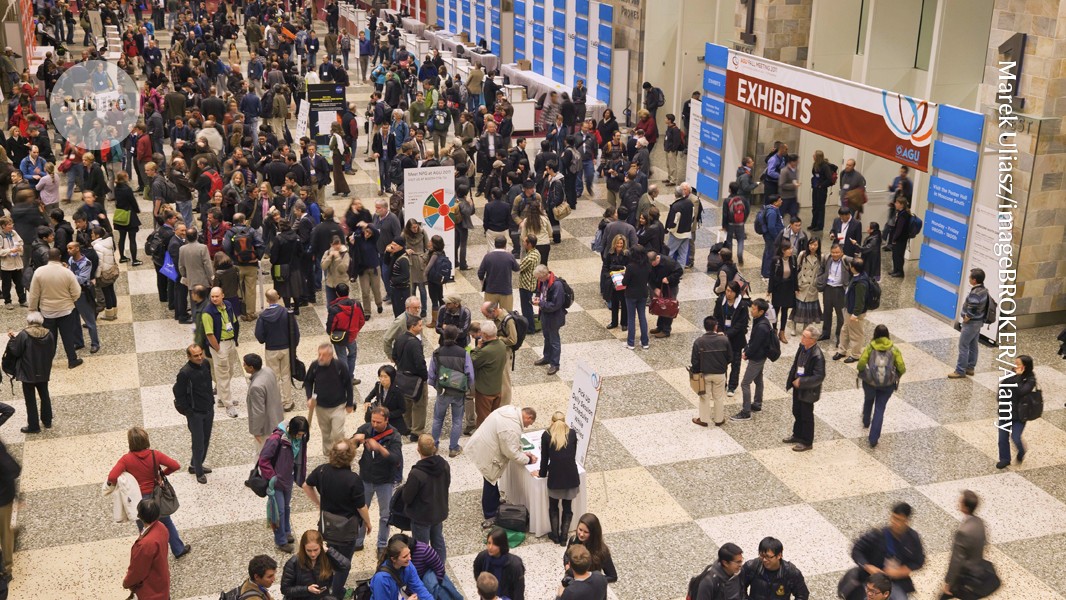

Organizers of the American Geophysical Union’s annual meeting (pictured, a past meeting), which started 15 December, expect it to draw fewer visitors than it did in 2024.Credit: Marek Uliasz/imageBROKER/Alamy
Attendance at several of the biggest science conferences held in the United States either fell this year compared with last year or is expected to fall in 2026. There are many reasons for the changes, but at least some researchers are curbing their travel to the United States because of policies put in place by the administration of US President Donald Trump.
The obstacles have galvanized some meeting organizers to hatch alternative plans to bring the international research community together.
Meet the early-career scientists planning to leave the United States
Earlier this month, for instance, the artificial-intelligence (AI) conference NeurIPS hosted not only its main meeting in San Diego, California, but also its first-ever alternative location, in Mexico City, with the goal of alleviating travel challenges. Meanwhile, a group of AI researchers in Europe organized an independent spinoff conference, dubbed EurIPS, in Copenhagen.
“Our main focus was on giving a home to people who felt intellectually homeless this year,” says Søren Hauberg, a machine-learning and computer-vision researcher at the Technical University of Denmark in Lyngby who helped to organize EurIPS.
Smaller crowds
Nature asked the organizers of large conferences that were scheduled to take place in US cities in the second half of 2025 or the first quarter of 2026 for details of their attendance trends. Of the six that responded, three had seen or were expecting a drop in attendance compared with the previous year.
In some cases, the observed decrease was slight, and the reasons were complex. For instance, attendance at the Society for Neuroscience’s annual meeting last month was down 6%, from 22,359 people in 2024 to 21,093 this year. The number of countries those attendees represented also fell, from 88 in 2024 to 73 in 2025. Organizers of the conference, one of the biggest in the United States, say that attendance has fluctuated since the start of the COVID-19 pandemic in 2020, making it difficult to pinpoint the effect Trump’s policies have had.
Organizers of the American Geophysical Union (AGU) conference, another of the nation’s largest meetings, say that they also are seeing a drop in numbers at the 2025 meeting, which began on Monday, compared with 2024. More than 30,000 people attended last year’s AGU conference; more than 20,000 were registered for this year’s as of Monday, conference organizers say. The lighter attendance was notable in the poster and exhibit halls, which were slightly less jam-packed than usual.
Barriers to entry
Scientists hoping to travel to the United States in 2025 faced a raft of new restrictions. As part of Trump’s focus on immigration and visa enforcement, border officials have tightened up scrutiny of incoming travellers, turning some away at airports and other entry points. In June, Trump’s administration banned or limited entry for citizens of 19 countries, including Iran and Venezuela, citing national security concerns. And on 9 December, the administration proposed requiring visitors from dozens of countries to provide their social media posts for the past five years before entering the United States.
Other policies have also had an impact on scientists’ willingness or ability to attend US meetings. This week’s Pacifichem meeting in Honolulu, Hawaii, which around 11,000 people have registered to attend, has seen significantly fewer attendees than usual from Canada, says meeting chair Laurel Schafer, a chemist at the University of British Columbia in Vancouver. That aligns, she says, with overall drops in tourism from Canada to the United States after Trump imposed tariffs on Canadian goods and said he would make it “the 51st state”.

Where is the best place to hold a scientific conference right now?
For Tanja Junkers, a chemist at Monash University in Melbourne, Australia, the deciding factor on attending Pacifichem was Trump’s attacks on trans and nonbinary people; on his first day in office he issued an executive order declaring that there are “two sexes, male and female” and that the government will “enforce all sex-protective laws to promote this reality”. “Being of a gender-diverse background, I do not feel I am able to safely travel to the US, even to a more liberal state such as Hawaii,” Junkers says. She helped to arrange a symposium at the meeting from a distance, but did not participate in it, even remotely.

