


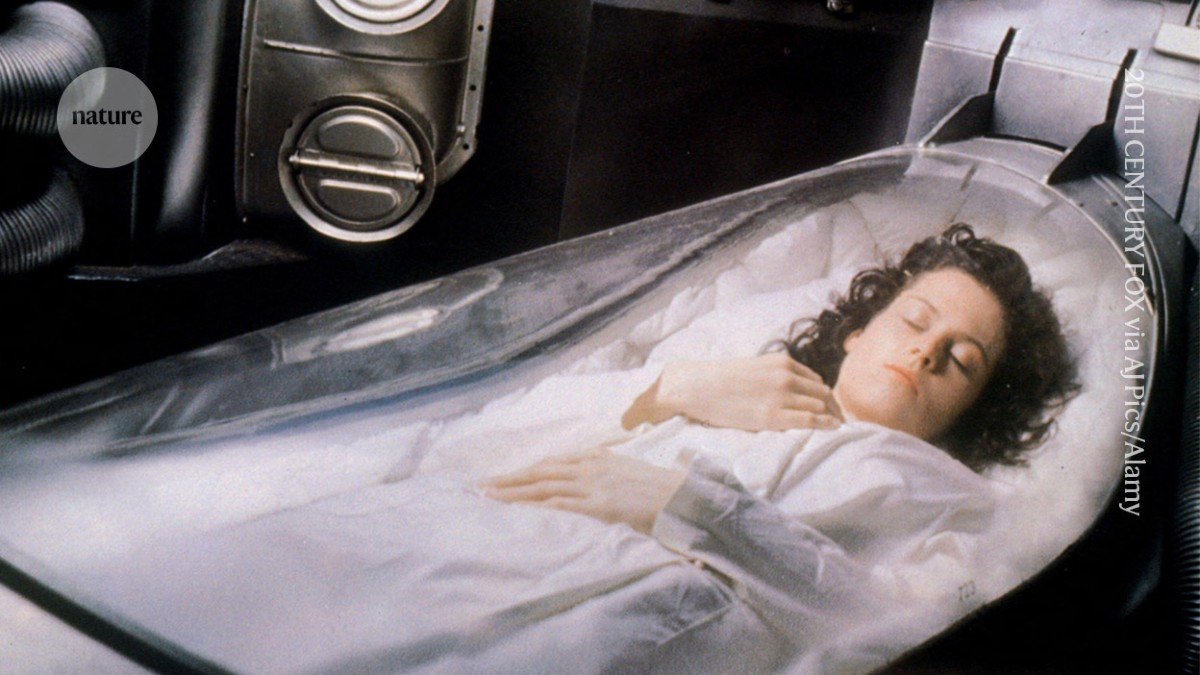

A ‘cryosleep pod’ in the 1979 science-fiction film Alien.Credit: 20TH CENTURY FOX via AJ Pics/Alamy
A familiar trope in science fiction is the cryopreserved time traveller, their body deep-frozen in suspended animation, then thawed and reawakened in another decade or century with all of their mental and physical capabilities intact.
Researchers attempting the cryogenic freezing and thawing of brain tissue from humans and other animals — mostly young vertebrates — have already shown that neuronal tissue can survive freezing on a cellular level and, after thawing, function to some extent. But it has not been possible to fully restore the processes necessary for proper brain functioning — neuronal firing, cell metabolism and brain plasticity1,2.
A team in Germany has now demonstrated a method for cryopreserving and thawing mouse brains that leaves some of this functionality intact. The study, published on 3 March in Proceedings of the National Academy of Sciences3, details the authors’ use of a method called vitrification, which preserves tissue in a glass-like state, along with a thawing process that preserves living tissue.
“If brain function is an emergent property of its physical structure, how can we recover it from complete shutdown?” asks Alexander German, a neurologist at the University of Erlangen–Nuremberg in Germany and lead author of the study. The findings, he says, hint at the potential to one day protect the brain during disease or in the wake of severe injury, set up organ banks, and even achieve whole-body cryopreservation of mammals.
Mrityunjay Kothari, who studies mechanical engineering at the University of New Hampshire in Durham, agrees that the study advances the state of the art in cryopreservation of brain tissue. “This kind of progress is what gradually turns science fiction into scientific possibility,” he says. However, he adds that applications such as the long-term banking of large organs or mammals remain far beyond the capabilities of the study.
Preserved for the future
The main reason the brain struggles to fully recover from freezing is because of damage caused by the formation of ice crystals. These displace or puncture the tissue’s delicate nanostructure, disrupting key cellular processes. “Beyond ice, we must account for several considerations, including osmotic stress and toxicity due to cryoprotectants,” says German.
German and his colleagues turned to an ice-free method of cryopreservation called vitrification in an effort to preserve brain function. Vitrification cools liquids fast enough to trap molecules in a disorganized, glass-like state before they have a chance to form ice crystals. “We wanted to see if function could restart after the complete cessation of molecular mobility in the vitreous state,” says German.
They first tested their method on 350-micrometre-thick slices of mouse brains which included the hippocampus — a core brain hub for memory and spatial navigation. Brain slices were pre-treated in a solution containing cryopreservation chemicals before being rapidly cooled using liquid nitrogen at −196 ºC. They were then kept in a freezer at −150 ºC in a glass-like state for between ten minutes and seven days.
After thawing the brain slices in warm solutions, the team analysed the tissue to see whether it had retained any functional activity. Microscopy showed that neuronal and synaptic membranes were intact, and tests for mitochondrial activity revealed no metabolic damage. Electrical recordings of neurons showed that, despite moderate deviations compared with control cells, the neurons’ responses to electrical stimuli were near normal.
Hippocampal neuronal pathways still showed the synaptic strengthening or ‘long-term potentiation’ that underlies learning and memory. However, because such slices naturally degrade, observations were limited to a few hours.

The sci-fi films that physicists love to watch — from Interstellar to Spider-Man

