


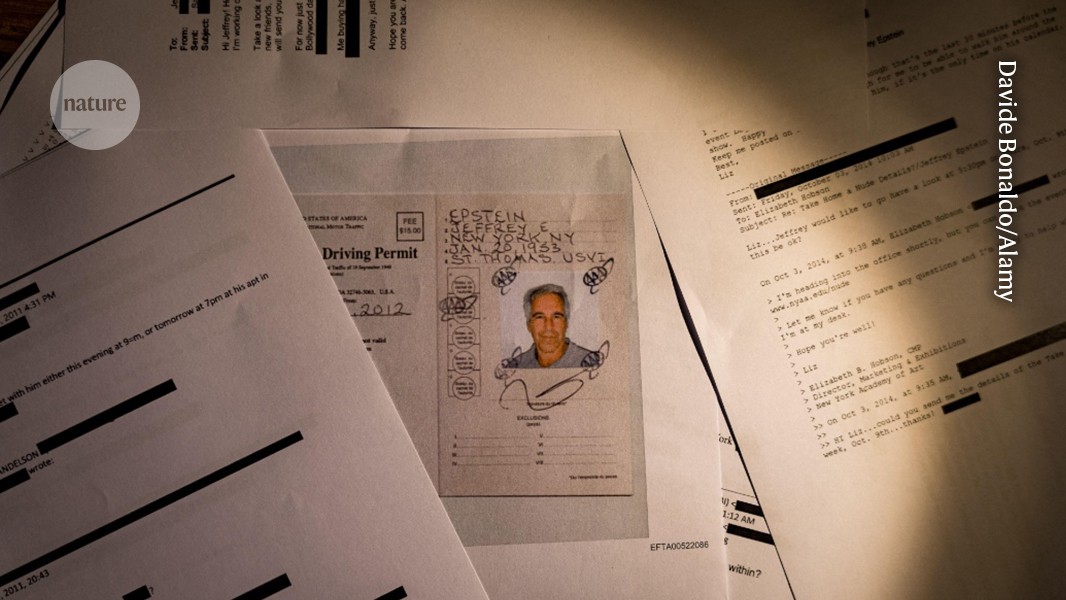

Jeffrey Epstein, a convicted sex offender, cultivated ties with many scientists and other academics.Credit: Davide Bonaldo/Alamy
Several scientists who are linked to convicted sex offender Jeffrey Epstein in files released last month are now facing consequences.
Palaeontologist John ‘Jack’ Horner, an adviser to the Jurassic Park film series, is no longer employed by Chapman University in Orange, California, university spokesman Robert Hitchcock told Nature today. E-mails in the newly released files show that Horner visited Epstein at one of his properties in 2012, when Horner was at Montana State University in Bozeman. In one e-mail sent in 2012 to Epstein’s assistant, Horner thanked Epstein and “the girls” for his visit.
Hitchcock declined to comment on whether the move was connected to Horner’s involvement with Epstein. But in an earlier statement, Hitchcock said that the university was “looking into the matter” and that it took the e-mails “very seriously”.
In a statement, Horner wrote that he visited Epstein to seek a donation for a research project. He said that he was aware that Epstein had been charged with soliciting a prostitute and had served a sentence, but he was unaware of other allegations or misconduct. He also wrote that he regrets not investigating Epstein’s background and that he used “poor judgement” in pursuing Epstein as a donor.
His statement says that he now regrets his use of the term ‘girls’ to refer to people who were introduced to him as college students during his visit. He now understands “the students may have been victims of Epstein”, Horner wrote. Horner did not respond to a request for comment about his departure from the university, where he taught classes.
Private wealth
Epstein, a wealthy financier, socialized with scientists and invested millions of dollars in research projects. He pled guilty in 2008 to procuring minors for prostitution and solicitation of prostitution and served more than 12 months in jail. He died by suicide in 2019, shortly after being arrested on charges of trafficking minors for sex.
MIT review of Epstein donations finds “significant mistakes of judgment”
Even before the new documents were released, it was clear that some scientists continued to associate with him after he served time in prison, and some scientific institutions continued to accept or solicit donations from him. For example, the Massachusetts Institute of Technology in Cambridge accepted a total of US$850,000 from Epstein over roughly 15 years.
The millions of files that were collected as part of the US investigation into Epstein and released last month consist of investigative materials, correspondence and third‑party records; their contents have not been independently verified by Nature. The files mention multiple scientists, but such mentions do not mean that the scientists were involved in Epstein’s criminal activities, had knowledge of Epstein’s alleged crimes or had done anything wrong.
Extensive contact
The files indicate that some researchers had extensive interactions with Epstein after his 2008 guilty plea. Now, some of these researchers have lost academic titles or responsibilities.
On 24 February, Richard Axel, a Nobel-prize-winning biologist at Columbia University in New York City, announced that he was stepping down as co-director of Columbia’s Mortimer B. Zuckerman Mind Brain Behavior Institute because of his associations with Epstein. “My past association with Jeffrey Epstein was a serious error in judgment, which I deeply regret,” Axel said in a statement. In its own statement, Columbia said that it had “seen no evidence that Dr. Axel violated any University policy or the law”, but that it agreed with his decision. Axel could not immediately be reached for comment.
In a statement dated 11 February, Columbia announced that it is penalizing a dental-medicine researcher and a dentist with a voluntary faculty appointment for their roles in what the university calls the “irregular” admission of a student to Columbia’s College of Dental Medicine. The university did not name the student, but some of the newly released files show that the student was Karyna Shuliak, Epstein’s girlfriend.
The dental school initially rejected Shuliak in 2012. But later that year, she secured a place with the help of Letty Moss-Salentijn, vice-dean for academic affairs at the college and Thomas Magnani, who has a private dental practice in New York City and was on the dental college’s admissions review committee, according to newly released files.
Epstein files reveal deeper ties to scientists than previously known
In 2018, Moss-Salentijn sent a proposal for a project to Shuliak and arranged a dinner with Shuliak, Epstein and Magnani at which the proposal was to be discussed, the files show. The e-mails also show that Magnani was involved in securing financial donations from Epstein for the school.
Columbia says that Shuliak’s acceptance did not meet its “standards for integrity and independence in admissions”. It also says that the university has terminated Magnani’s voluntary faculty appointment and that his private dental practice is no longer associated with the school. Moss-Salentijn will step down from her administrative roles, the statement says. A university official confirmed to Nature that Moss-Salentijn remains a tenured faculty member.
Moss-Salentijn and Magnani did not respond to requests for comment. Shuliak could not be reached for comment.

