


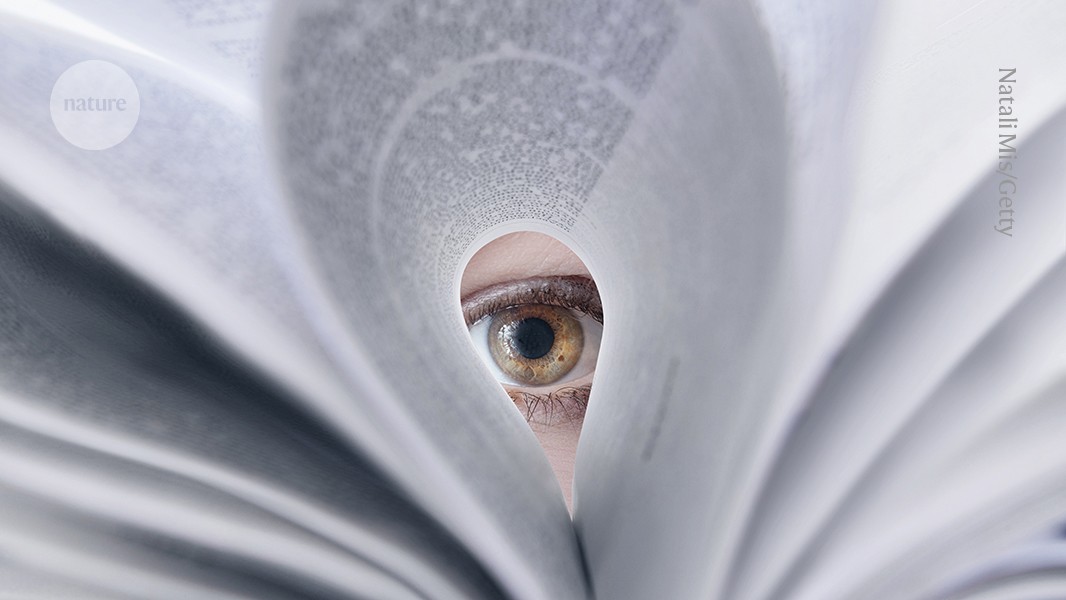

Image sleuths noticed irregularities in figures from scores of papers co-authored by Ali Khademhosseini.Credit: Natali Mis/Getty
In December 2024, Elisabeth Bik noticed irregularities in a few papers by a highly-cited bioengineer, Ali Khademhosseini. She started looking at more publications on which he was a co-author, and the issues soon piled up: some figures were stitched together strangely, and images of cells and tissues were duplicated, rotated, mirrored and sometimes reused and labelled differently.
Bik, a microbiologist and leading research-integrity specialist based in San Francisco, California, ended up flagging about 80 papers on PubPeer, a platform that allows researchers to review papers after publication. A handful of other volunteer science sleuths found more, bringing the total to 90.
The articles were published in 33 journals over 20 years and have been cited a combined total of 14,000 times. Although there are hundreds of co-authors on the papers, the sleuthing effort centred on Khademhosseini, who is a corresponding author on about 60% of them.
Why retractions data could be a powerful tool for cleaning up science
He and his co-authors sprang into action. Responding to the concerns, some of which were reported in the blog For Better Science, became like a full-time job, says Khademhosseini, who until October was director and chief executive of the Terasaki Institute for Biomedical Innovation in Los Angeles, California. “I alerted journals, I alerted collaborators. We tried to do our best to make the literature correct.” In many cases, he and his co-authors provided original source data to journal editors, and the papers were corrected.
Khademhosseini told Nature that investigations into his work have been carried out and have found no evidence of misconduct by him. The Terasaki Institute says that an “internal review has not found that Dr. Khademhosseini engaged in research misconduct”.
The case raises questions about oversight in large laboratories and about when a paper needs to be retracted and when a correction is sufficient. In some cases, journals have issued corrections for papers containing issues that research-integrity sleuths describe as “clearly data manipulation”, and the corrections were issued without source data. Bik and others argue that this approach sets a bad precedent. “I don’t think that any part of a study that bears these signs of data manipulation should be trusted,” says Reese Richardson, who studies data integrity at Northwestern University in Evanston, Illinois. He argues such papers should be retracted.
Khademhosseini defends the corrections and says that the conclusions of the papers still hold. He says he has not seen any “conclusive evidence” of misconduct or “purposeful manipulation” in the papers, and nothing that would require a retraction.
Finding flaws
For three decades, Khademhosseini has developed biomedical technologies such as organs on chips and hydrogel wound treatments. His work has been funded by the US National Institutes of Health, and by other public and private agencies. As a PhD student, he worked under Robert Langer, a renowned bioengineer at the Massachusetts Institute of Technology, in Cambridge. Khademhosseini has published more than 1,000 papers, which have been cited more than 100,000 times in total. He has also received numerous awards and honours, most recently, the 2024 Biomaterials Global Impact Award, from the journal Biomaterials.
This science sleuth revealed a retraction crisis at Indian universities
In October, Khademhosseini left the Terasaki Institute. He says that he did so to work on a start-up “to accelerate scientific discovery using AI”, and that his departure was not related to the PubPeer comments. The institute also says that his departure “was unrelated to any research integrity inquiries”.
To get a sense of the severity of the image-related issues, Nature’s news team analysed the 90 papers flagged on PubPeer in consultation with four image-integrity specialists, including Bik and Richardson, and three bioengineers. The team relied on guidance from the International Association of Scientific, Technical and Medical Publishers (STM). This ranks image irregularities on the basis of the type of aberration, perceived intent and impact on research conclusions. Five papers had issues unrelated to images, such as authorship disputes or complaints about reported conflicts of interest. Of the remaining 85, 42 were classed as ‘level I’: containing minor issues, such as an accidentally duplicated image that could easily be corrected with raw data. Another 20 papers had more substantial problems, falling into level II. And 23 papers considered level III had more serious issues, including multiple manipulations that directly affect the interpretation of the data. STM guidelines recommend that level-II and level-III issues are investigated to rule out misconduct.
Khademhosseini disputes the Nature news team’s analysis, saying it contains “substantial inaccuracies”. He says, for example, that many of the figures classified as having severe problems were in fact peripheral to the conclusions of the papers, and that some errors that the analysis deemed intentional could in fact have been accidents.

Thousands of highly cited scientists have at least one retraction
Khademhosseini adds that the high number of flagged papers results from the fact that he’s published so many papers during his career, each of which has about 80 images. He objects to being singled out, and estimates that the rate of errors in his flagged papers is below the average error rate in biomedical literature, which is sometimes given as 4%. “If you go after anybody who has been around a long time, you can dig up stuff,” he says. What’s more, he argues that the artificial-intelligence-powered tools that sleuths sometimes use to help them detect image irregularities raise the average error rate in the published literature, making his numbers look even more reasonable.
Bik estimates that she looked at about 530 papers to find the errors she did. She says that she used AI to analyse some of Khademhosseini’s papers, but that she also verifies each irregularity by eye.

