


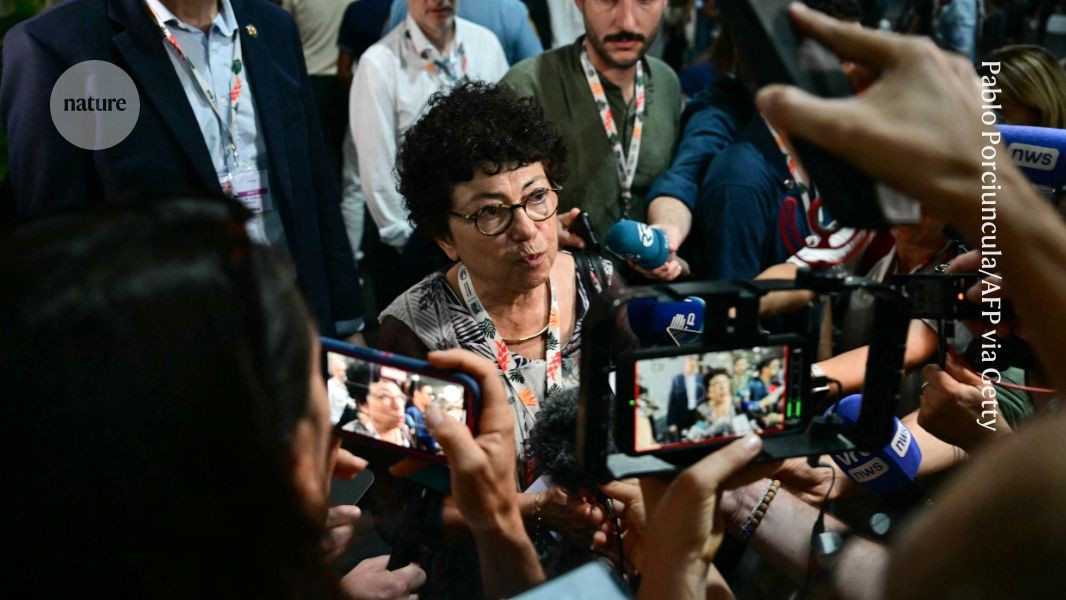

Environmental journalists at last year’s COP30 climate meeting in Belém, Brazil, interview the French ecology and biodiversity minister Monique Barbut. Credit: Pablo Porciuncula/AFP via Getty
In June 2025, a year-long investigation exposed an illegal trade smuggling timber from protected areas in the Congolese rainforest into neighbouring Burundi.
Award-winning Burundian journalist Arthur Bizimana and his collaborator Martin Leku, from the Democratic Republic of the Congo, risked their safety by travelling deep into the rainforest — the world’s second-largest — to gather material for their exclusive story on the impact on this crucial carbon sink.
Their assignment was financially supported by InfoNile, a journalism network focusing on cross-border investigations in the Nile Basin, and Global Forest Watch, a data platform funded by the United Nations Environment Programme and the United States Agency for International Development (USAID), among others. It’s the kind of in-depth investigative work that far exceeds the reporting budgets of most research news publications, such as Nature or Science — and that attracts little attention from large media organizations and newspapers. Often, such reporting is made possible only because of grants given to journalists by private philanthropies or government donors.
But with these grants drying up as philanthropic donors tighten their purse strings in the wake of US-led cuts to international development and health budgets, the ability of journalists such as Bizimana and Leku to hold power to account is diminishing.
Marius Dragomir, a Romanian journalist and director of the Media and Journalism Research Center in Tallinn, a think tank and global research hub he founded in 2022, describes the funding threats to science journalism as “a disaster”. He adds: “If you look at the geopolitical situation today, I think science is critical.” There is a need for balanced reporting of science-related topics, but “a lot of that coverage is disappearing” at the exact moment it’s needed, he explains.
Grant-supported work is an important part of the science-journalism ecosystem. Freelance science journalists can apply for reporting grants from organizations such as InfoNile, the Pulitzer Center in Washington DC and the European Journalism Centre in Maastricht, the Netherlands. News organizations also apply for grants to beef up their newsrooms, or to fund their operations entirely. In the United States, for example, around one-quarter of mainstream news outlets operate on a non-profit basis, according to a 2021 study conducted by the Future of Media Project at Harvard University in Cambridge, Massachusetts.
The funding situation “is affecting our efforts to hold organizations accountable”, says InfoNile co-founder Fredrick Mugira. “We used to do stories around biodiversity loss, so we would fund journalists to go deep into rainforests in Congo, into parts of Rwanda, but now we have no money.” So now, Mugira warns, “you don’t get stories about logging, about who is cutting the trees.”
Digging in: last chance to save a native forest
It’s an example of the wider impact of US President Donald Trump’s decision to close USAID, which ceased operations in July last year. The federal agency was the world’s largest spender on international development and a significant funder of science-based investigative journalism. And the closure had secondary effects: although InfoNile didn’t receive funding just from the US government, it benefited from the ecosystem of philanthropic foundations and intermediaries that has been left reeling from the US freeze on international aid. Such organizations are often asked to step in and fill holes in funding for other programmes.
InfoNile’s parent organization, Water Journalists Africa, is a Uganda-based non-profit membership organization, founded in 2011, that connects investigative journalists from some 50 African countries with scientists and activists. A year ago, it had four international organizations pledging support — now there is just one, says Mugira, who is a fellow in social and economic equity at the London School of Economics and Political Science, UK.
The Global Forest Watch project that funded Bizimana and Leku’s investigation cannot continue, and a US-funded project in South Sudan was not renewed after it ended in November last year, Mugira says. InfoNile’s total budget fell from around US$300,000 in 2024 to less than $230,000 for 2025.
In 2024, US lawmakers earmarked $272 million in foreign assistance for ‘independent media and free flow of information’, according to US government data. Of this, around $150 million was set aside to support journalism, but the vast majority of that was set to disappear in 2025 and beyond, according to estimates compiled by a group of media-development consortia, including the BBC’s international charity BBC Media Action.
Support slashed
The media non-profit organization Internews, which is headquartered in Arcata, California, and supports independent media outlets in more than 100 nations, was among the largest recipients of government grants. It said its 2025 allocation of US government funding was $126 million, but that it had now lost 95% of that.
Its environmental reporting arm — the Earth Journalism Network — provides grants enabling journalists from low- and middle-income countries to attend events such as the United Nations COP climate talks, including COP30, which was held in Belém, Brazil, last year.
In 2025, “we had five or six grants from the US federal government, both from USAID and the State Department, at the beginning of the year — they were all halted in January and then terminated later,” says the network’s executive director, James Fahn. He says this has reduced its 2024 budget of around $9 million by between one-quarter and one-third.
Climate Tracker, headquartered in Quezon City in the Philippines and in Santiago, is another organization that provides travel grants to climate meetings, and also offers training. It said it had only been able to fund some journalists from Latin America to attend last year’s COP, because of funding constraints.
Who will fill the climate-data void left by the Trump administration?
USAID’s dismantling comes at a time when funding for science journalism is already in decline. Some large foundations funded by philanthropy, such as the Kavli Foundation in Los Angeles, California, and Robert Bosch Stiftung in Stuttgart, Germany, have scaled back their media funding to focus on supporting science itself.
Similarly, the Howard Hughes Medical Institute (HHMI), a non-profit biomedical research organization in Chevy Chase, Maryland, sharply reduced its support for science journalism in 2024, according to a source who is familiar with the institute’s journalism partnerships, speaking on condition of anonymity.
However, an HHMI spokesperson declined to comment directly, saying: “HHMI’s support for science journalism remains strong and ongoing.”
Grants for science, climate and health news have been falling over the past few years, according to data from Media Impact Funders, a US-based non-profit organization focused on media philanthropy, which includes major foundations and news organizations among its membership. A search at the time of publication using its interactive map shows that philanthropic grants for journalism, news and information containing the keywords science, health and environment had fallen from $86.5 million in 2021 to $63 million in 2023.
The results are likely to be skewed towards the United States because the information is pulled from the US grant database Candid, which might not include data from some foreign funders, according to Nina Sachdev, deputy director of external affairs at Media Impact Funders. The database also relies on foundations providing data and definitions, so there is a risk of double reporting, she adds.
However, it gives a general picture of declining funding for science journalism, even before the USAID freeze.
A rising tide of misinformation
The funding void triggered by USAID’s closure last year means that foundations are now being inundated with grant applications. Those in the United States, particularly funders focused on science, climate and the environment, have been “besieged with requests for money, mainly from the research community”, said Meaghan Parker, executive director of the Council for the Advancement of Science Writing. The non-profit organization in Seattle, Washington, works to increase and improve science journalism, and was created in 1960 as a response to poor-quality reporting after the launches of Soviet Sputnik satellites from the late 1950s.
“This is the priority order of most of these foundations: science first,” she says. “Journalism is falling down the list.”
“Options for traditional revenue streams are limited, and philanthropic support, which has long helped sustain our work, continues to decline,” says Cayley Clifford, deputy chief editor of Africa Check, a fact-checking organization in Johannesburg, South Africa, which focuses on science, health and general news. “Ensuring this does not affect the scope of the work we’re able to take on is a top priority for the next few months.”
All of this comes at a time when science news is critically important to help stem a rising global tide of disinformation and misinformation.

