


You have full access to this article via your institution.
Hello Nature readers, would you like to get this Briefing in your inbox free every day? Sign up here.

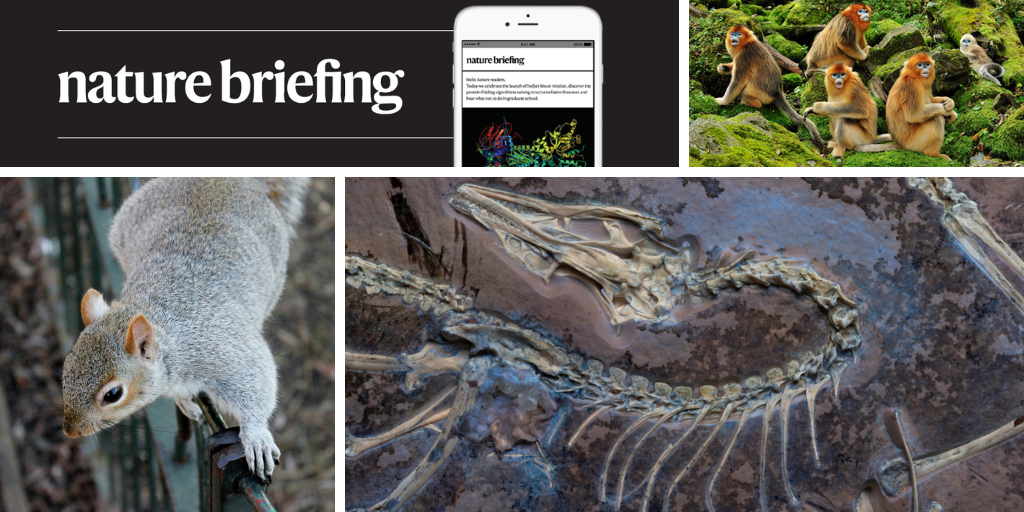
In golden snub-nosed monkeys, sexual interactions between individuals of the same sex seem to fortify social bonds. Credit: Thomas Marent/Nature Picture Library
Sexual behaviour between primates of the same sex is part of the normal lives of some species and could play an important part in their long-term success. Researchers identified instances of same-sex sexual behaviour in 59 species of non-human primate, and suggest that it might be a response to harsh environments, predation and complex social hierarchies. “A lot of people have long regarded same-sex behaviour as an accident, or rare,” says evolutionary biologist and study co-author Vincent Savolainen. But “it’s part of the normal social life of primates”.
Reference: Nature Ecology & Evolution paper
Almost £5 million (US$6.6 million) will be spent stashing contraceptive-laden hazelnut butter in special squirrel feeders to suppress the population of invasive grey squirrels (Sciurus carolinensis) in the United Kingdom. Researchers have been working on a world-first contraceptive for grey squirrels and a prototype feeder that allows heavy greys to access the buttery bait, but prevents lighter red squirrels (Sciurus vulgaris) from getting inside. If it works, the approach could be cheaper and more effective than culling at protecting the country’s much loved rodents.
The Economist | 4 min read (free registration required)
The US Environmental Protection Agency (EPA) will reverse decades of policy and stop including human health in cost–benefit analyses when setting air-pollution limits, reports The New York Times. Instead, the agency will only tally the cost to industry of regulating two of the most widespread toxic pollutants: fine PM2.5 particulate matter and ozone. “The idea that EPA would not consider the public health benefits of its regulations is anathema to the very mission of EPA,” says legal scholar Richard Revesz.
The New York Times | 8 min read
Features & opinion

Ultraviolet light helps to reveal soft tissue preserved along with the bones of an Archaeopteryx fossil at the Field Museum in Chicago, Illinois.Credit: Delaney Drummond/Field Museum
For more than a century, Archaeopteryx was the earliest known bird genus, and the only one known from the Jurassic period, when birds first evolved. Last year, fossils of a newly discovered genus revealed that Archaeopteryx wasn’t alone: a creature called Baminornis also walked the Jurassic Earth — and flew as well. These two genera of birds are so different that some researchers suggest that the first birds predated them both. The findings are revealing clues about how and why birds evolved, and hint that the evolutionary story of birds has an even earlier chapter than researchers thought.
To boost their creativity, people should ask artificial intelligence models how to think, not what to think, argues complexity-science researcher Brian Uzzi. The best collaborators help others to discover their own knowledge, and help to link ideas from seemingly disparate schools of thought, Uzzi says — two qualities that users can find in AI. If users ask bots for a reasoning process, not outright answers, “we can create partnerships that push past conventions and promote scientific innovation”, writes Uzzi.
Nine climate researchers and policy leaders, including the chair of the UK Climate Change Committee, argue that “key elements of climate action are irreversible” despite factors “such as the deliberate efforts by the current US administration to weaken climate policies, discredit climate science and promote fossil fuels”. They point to backstops that prevent regression, such as the proliferation of long-lived infrastructure to carry renewable energy. Another essential positive force: talking about what’s going well. “Stories that envision a positive, achievable future are themselves feedback loops,” they write.
If you enjoy this newsletter, please consider recommending it to a friend or colleague.
Thanks for reading,
Flora Graham, senior editor, Nature Briefing
With contributions by Jacob Smith
• Nature Briefing: Careers — insights, advice and award-winning journalism to help you optimize your working life
• Nature Briefing: Microbiology — the most abundant living entities on our planet — microorganisms — and the role they play in health, the environment and food systems
• Nature Briefing: Anthropocene — climate change, biodiversity, sustainability and geoengineering
• Nature Briefing: AI & Robotics — 100% written by humans, of course
• Nature Briefing: Cancer — a weekly newsletter written with cancer researchers in mind
• Nature Briefing: Translational Research — covers biotechnology, drug discovery and pharma

