


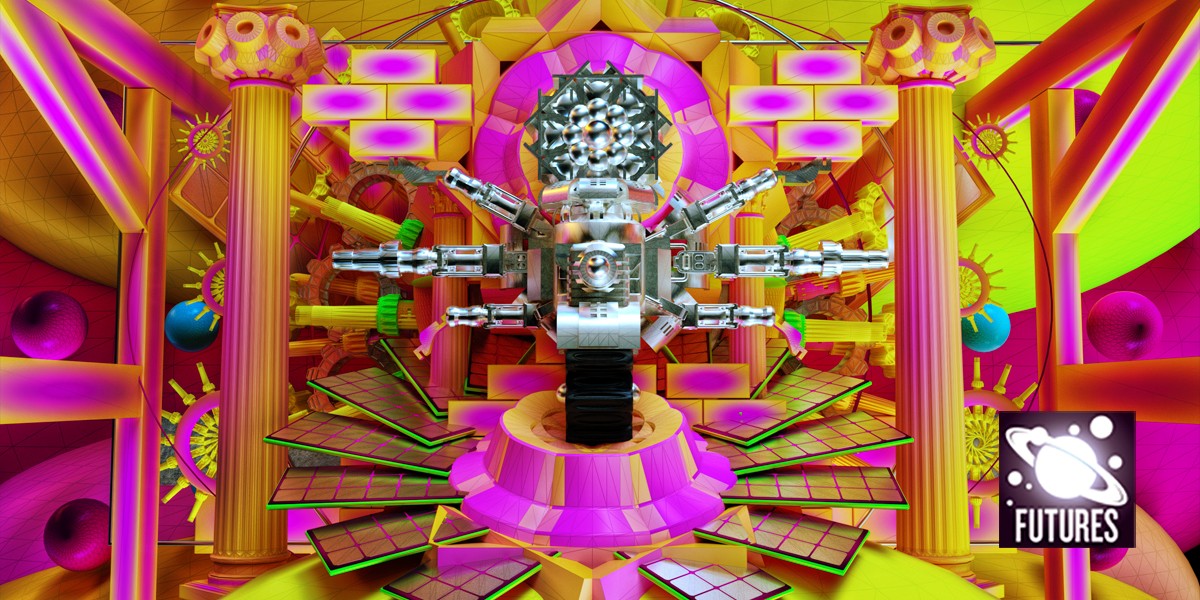
After the Cataclysm, the humans brought in robots to clear the rubble. It was why the robots had been constructed. They were sturdy enough to withstand any further tremors and falling debris, and they were strong enough to lift the shattered pieces of buildings.
Twobit worked tirelessly, like their fellow robots. Solar panels kept them energized, and the engineers had developed circulatory systems to keep their joints lubricated by filtering elements from the air and remixing them, the peak of intelligent design.
If the element mix was sometimes off, it rarely caused problems that were unsolvable.
Twobit’s present task was within the remnants of an older building, one with a marble façade that had weakened in the years before the Cataclysm, as the changing climate had impacted air, earth and sea. The faults that had developed in the marble had caused it to cascade off the ruined structure like an avalanche, dusted with what could almost be mistaken for a fresh, powdery snow.
Not that anyone living remembered what snow looked like. Twobit only had old recordings of what snow was, and they observed that this marble dust was not cold enough to be snow.
But those recordings also showed them what this building once looked like and how important it had been to humans.
And that gave them an idea.
*****
“What’s that unit doing?” Jinj asked, studying Twobit on the feed.
“Stacking rubble,” Chang replied.

Read more science fiction from Nature Futures
“Yes, I can see that, but aren’t they supposed to be stacking it in Sector 1?”
Chang hmmph-ed. “Right, I’ll send a reminder protocol.”
“It looks like —” Jinj began. “— nah, why would a robot be trying to rebuild? That’s not what this crew is programmed for.”
“You think it’s got a bad mix?”
“The air there has heavier-than-standard percentages of calcium and carbon, but last I heard, we don’t have enough data to know what that means.”
Chang drummed her fingers on the desk, gaze unfocused as she thought. “Send the data to Mohini up in environmental. She has a theory about which elements are causing the units to go off their protocols. I’ll send the reminder to the unit.”
“Copy. Wish we knew what’s going on in these units’ processors, though.”
“Figure that out, and you can probably get reassigned from surveillance detail.” Chang grinned. “Get moved up to the lab with the engineers who’re tearing their hair out about causation and correlation.”
Jinj chuckled. “Livin’ the dream.”
*****
Twobit received the reminder protocol. “Move debris to Sector 1.”
Sector 1 was not where this building had stood, but perhaps it was near enough. And there were already materials available in that location.
They sent back an acknowledgement and got to work.
*****
Mohini stared at the data. Calcium and carbon levels were 10% higher than they should have been in and around Sector 1. It was one of many reasons that humans descended from those who had survived the Cataclysm were still sequestered in subterranean bunkers, watching and controlling the robots.
Except, at the moment, they weren’t controlling the robots.
“The records say that’s the old state building,” Jinj said. She hadn’t figured out what was going through the robots’ minds, but Mohini had requested her to come up to the environmental lab to brainstorm.
Mohini nodded. “Why that building, though?”
“It was one of the bigger buildings.” Jinj scanned the text on her tablet, picking out some of the notes that grabbed her attention. “Impressive edifice, seat of government.”
“But not currently usable, and —” Mohini trailed off. “I don’t think it looked like what they’re building.”
The entire crew around Sector 1 was working on this new building, roughly 200 metres west of its former location. They’d brought in lumber from other structures and were using it to contain smaller pieces of rubble on each course, with the lumber on alternating sides of the building.
“It’s like a layer cake, but criss-crossed,” Jinj said.
“Kath-kuni,” Mohini said. “Mātāmahī — my grandmother — called it ‘safe as houses’, but it really means wooden corners. They were everywhere in the town she lived in. The wood moves just enough when there’s an earthquake to keep everything standing, and the stone helps keep it warm and dry inside.”

