


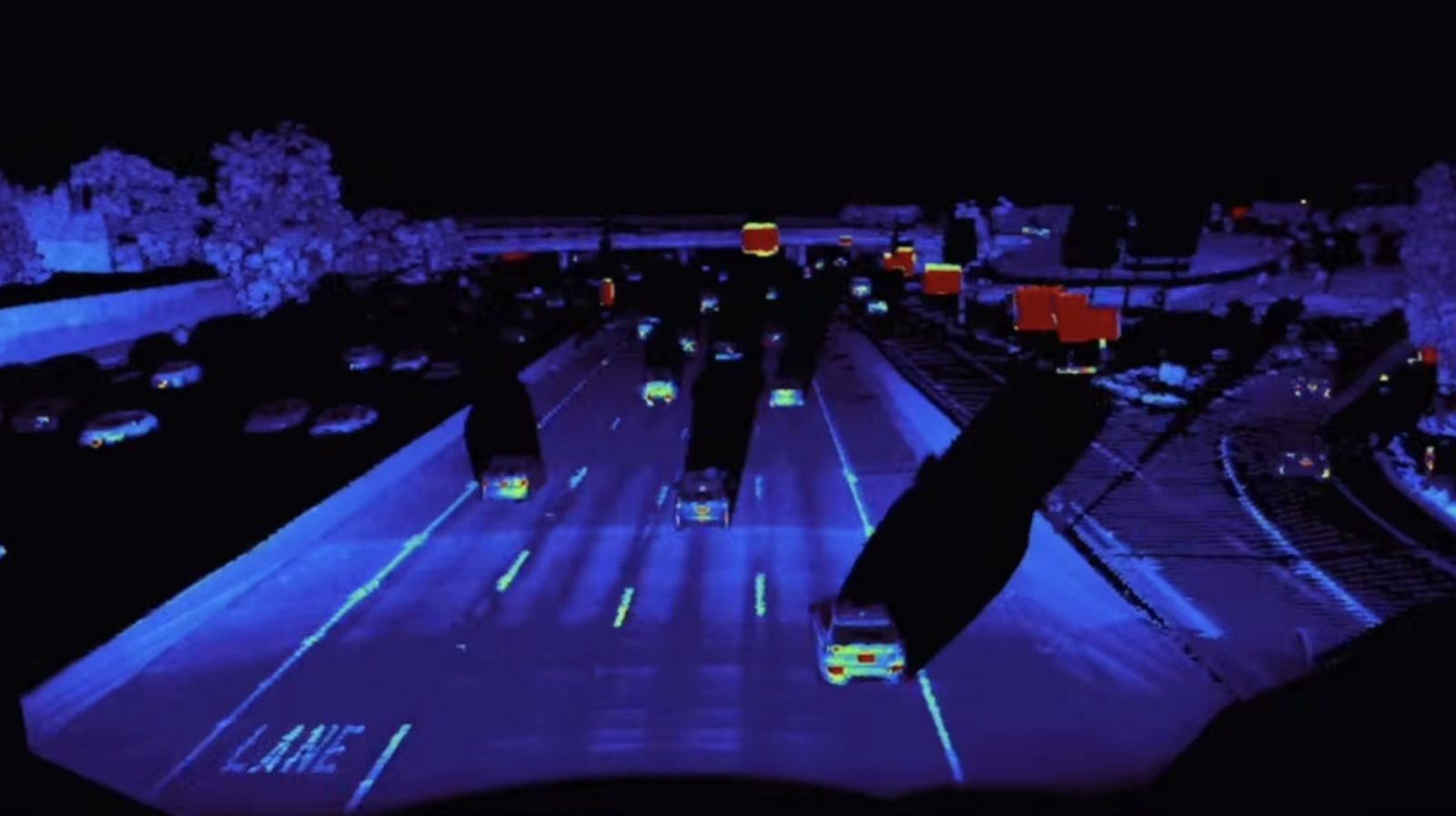
While a certain car company blindly refuses to incorporate lidar into its semi-autonomous driving systems, Rivian has announced it is embracing the technology, and on its less expensive model, no less. In a livestream on its Autonomy and AI day, Rivian announced that its upcoming R2 will incorporate lidar, in addition to cameras and radar, to paint a more detailed, accurate picture of its surroundings than current models.
Look past the corporate speak and AI buzzwords to make investors happy, and there’s some real meat and potatoes in what Rivian is saying. About half an hour into the presentation, James Philbin, Rivian’s Vice President Autonomy and AI, shows a side-by-side visual comparison of Rivian’s autonomy software identifying and interpreting objects ahead using only its cameras, cameras and radar, and the trifecta of cameras, radar, and lidar.
“Cameras alone can handle most autonomy tasks most of the time,” says Philbin. “But for full autonomy, most of the time isn’t enough. Autonomy needs to work all of the time, on a moonless night, in the snow, and here in the fog.” That’s why every second-generation Rivian R1 uses a combination of cameras and radar to perceive beyond visual range, gain better depth perception, and determine the velocities of objects. Adding lidar to the mix extends that perception even farther. While Rivian does not make the claim, this visual representation suggests that using all three technologies together is as significant an improvement as adding radar to cameras alone.
Better, smaller, cheaper
Earlier in the presentation, Vidya Rajagopalan, Senior Vice President Electrical Hardware, explains how this is possible without breaking the bank, which was the main reason Elon Musk cited for not using lidar on Teslas. That may have been the case in the past, when a lidar system cost tens of thousands of dollars, but today it only costs a few hundred dollars. A modern lidar system also has 25 times better resolution than one from ten years ago, yet it doesn’t require the enormous setups we’ve gotten used to seeing on Waymo robotaxis. Admittedly, Waymo uses 360-degree lidar domes, while the ones currently going into vehicles with autonomous technology are forward-facing only. However, that means the lidar unit can be contained inside a small bulge at the front of the roof that many won’t notice, similar to the system Volvo used to use, but even more blended into the roof. Even better, Rivian assures us that, unlike certain other lidar systems, this one will not damage your smartphone’s camera.
The technology is advancing rapidly, both in the hardware’s raw capabilities and the software’s ability to interpret the data and gain a deeper understanding of its surroundings. It would be a safe assumption that lidar will make its way into the R1 before long, but since the R2 is still in development, it makes sense to incorporate it here first, before the platform’s design is locked down. It also makes a bold statement to add lidar to the “downmarket” model first rather than the flagship R1, demonstrating just how attainable it is today. Even Tesla is quietly beginning to see the laser light of lidar.

