


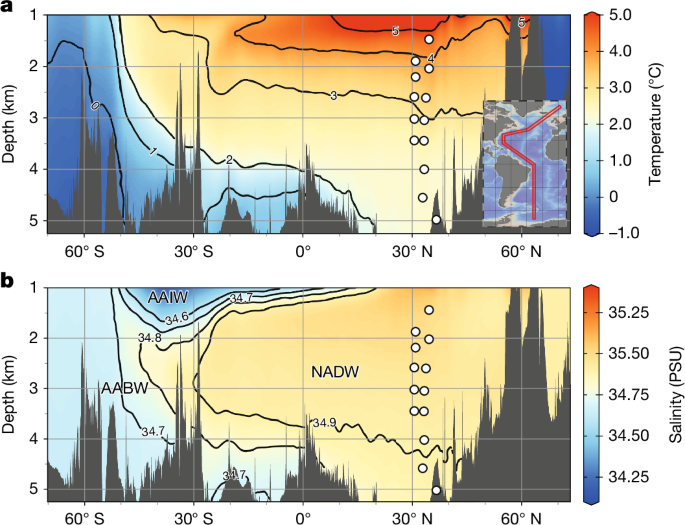
Clark, P. U. et al. The Last Glacial Maximum. Science 325, 710–714 (2009).
Kageyama, M. et al. The PMIP4 Last Glacial Maximum experiments: preliminary results and comparison with the PMIP3 simulations. Clim. Past 17, 1065–1089 (2021).
Curry, W. B. & Oppo, D. W. Glacial water mass geometry and the distribution of δ13C of ΣCO2 in the western Atlantic Ocean. Paleoceanography 20, PA1017 (2005).
Oppo, D. W. et al. Data constraints on glacial atlantic water mass geometry and properties. Paleoceanogr. Paleoclimatol. 33, 1013–1034 (2018).
Blaser, P. et al. Prevalent North Atlantic Deep Water during the Last Glacial Maximum and Heinrich Stadial 1. Nat. Geosci. 18, 410–416 (2025).
Adkins, J. F., McIntyre, K. & Schrag, D. P. The salinity, temperature, and δ18O of the glacial deep ocean. Science 298, 1769–1773 (2002).
Locarnini, R. A. et al. World Ocean Atlas 2023. Volume 1: Temperature (NOAA, 2024).
Reagan, J. R. et al. World Ocean Atlas 2023. Volume 2: Salinity (NOAA, 2024).
Talley, L. D., Pickard, G. L., Emery, W. J. & Swift, J. H. in Descriptive Physical Oceanography 6th edn (eds Talley, L. D. et al.) 245–301 (Academic Press, 2011).
Sherriff-Tadano, S., Abe-Ouchi, A., Yoshimori, M., Oka, A. & Chan, W.-L. Influence of glacial ice sheets on the Atlantic meridional overturning circulation through surface wind change. Clim. Dyn. 50, 2881–2903 (2018).
Klockmann, M., Mikolajewicz, U. & Marotzke, J. The effect of greenhouse gas concentrations and ice sheets on the glacial AMOC in a coupled climate model. Clim. Past 12, 1829–1846 (2016).
Oka, A., Hasumi, H. & Abe-Ouchi, A. The thermal threshold of the Atlantic meridional overturning circulation and its control by wind stress forcing during glacial climate. Geophys. Res. Lett. 39, L09709 (2012).
Pöppelmeier, F., Gutjahr, M., Blaser, P., Keigwin, L. D. & Lippold, J. Origin of abyssal NW Atlantic water masses since the Last Glacial Maximum. Paleoceanogr. Paleoclimatology 33, 530–543 (2018).
Wharton, J. H. et al. Deeper and stronger North Atlantic Gyre during the Last Glacial Maximum. Nature https://doi.org/10.1038/s41586-024-07655-y (2024).
Keigwin, L. D. & Swift, S. A. Carbon isotope evidence for a northern source of deep water in the glacial western North Atlantic. Proc. Natl Acad. Sci. USA 114, 2831–2835 (2017).
Wunsch, C. Last Glacial Maximum and deglacial abyssal seawater oxygen isotopic ratios. Clim. Past 12, 1281–1296 (2016).
Miller, M. D., Simons, M., Adkins, J. F. & Minson, S. E. The information content of pore fluid δ18O and [Cl−]. J. Phys. Oceanogr. 45, 2070–2094 (2015).
Petit, T., Lozier, M. S., Josey, S. A. & Cunningham, S. A. Atlantic deep water formation occurs primarily in the Iceland Basin and Irminger Sea by local buoyancy forcing. Geophys. Res. Lett. 47, e2020GL091028 (2020).
Martin, W. R. & Sayles, F. L. CaCO3 dissolution in sediments of the Ceara Rise, western equatorial Atlantic. Geochim. Cosmochim. Acta 60, 243–263 (1996).
Weldeab, S., Arce, A. & Kasten, S. Mg/Ca-ΔCO32−porewater–temperature calibration for Globobulimina spp.: a sensitive paleothermometer for deep-sea temperature reconstruction. Earth Planet. Sci. Lett. 438, 95–102 (2016).
Marchitto, T. M., Bryan, S. P., Doss, W., McCulloch, M. T. & Montagna, P. A simple biomineralization model to explain Li, Mg, and Sr incorporation into aragonitic foraminifera and corals. Earth Planet. Sci. Lett. 481, 20–29 (2018).
Cronin, T. M., Dwyer, G. S., Baker, P. A., Rodriguez-Lazaro, J. & DeMartino, D. M. Orbital and suborbital variability in North Atlantic bottom water temperature obtained from deep-sea ostracod Mg/Ca ratios. Palaeogeogr. Palaeoclimatol. Palaeoecol. 162, 45–57 (2000).
Dwyer, G. S., Cronin, T. M., Baker, P. A. & Rodriguez-Lazaro, J. Changes in North Atlantic deep-sea temperature during climatic fluctuations of the last 25,000 years based on ostracode Mg/Ca ratios. Geochem. Geophys. Geosyst. 1, 1028 (2000).
Yasuhara, M. et al. North Atlantic Intermediate Water variability over the past 20,000 years. Geology 47, 659–663 (2019).
LeGrande, A. N. & Schmidt, G. A. Global gridded data set of the oxygen isotopic composition in seawater. Geophys. Res. Lett. 33, L12604 (2006).
Rohling, E. J. Progress in paleosalinity: overview and presentation of a new approach. Paleoceanography 22, PA3215 (2007).
Zhang, J. et al. Asynchronous warming and δ18O evolution of deep Atlantic water masses during the last deglaciation. Proc. Natl Acad. Sci. USA 114, 11075–11080 (2017).
Hirschi, J. J.-M. et al. The Atlantic Meridional Overturning Circulation in high-resolution models. J. Geophys. Res. Oceans 125, e2019JC015522 (2020).
Waelbroeck, C. et al. Constraints on surface seawater oxygen isotope change between the Last Glacial Maximum and the Late Holocene. Quat. Sci. Rev. 105, 102–111 (2014).
Benetti, M., Reverdin, G., Aloisi, G. & Sveinbjörnsdóttir, Á. Stable isotopes in surface waters of the Atlantic Ocean: indicators of ocean–atmosphere water fluxes and oceanic mixing processes. J. Geophys. Res. Oceans 122, 4723–4742 (2017).
Warken, S. F. et al. Caribbean hydroclimate and vegetation history across the last glacial period. Quat. Sci. Rev. 218, 75–90 (2019).
Bartlein, P. J. et al. Pollen-based continental climate reconstructions at 6 and 21 ka: a global synthesis. Clim. Dyn. 37, 775–802 (2011).
Cronin, T. M. et al. Deep Arctic Ocean warming during the last glacial cycle. Nat. Geosci. 5, 631–634 (2012).
Bauch, H. A. et al. A multiproxy reconstruction of the evolution of deep and surface waters in the subarctic Nordic Seas over the last 30,000 yr. Quat. Sci. Rev. 20, 659–678 (2001).
Thornalley, D. J. R., Elderfield, H. & McCave, I. N. Reconstructing North Atlantic deglacial surface hydrography and its link to the Atlantic overturning circulation. Glob. Planet. Change 79, 163–175 (2011).
Alley, R. B. & Clark, P. U. The deglaciation of the Northern Hemisphere: a global perspective. Annu. Rev. Earth Planet. Sci. 27, 149–182 (1999).
Winton, M. The effect of cold climate upon North Atlantic Deep Water formation in a simple ocean–atmosphere model. J. Clim. 10, 37–51 (1997).
Hanawa, K. & D. Talley, L. in International Geophysics Vol. 77 (eds Siedler, G. et al.) 373–386 (Academic Press, 2001).
Seltzer, A. M., Davidson, P. W., Shackleton, S. A., Nicholson, D. P. & Khatiwala, S. Global ocean cooling of 2.3 °C during the Last Glacial Maximum. Geophys. Res. Lett. 51, e2024GL108866 (2024).
Bereiter, B., Shackleton, S., Baggenstos, D., Kawamura, K. & Severinghaus, J. Mean global ocean temperatures during the last glacial transition. Nature 553, 39–44 (2018).
Barker, S. & Knorr, G. A systematic role for extreme ocean–atmosphere oscillations in the development of glacial conditions since the Mid Pleistocene transition. Paleoceanogr. Paleoclimatology 38, e2023PA004690 (2023).
Våge, K., Papritz, L., Håvik, L., Spall, M. A. & Moore, G. W. K. Ocean convection linked to the recent ice edge retreat along east Greenland. Nat. Commun. 9, 1287 (2018).
Lique, C. & Thomas, M. D. Latitudinal shift of the Atlantic Meridional Overturning Circulation source regions under a warming climate. Nat. Clim. Change 8, 1013–1020 (2018).
Schlitzer, R. Ocean Data View: EPIC3 (ODV, 2022).
Marchitto, T. M. et al. Improved oxygen isotope temperature calibrations for cosmopolitan benthic foraminifera. Geochim. Cosmochim. Acta 130, 1–11 (2014).
Henry, L. G. et al. North Atlantic ocean circulation and abrupt climate change during the last glaciation. Science 353, 470–474 (2016).
Lauvset, S. K. et al. GLODAPv2.2022: the latest version of the global interior ocean biogeochemical data product. Earth Syst. Sci. Data 14, 5543–5572 (2022).
McDougall, T. J. & Barker, P. M. Getting started with TEOS-10 and the Gibbs seawater (GSW) oceanographic toolbox. Scoriapso WG 127, 1–28 (2011).
Dalton, A. S. et al. An updated radiocarbon-based ice margin chronology for the last deglaciation of the North American Ice Sheet Complex. Quat. Sci. Rev. 234, 106223 (2020).
Hughes, A. L. C., Gyllencreutz, R., Lohne, ØS., Mangerud, J. & Svendsen, J. I. The last Eurasian ice sheets—a chronological database and time-slice reconstruction, DATED-1. Boreas 45, 1–45 (2016).
Thornalley, D. J. R., Elderfield, H. & McCave, I. N. Intermediate and deep water paleoceanography of the northern North Atlantic over the past 21,000 years. Paleoceanography 25, PA1211 (2010).
Barker, S., Kiefer, T. & Elderfield, H. Temporal changes in North Atlantic circulation constrained by planktonic foraminiferal shell weights. Paleoceanography 19, PA3008 (2004).
Boyle, E. & Rosenthal, Y. in The South Atlantic: Present and Past Circulation (eds Wefer, G. et al.) 423–443 (Springer, 1996).
Marchitto, T. M. Precise multielemental ratios in small foraminiferal samples determined by sector field ICP-MS. Geochem. Geophys. Geosyst. 7, Q05P13 (2006).
Barker, S., Greaves, M. & Elderfield, H. A study of cleaning procedures used for foraminiferal Mg/Ca paleothermometry. Geochem. Geophys. Geosyst. 4, 8407 (2003).
Elderfield, H., Yu, J., Anand, P., Kiefer, T. & Nyland, B. Calibrations for benthic foraminiferal Mg/Ca paleothermometry and the carbonate ion hypothesis. Earth Planet. Sci. Lett. 250, 633–649 (2006).
Stirpe, C. R. et al. The Mg/Ca proxy for temperature: a Uvigerina core-top study in the Southwest Pacific. Geochim. Cosmochim. Acta 309, 299–312 (2021).
Bryan, S. P. & Marchitto, T. M. Mg/Ca–temperature proxy in benthic foraminifera: new calibrations from the Florida Straits and a hypothesis regarding Mg/Li. Paleoceanography 23, PA2220 (2008).
Hasenfratz, A. P. et al. Mg/Ca-temperature calibration for the benthic foraminifera Melonis barleeanum and Melonis pompilioides. Geochim. Cosmochim. Acta 217, 365–383 (2017).
Grunert, P. et al. Mg/Ca-temperature calibration for costate Bulimina species (B. costata, B. inflata, B. mexicana): a paleothermometer for hypoxic environments. Geochim. Cosmochim. Acta 220, 36–54 (2018).
Quillmann, U., Marchitto, T. M., Jennings, A. E., Andrews, J. T. & Friestad, B. F. Cooling and freshening at 8.2 ka on the NW Iceland Shelf recorded in paired δ18O and Mg/Ca measurements of the benthic foraminifer Cibicides lobatulus. Quat. Res. 78, 528–539 (2012).
Skirbekk, K. et al. Benthic foraminiferal growth seasons implied from Mg/Ca–temperature correlations for three Arctic species. Geochem. Geophys. Geosyst. 17, 4684–4704 (2016).
Kristjánsdóttir, G. B., Lea, D. W., Jennings, A. E., Pak, D. K. & Belanger, C. New spatial Mg/Ca-temperature calibrations for three Arctic, benthic foraminifera and reconstruction of north Iceland shelf temperature for the past 4000 years. Geochem. Geophys. Geosyst. 8, Q03P21 (2007).
Yu, J., Elderfield, H., Greaves, M. & Day, J. Preferential dissolution of benthic foraminiferal calcite during laboratory reductive cleaning. Geochem. Geophys. Geosyst. 8, Q06016 (2007).
Bernasconi, S. M. et al. InterCarb: a community effort to improve interlaboratory standardization of the carbonate clumped isotope thermometer using carbonate standards. Geochem. Geophys. Geosyst. 22, e2020GC009588 (2021).
Bernasconi, S. M. et al. Background effects on Faraday collectors in gas-source mass spectrometry and implications for clumped isotope measurements. Rapid Commun. Mass Spectrom. 27, 603–612 (2013).
Meckler, A. N., Ziegler, M., Millán, M. I., Breitenbach, S. F. M. & Bernasconi, S. M. Long-term performance of the Kiel carbonate device with a new correction scheme for clumped isotope measurements. Rapid Commun. Mass Spectrom. 28, 1705–1715 (2014).
Meinicke, N., Reimi, M. A., Ravelo, A. C. & Meckler, A. N. Coupled Mg/Ca and clumped isotope measurements indicate lack of substantial mixed layer cooling in the Western Pacific Warm Pool during the last ∼5 million years. Paleoceanogr. Paleoclimatol. 36, e2020PA004115 (2021).
Schrag, D. P. et al. The oxygen isotopic composition of seawater during the Last Glacial Maximum. Quat. Sci. Rev. 21, 331–342 (2002).
Clark, P. U. et al. Global mean sea level over the past 4.5 million years. Science 390, eadv8389 (2025).
Duplessy, J.-C., Labeyrie, L. & Waelbroeck, C. Constraints on the ocean oxygen isotopic enrichment between the Last Glacial Maximum and the Holocene: paleoceanographic implications. Quat. Sci. Rev. 21, 315–330 (2002).
Lisiecki, L. E. & Raymo, M. E. A Pliocene-Pleistocene stack of 57 globally distributed benthic δ18O records. Paleoceanography 20, PA1003 (2005).
Rohling, E. J. & Bigg, G. R. Paleosalinity and δ18O: a critical assessment. J. Geophys. Res. Oceans 103, 1307–1318 (1998).
Valley, S. G., Lynch-Stieglitz, J. & Marchitto, T. M. Intermediate water circulation changes in the Florida Straits from a 35 ka record of Mg/Li-derived temperature and Cd/Ca-derived seawater cadmium. Earth Planet. Sci. Lett. 523, 115692 (2019).
Umling, N. E. et al. Atlantic circulation and ice sheet influences on upper South Atlantic temperatures during the last deglaciation. Paleoceanogr. Paleoclimatol. 34, 990–1005 (2019).
Oppo, D. W. et al. Deglacial temperature and carbonate saturation state variability in the tropical Atlantic at Antarctic Intermediate Water depths. Paleoceanogr. Paleoclimatol. 38, e2023PA004674 (2023).
Ezat, M. M., Rasmussen, T. L. & Groeneveld, J. Reconstruction of hydrographic changes in the southern Norwegian Sea during the past 135 kyr and the impact of different foraminiferal Mg/Ca cleaning protocols. Geochem. Geophys. Geosyst. 17, 3420–3436 (2016).
Marcott, S. A. et al. Ice-shelf collapse from subsurface warming as a trigger for Heinrich events. Proc. Natl Acad. Sci. USA 108, 13415–13419 (2011).
Skinner, L. C., Shackleton, N. J. & Elderfield, H. Millennial-scale variability of deep-water temperature and δ18Odw indicating deep-water source variations in the Northeast Atlantic, 0–34 cal. ka BP. Geochem. Geophys. Geosyst. 4, 1098 (2003).
Hasenfratz, A. P. et al. The residence time of Southern Ocean surface waters and the 100,000-year ice age cycle. Science 363, 1080–1084 (2019).
Yu, J. & Elderfield, H. Benthic foraminiferal B/Ca ratios reflect deep water carbonate saturation state. Earth Planet. Sci. Lett. 258, 73–86 (2007).
Doss, W., Marchitto, T. M., Eagle, R., Rashid, H. & Tripati, A. Deconvolving the saturation state and temperature controls on benthic foraminiferal Li/Ca, based on downcore paired B/Ca measurements and coretop compilation. Geochim. Cosmochim. Acta 236, 297–314 (2018).
Humphreys, M. P. et al. PyCO2SYS: marine carbonate system calculations in Python. Zenodo https://doi.org/10.5281/zenodo.16420947 (2025).
Wadley, M. R., Bigg, G. R., Rohling, E. J. & Payne, A. J. On modelling present-day and last glacial maximum oceanic δ18O distributions. Glob. Planet. Change 32, 89–109 (2002).
Brennan, C. E., Weaver, A. J., Eby, M. & Meissner, K. J. Modelling oxygen isotopes in the University of Victoria Earth system climate model for pre-industrial and Last Glacial Maximum conditions. Atmos. Ocean 50, 447–465 (2012).
Werner, M. et al. Glacial–interglacial changes in H218O, HDO and deuterium excess—results from the fully coupled ECHAM5/MPI-OM Earth system model. Geosci. Model Dev. 9, 647–670 (2016).
Gu, S. et al. Assessing the potential capability of reconstructing glacial Atlantic water masses and AMOC using multiple proxies in CESM. Earth Planet. Sci. Lett. 541, 116294 (2020).
Caley, T., Roche, D. M., Waelbroeck, C. & Michel, E. Oxygen stable isotopes during the Last Glacial Maximum climate: perspectives from data–model (iLOVECLIM) comparison. Clim. Past 10, 1939–1955 (2014).
Bemis, B. E., Spero, H. J., Bijma, J. & Lea, D. W. Reevaluation of the oxygen isotopic composition of planktonic foraminifera: experimental results and revised paleotemperature equations. Paleoceanography 13, 150–160 (1998).
Nyland, B. F., Jansen, E., Elderfield, H. & Andersson, C. Neogloboquadrina pachyderma (dex. and sin.) Mg/Ca and δ18O records from the Norwegian Sea. Geochem. Geophys. Geosyst. 7, Q10P17 (2006).
Kim, S.-T. & O’Neil, J. R. Equilibrium and nonequilibrium oxygen isotope effects in synthetic carbonates. Geochim. Cosmochim. Acta 61, 3461–3475 (1997).
Gray, W. R. & Evans, D. Nonthermal influences on Mg/Ca in planktonic foraminifera: a review of culture studies and application to the Last Glacial Maximum. Paleoceanogr. Paleoclimatol. 34, 306–315 (2019).
Hönisch, B. & Hemming, N. G. Surface ocean pH response to variations in pCO2 through two full glacial cycles. Earth Planet. Sci. Lett. 236, 305–314 (2005).
Felden, J. et al. PANGAEA – data publisher for earth & environmental science. Sci. Data 10, 347 (2023).
Wharton, J. et al. Mid-to-late Holocene and LGM multiproxy temperature, stable isotope, and seawater δ18O data from the North Atlantic [dataset bundled publication]. PANGAEA https://doi.org/10.1594/PANGAEA.988210 (2026).
Wharton, J. H. Relatively warm deep water formation persisted in the Last Glacial Maximum (python script). Zenodo https://doi.org/10.5281/zenodo.17733604 (2026).
The GEBCO_2014 Grid, version 20150318 (GEBCO Compilation Group, 2015).
Mawbey, E. M. et al. Mg/Ca–temperature calibration of polar benthic foraminifera species for reconstruction of bottom water temperatures on the Antarctic shelf. Geochim. Cosmochim. Acta 283, 54–66 (2020).
Barrientos, N. et al. Arctic Ocean benthic foraminifera Mg/Ca ratios and global Mg/Ca-temperature calibrations: new constraints at low temperatures. Geochim. Cosmochim. Acta 236, 240–259 (2018).
Sessford, E. G. et al. High-resolution benthic Mg/Ca temperature record of the intermediate water in the Denmark Strait across D–O Stadial–Interstadial cycles. Paleoceanogr. Paleoclimatol. 33, 1169–1185 (2018).
Lear, C. H., Rosenthal, Y. & Slowey, N. Benthic foraminiferal Mg/Ca-paleothermometry: a revised core-top calibration. Geochim. Cosmochim. Acta 66, 3375–3387 (2002).
Elderfield, H. et al. A record of bottom water temperature and seawater δ18O for the Southern Ocean over the past 440 kyr based on Mg/Ca of benthic foraminiferal Uvigerina spp. Quat. Sci. Rev. 29, 160–169 (2010).
Daëron, M. & Gray, W. R. Revisiting oxygen-18 and clumped isotopes in planktic and benthic foraminifera. Paleoceanogr. Paleoclimatol. 38, e2023PA004660 (2023).
Anderson, N. T. et al. A unified clumped isotope thermometer calibration (0.5–1,100 °C) using carbonate-based standardization. Geophys. Res. Lett. 48, e2020GL092069 (2021).
Daëron, M. & Vermeesch, P. Omnivariant generalized least squares regression: theory, geochronological applications, and making the case for reconciled Δ47 calibrations. Chem. Geol. 647, 121881 (2024).
Ezat, M. M. et al. Deep ocean storage of heat and CO2 in the Fram Strait, Arctic Ocean during the last glacial period. Paleoceanogr. Paleoclimatol. 36, e2021PA004216 (2021).
El bani Altuna, N., Ezat, M. M., Greaves, M. & Rasmussen, T. L. Millennial-scale changes in bottom water temperature and water mass exchange through the Fram Strait 79°N, 63–13 ka. Paleoceanogr. Paleoclimatol. 36, e2020PA004061 (2021).
Thornalley, D. J. R. et al. A warm and poorly ventilated deep Arctic Mediterranean during the last glacial period. Science 349, 706–710 (2015).
Keigwin, L. D. Radiocarbon and stable isotope constraints on Last Glacial Maximum and Younger Dryas ventilation in the western North Atlantic. Paleoceanography 19, PA4012 (2004).
Pöppelmeier, F. et al. Influence of ocean circulation and benthic exchange on deep Northwest Atlantic Nd isotope records during the past 30,000 years. Geochem. Geophys. Geosyst. 20, 4457–4469 (2019).
Lippold, J. et al. Constraining the variability of the Atlantic Meridional Overturning Circulation during the Holocene. Geophys. Res. Lett. 46, 11338–11346 (2019).
Lippold, J. et al. Does sedimentary 231Pa/230Th from the Bermuda Rise monitor past Atlantic Meridional Overturning Circulation? Geophys. Res. Lett. 36, L12601 (2009).
Carlson, A. E. et al. Subtropical Atlantic salinity variability and Atlantic meridional circulation during the last deglaciation. Geology 36, 991–994 (2008).
Hall, I. R., Evans, H. K. & Thornalley, D. J. R. Deep water flow speed and surface ocean changes in the subtropical North Atlantic during the last deglaciation. Glob. Planet. Change 79, 255–263 (2011).
Peck, V. L. et al. High resolution evidence for linkages between NW European ice sheet instability and Atlantic Meridional Overturning Circulation. Earth Planet. Sci. Lett. 243, 476–488 (2006).
Benway, H. M., McManus, J. F., Oppo, D. W. & Cullen, J. L. Hydrographic changes in the eastern subpolar North Atlantic during the last deglaciation. Quat. Sci. Rev. 29, 3336–3345 (2010).
Elderfield, H. & Ganssen, G. Past temperature and δ18O of surface ocean waters inferred from foraminiferal Mg/Ca ratios. Nature 405, 442–445 (2000).
Hoff, U., Rasmussen, T. L., Stein, R., Ezat, M. M. & Fahl, K. Sea ice and millennial-scale climate variability in the Nordic Seas 90 kyr ago to present. Nat. Commun. 7, 12247 (2016).

