


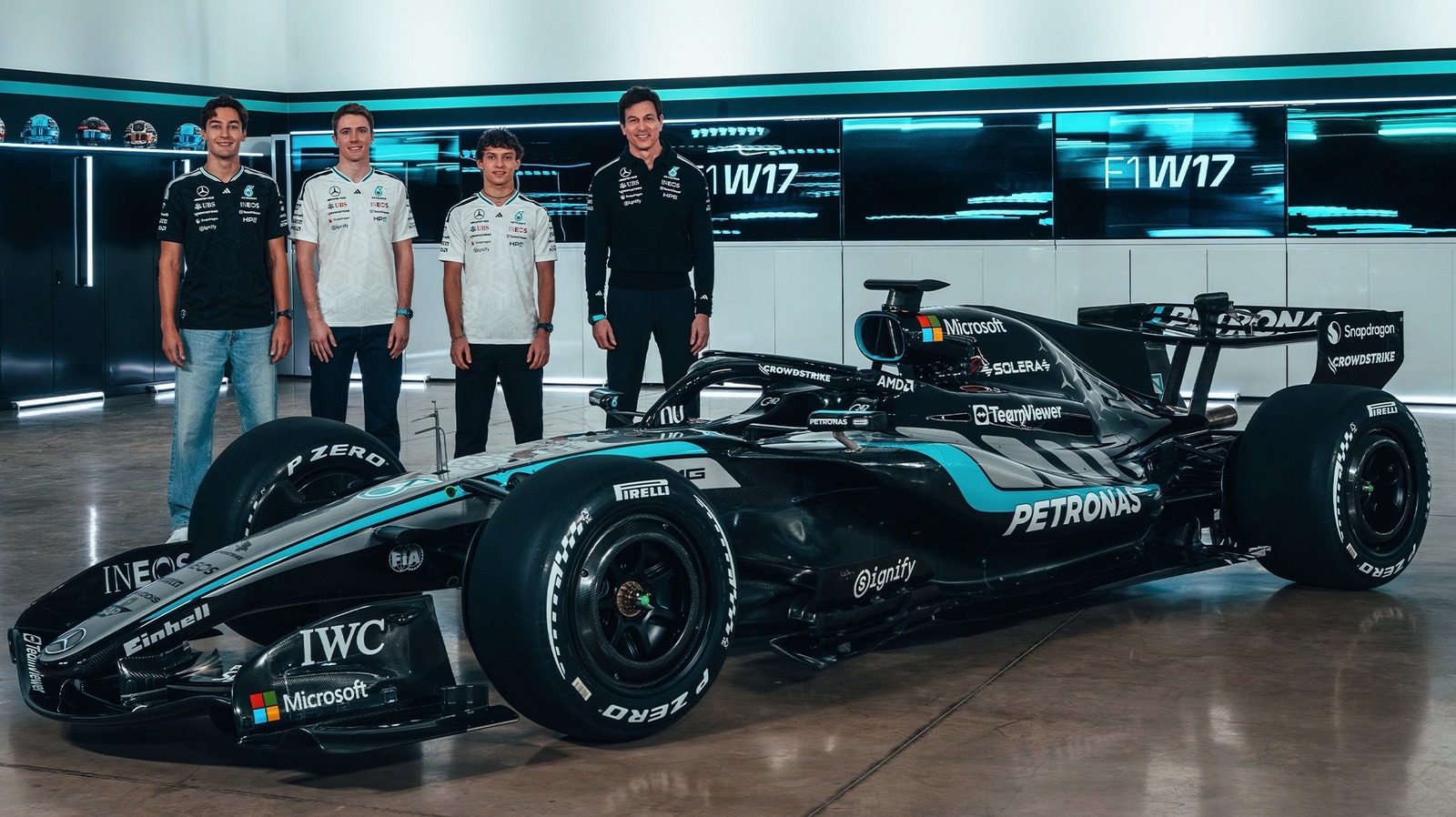
After running near the top of the timesheets during the five-day test at the Barcelona circuit in late January, it was noted that the Mercedes-AMG team had a not-insignificant power advantage over the rest of the F1 grid. The new engine regulations for 2026 are meant to downplay the gasoline engine, giving significantly more power to the hybrid electric motor.
One of the ways the series manages engine output is through a mandated maximum compression ratio, this year lowered to 16:1 from 2025’s allowed 18:1. Leaked documents seem to prove that Mercedes-AMG’s engine may pass the compression ratio measurement with a cold engine, but as it warms up in race conditions the ratio also increases.
Engine suppliers Audi, Ferrari, and Honda sent a joint letter to the FIA in late January requesting clarification on the rule, though the FIA did not seem to be interested in interfering with the Mercedes engine. This week, following a meeting of the Power Unit Advisory Committee, it seems the three manufacturers signed on to the letter are still interested in a regulatory intervention to change the compression ratio measuring method.
In order to force F1’s hand, Audi, Ferrari, and Honda needed to get Red Bull Ford Powertrains onboard, as a supermajority (four of the five engine manufacturers, plus the FIA and F1) is needed to push a regulation change this close to the season beginning.
The rumor in the paddock is that Red Bull attempted to replicate Mercedes’ efforts, but couldn’t find the gains Mercedes did and instead leaked the documents to the other manufacturers in an effort to bring this to light. With support from Red Bull, the anti-Mercedes teams will have to hope that Formula One Management will vote their way.
Is Mercedes cheating?
Mercedes team boss Toto Wolff was very clear about where he stands on his team’s engine. “The power unit is legal,” he said. “The power unit corresponds to how the regulations are written. The power unit corresponds to how the checks are being done.”
Wolff also mentioned his disappointment that other teams were more concerned with trying to legislate their competitors out of contention instead of just building a better car. “Specifically in that area, it’s very clear what the regulations say. It’s very clear what the standard procedures are on any motors, even outside of Formula 1. So just get your sh*t together.”
The 2026 Formula One World Championship will finalize all engine homologation on March 1st, which would give Mercedes very little time to build a different engine if it were required to by any potential engine regulation or measurement change. Likewise, the season kicks off a week later at the Australian Grand Prix in Melbourne on the 8th of March. It seems highly unlikely that F1 would make an engine rule change now that could have massive implications on the running order for the 2026 season.
If anything, it seems more likely that the FIA would allow this method of measurement for the full 2026 season, giving Mercedes the competitive advantage it has built. If the FIA and FOM decided they wanted to change the rulebook for 2027, however, that would allow Mercedes plenty of time to develop a new engine for that set of rules. Creative interpretation of the rulebook is what Formula One is about, after all.

