



On February 12, ahead of the Munich Security Conference, Quantum Systems announced a €150 million financing package backed by the European Investment Bank, Commerzbank, Deutsche Bank, and KfW.
The EIB alone provided a €70 million loan, marking its second investment in the company since 2021.
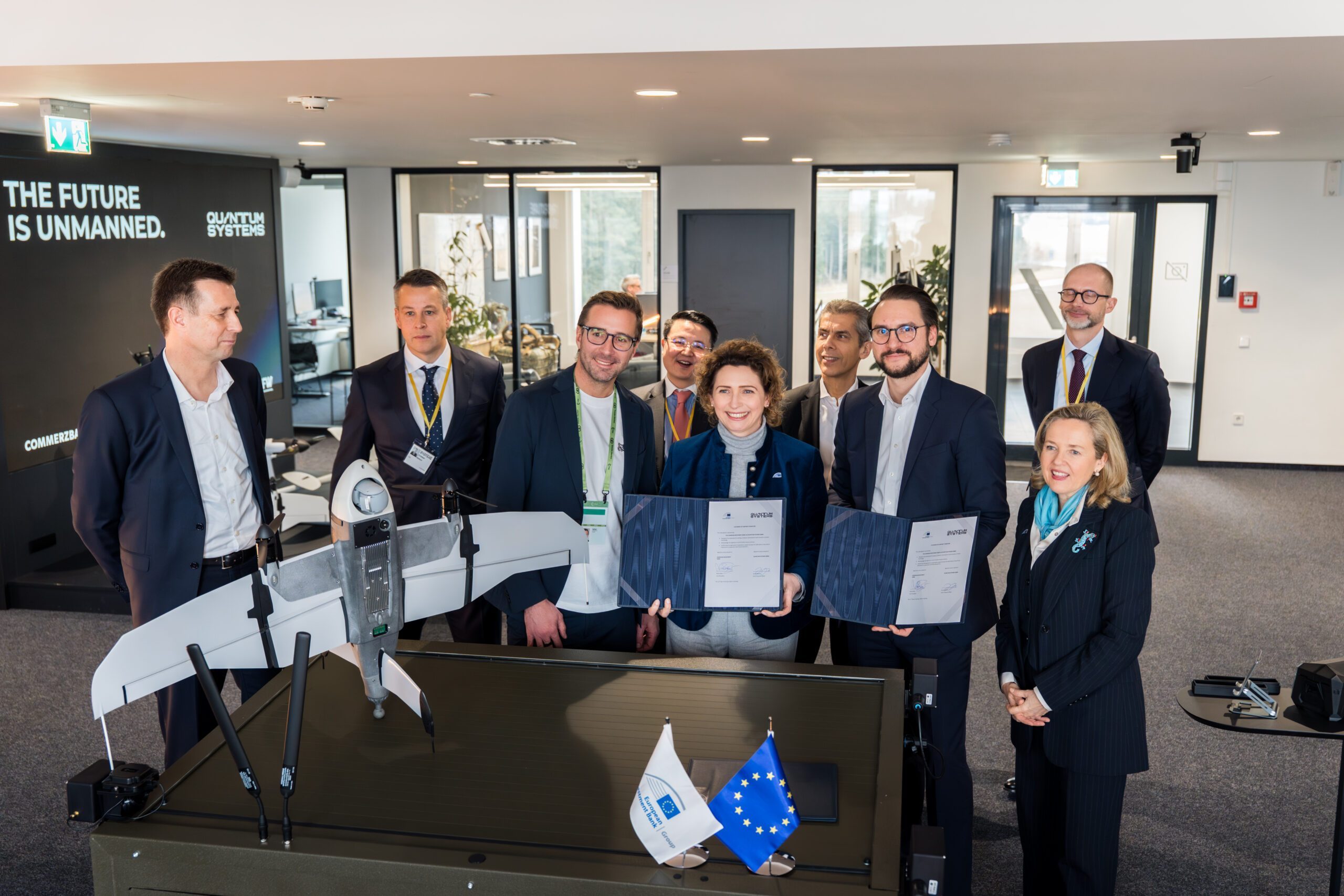
The significance goes beyond the balance sheet.
Recent adjustments to ESG frameworks now allow European banks to support security-relevant technologies more directly. In practical terms, that means European defense innovation can now scale with European capital rather than relying on foreign markets or constrained funding channels.
“This financing is a strong vote of confidence in our company, technology, and our vision,” said Jonas Jarosch. “It enables us to scale responsibly while remaining firmly anchored in Europe. Security and technological sovereignty start with the ability to invest long-term in critical capabilities.”
EIB President Nadia Calviño framed it in strategic terms:
“Drones and aerial intelligence are already indispensable for Europe’s security – from defending Ukraine to protecting critical infrastructure and borders. With this EUR 70 million financing, the EIB is backing a European technology champion in Germany and showing how public and private finance can scale up Europe’s defence capabilities and better protect our citizens.”
This marks a notable shift. European institutions are no longer cautiously orbiting the defense drone sector. They are underwriting it.
From Capital to Capability: Production for Ukraine
The financing announcement was immediately followed by proof of execution.
At a newly established joint venture between Quantum Systems and Frontline Robotics, called Quantum Frontline Industries, President Zelenskyy received the first Ukrainian drone manufactured in Germany: the Linza 3.0.
The facility plans to produce up to 10,000 drones for the Ukrainian Armed Forces within a year. Early-stage production has already begun.
During his visit, Zelenskyy told employees: “I want to thank the people of Germany for the support of your nation since the start of the war. Your solidarity means a great deal to us. I also want to congratulate both companies and say how proud I am of the important work they are doing.”
German Defence Minister Boris Pistorius described the project as moving at “lightspeed,” noting that battlefield lessons are feeding innovation cycles.
The Linza 3.0 itself reflects that dynamic. The multi-purpose drone features AI-enabled visual-inertial navigation, a 12-inch frame, up to 4 kg payload capacity, a 15 km range, and up to 60 minutes of endurance. More than 60 units are already deployed with Ukrainian forces.
Matthias Lehna of Quantum Frontline Industries emphasized the speed of execution:
“Quantum Frontline Industries has started production in just two months after the announcement. QFI is the first of its kind but will not be the last. We are proud to be a flagship company for Ukrainian German industrial cooperation and proud to support the Armed Forces of Ukraine with the best technology of both countries.”
Why This Matters for the Drone Industry
Quantum Systems has long positioned itself as a European alternative in the tactical and reconnaissance UAS market. Its growth trajectory has been impressive, and includes expansion in the U.S. market and an increasing role in defense and public safety applications.
What makes this moment different is alignment.
Capital, industrial capacity, and geopolitical necessity are moving in the same direction.
The €150 million financing enables scaling of production and technology development inside Europe. The German-Ukrainian joint venture translates that capital into operational capability. The presence of heads of state signals political backing at the highest level.
For companies that want to market security-relevant products in Europe, the message is clear: financing pathways are evolving. Sovereignty and supply chain resilience now sit alongside performance and price in procurement decisions.
Quantum Systems is not just building drones. It is participating in the architecture of European defense industrial policy.
And in today’s environment, that architecture may be as strategically important as the aircraft themselves.
Read more:

Miriam McNabb is the Editor-in-Chief of DRONELIFE and CEO of JobForDrones, a professional drone services marketplace, and a fascinated observer of the emerging drone industry and the regulatory environment for drones. Miriam has penned over 3,000 articles focused on the commercial drone space and is an international speaker and recognized figure in the industry. Miriam has a degree from the University of Chicago and over 20 years of experience in high tech sales and marketing for new technologies.
For drone industry consulting or writing, Email Miriam.
TWITTER:@spaldingbarker
Subscribe to DroneLife here.

