


You have full access to this article via your institution.
Hello Nature readers, would you like to get this Briefing in your inbox free every day? Sign up here.

Source: Ref. 1.
The rate of global warming has surged since 2015 and is now nearly double what it was in the 1970s, according to a new study. That’s faster than some other estimates, but the authors say their analysis captures a more accurate picture because it accounts for the effects of natural factors such as the El Niño weather pattern. Most climate scientists agree that warming is accelerating — partly because of a reduction in sun-reflecting air pollution — but some have questioned this study’s results. The authors’ methods for removing natural fluctuations are “imperfect and will leave some remaining effects”, says climate scientist Zeke Hausfather.
Reference: Geophysical Research Letters paper

Source: Copernicus Climate Change Service/European Centre for Medium-Range Weather Forecasts.
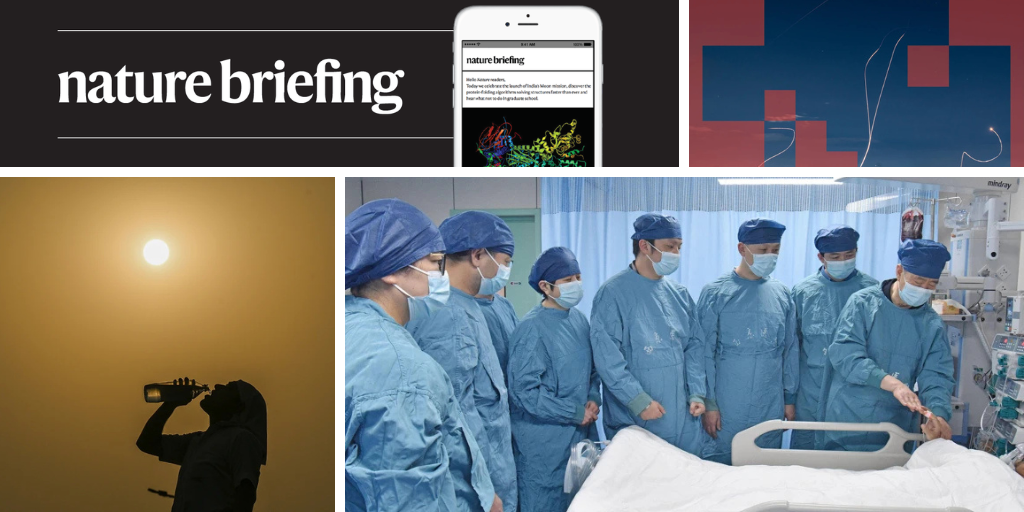
A 56-year-old man with liver failure has become the first living person to be surgically connected to a genetically modified pig liver. In the procedure, called an extracorporeal perfusion, surgeons connected the man to a pig liver outside his body so it could filter harmful waste products from his blood. The man was disconnected from the system after nearly three days to reduce the risk of infections, but there were no signs of rejection while he was connected, his medical team in China says. He later received a human liver transplant and is recovering well.
Scientists say they have made some of the first direct measurements of how long it takes an individual, ordinary protein to fold. The results were unexpected: they found no relationship between a protein’s sequence or size and the time it took to fold into its 3D shape. And proteins seem to fold more efficiently than other biomolecules, such as DNA — despite proteins having a more complex set of building blocks.
Reference: Physical Review Letters paper
Features & opinion
The escalating conflict between the United States, Israel and Iran has thrown a spotlight on the use of artificial intelligence in warfare. The US military is already using AI tools based on large language models for intelligence gathering and battlefield decisions. Meanwhile, international talks that seek to agree legal and ethical use of AI in warfare are hamstrung by lack of engagement from the main players, including the US, Israel and China, specialists say.
We “are witnessing a fundamental shift in how federal science agencies are being governed” in the United States, write two researchers with extensive experience of the National Institutes of Health. “The president, through political appointees, is exerting unprecedented control over what research gets funded and who conducts it, with little say from Congress.” Legislators must wrestle back control and work to ensure that the scientific community and an expert-driven civil service are guiding taxpayer-funded US science, they argue.
Psychologist Violeta Rodriguez sees hundreds of PhD applications a year — and knows all the ways they can go wrong. She outlines four of the most common application mistakes, as well as four interview mistakes, and how to avoid them. Don’t try to hide gaps or weaknesses in your CV, she advises — and practice clearly explaining your own work.
In Friday’s penguin-search puzzle, Leif Penguinson was exploring the exposed bed of the Mayo-Louti river in Cameroon during a dry spell. Did you find the penguin? When you’re ready, here’s the answer.
Thanks for reading,
Flora Graham, senior editor, Nature Briefing
With contributions by Jacob Smith & Nicola Jones
• Nature Briefing: Careers — insights, advice and award-winning journalism to help you optimize your working life
• Nature Briefing: Microbiology — the most abundant living entities on our planet — microorganisms — and the role they play in health, the environment and food systems
• Nature Briefing: Anthropocene — climate change, biodiversity, sustainability and geoengineering
• Nature Briefing: AI & Robotics — 100% written by humans, of course
• Nature Briefing: Cancer — a weekly newsletter written with cancer researchers in mind
• Nature Briefing: Translational Research — covers biotechnology, drug discovery and pharma


