


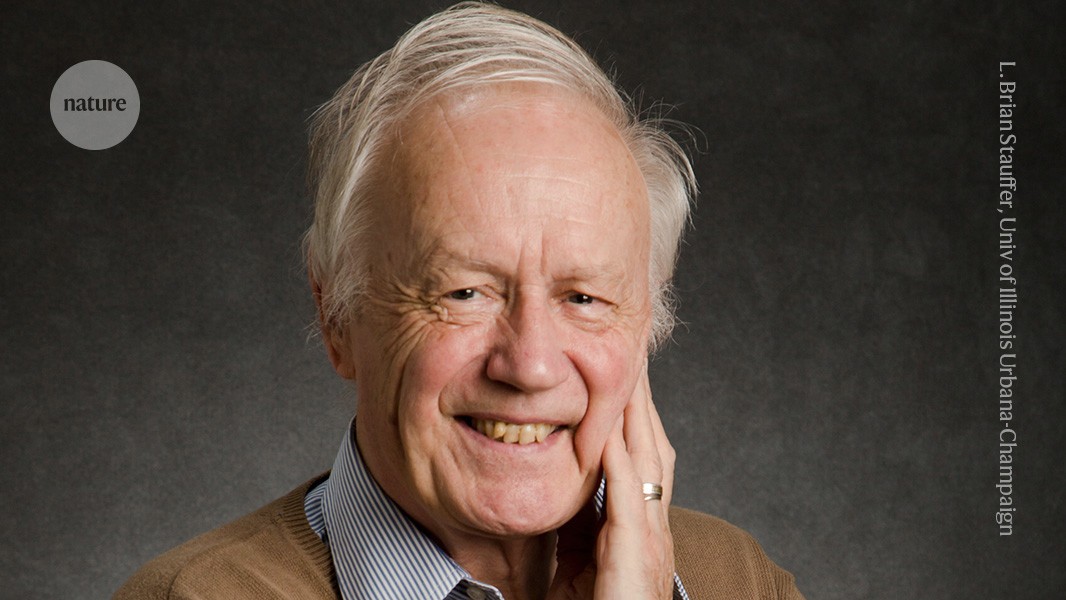

Credit: L. Brian Stauffer, University of Illinois Urbana-Champaign
Originally educated as a philosopher, Anthony (Tony) Leggett later switched to theoretical condensed-matter physics, and rapidly made the subject of macroscopic quantum phenomena his own. Only eight years after his PhD, he created a remarkably intuitive theory of superfluids. For this work, he was awarded the 2003 Nobel Prize in Physics. He is best known, however, for the creation of a theory that has enabled scientists to understand and harness quantum phenomena in computing. He has died aged 87.
Major Turing computing award goes to quantum science for first time
Born in 1938 in London, Leggett showed early talent in a variety of subjects, and went to Balliol College at the University of Oxford, UK, to study ‘Greats’ (philosophy, ancient languages and history). He was disappointed with the style of academic philosophy at Oxford, so after his degree, he changed focus. Benefiting from the space race — kicked off by the launch of Sputnik 1 in 1957, which prompted Western countries to encourage scholars to switch to science — he acquired funding for a second degree at Oxford, in physics. He continued on to do a PhD with Dirk ter Haar in condensed-matter theory. He later remarked that ter Haar’s hands-off supervision approach was advantageous for him. It enabled him to work on what he wanted, and to develop his independent style. During this time, Leggett also began to learn some of the many languages he became fluent in.
Leggett’s postdoctoral studies at the University of Illinois at Urbana-Champaign (UIUC) and at Kyoto University, Japan, were a revelation for him. He developed a unique theoretical style, combining the empirically based theory and model-building that were popular in Urbana with the pervasive influence of the Moscow-based Landau school of theoretical physics, which treated physics as a unified whole. This influenced much of his later work, which eschewed excessive mathematics and emphasized physical principles.
In 1967, Leggett started his first academic position at the University of Sussex near Brighton, UK, where he took on a huge teaching load, as well as supervising PhD students from around the world (including myself). He maintained this teaching load until he left the university in 1982. After an eight-month sabbatical at Cornell University in Ithaca, New York, he spent the rest of his career at UIUC.
Einstein hated entanglement — and five other quantum myths
It was during his years at Sussex that Leggett did the two pieces of work for which he is best known. First, between 1972 and 1976, he produced a complete theory of the newly discovered phases of an isotope of helium called liquid helium-3. Leggett recognized that these phases were superfluid, flowing without friction. Unlike superfluid helium-4, the 3He phases were extremely complex, and were described by a complicated mathematical framework. Leggett saw through all this to create a surprisingly simple theory of their behaviour. Among other predictions, he showed that studies of these phases using nuclear magnetic resonance would produce a bizarre and large signal — which was quickly confirmed by experiments.

