


For decades, Toyota has built its reputation on selling vehicles that don’t break. It’s built some great sports cars, too, but odds are, you aren’t buying that used Lexus RC F over a BMW M4 because it’s a better driver’s car — you’re buying it because it’ll be less of a headache to keep on the road.
The same goes for its trucks and SUVs, too. You can find trucks with bigger engines that may tow more or be more capable off-road, but the appeal of a 4Runner or Tundra (and the reason people are willing to pay a premium for them on the used market) is that combination of durability and reliability that should keep it running for another decade, if not two.
Virtual testing has, of course, come a long way since the 1990s, often speeding up the development process, but there’s still only so much it can do. If you want to build a truck that doesn’t break, you have to test it in the real world. And then test it again. And again. And again. That’s where Toyota’s Arizona Proving Ground comes in.
With a new construction project finally complete, Toyota gave us a peek behind the curtain, allowing journalists to see where and how the Japanese automaker puts its vehicles to the test, evaluating everything from road noise to off-road durability.
Full Disclosure: Toyota wanted me to see its newly updated proving ground so badly, it flew me to Phoenix, put me up in a hotel, provided a few meals and some drinks, and also shuttled me to and from the proving ground.
Same proving ground, only bigger
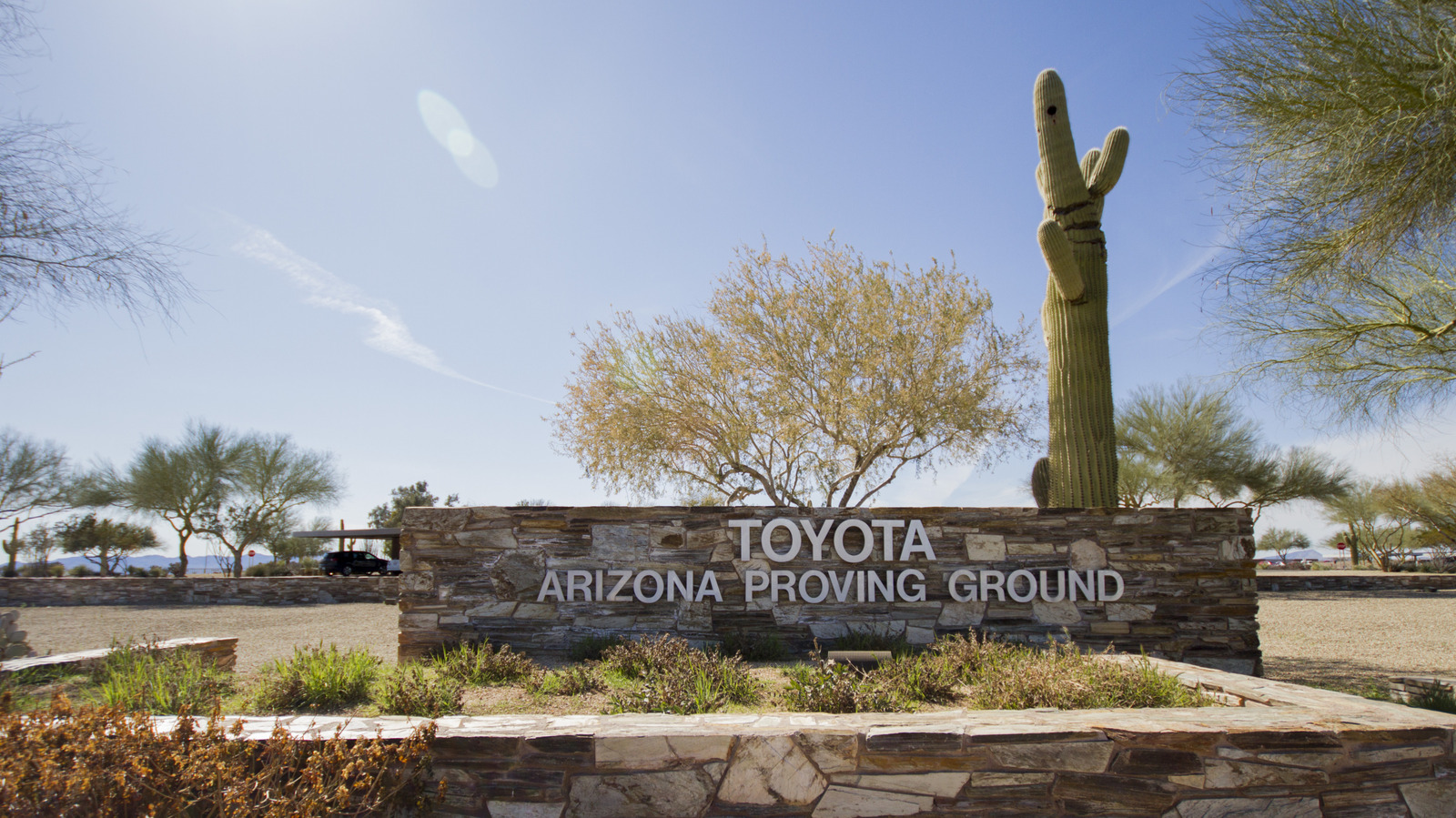
First established in 1993, the TAPG is located a little more than an hour outside Phoenix and sits on about 11,650 acres in the Sonoran Desert. Recently, Toyota poured $50 million into building it out further, adding a 5.5-mile test loop inside the preexisting 10-mile test track. It now boasts more than 60 miles of paved roads and more than 50 miles of off-road and dirt tracks, all in one facility designed to torture test Toyota’s trucks and SUVs.
If you were hoping to read about how I got to participate in the actual testing of a new vehicle or two that you haven’t seen yet, I’m sorry to disappoint. This wasn’t that kind of trip. They also took care to hide any of the truly good stuff I was hoping to see. Lucid had a couple of Air and Gravity EVs on site (that, for some reason, no one wanted to let me drive), but that was about it. No Sienna TRD Off-Road. No GR GT TRD Pro. No new Celica or MR2.
Instead, think of this trip more like a factory tour. Toyota spent a lot of money building out this proving ground, and it wanted to show it off. But the focus was more on just how much they could do with such a large campus. More of a chef’s tasting menu than a single entree that you can really dig into. And if there’s one thing it accomplished, it was showing off the massive scale of Toyota’s updated proving grounds.
That started with a tour in a Sienna, since everything was far too spread out to make walking a viable option. As much as the tour was focused on showing off different areas designed to evaluate how well a vehicle performed in all sorts of different tests, it also served to emphasize the scale of what Toyota has to work with. Back when I worked at one of the buff books, I spent a good bit of time at Hyundai’s proving ground in the Mojave Desert, since that’s where we did our car of the year testing, but that facility is only about 4,500 acres. Meanwhile, Toyota is working with more than twice that acreage and now focused more on trucks and other off-roaders than road cars.
Improving Downhill Assist Control
That doesn’t mean we didn’t learn anything aside from how massive the campus is. Among other things, my driver told us they’d originally envisioned doing more high-speed testing on the 10-mile oval but found that wasn’t really necessary — especially when you factor in how much it costs to maintain the aggressively banked turns. Apparently, in addition to the cost itself, it’s also difficult to find a company that can or is willing to do the work. So if you’re looking for a business idea, maybe consider getting into maintaining high-speed test tracks.
That said, Toyota did toss me the keys to a Tacoma a couple of times so I could see how they test features such as the Downhill Assist Control that its off-roaders offer. Again, it was more of a demonstration than anything else, but I did get to see how the new Tacoma handled a hill covered in smooth river rocks that were constantly shifting under the weight of the truck. Since you’re reading this, it didn’t end in disaster, and I also came away impressed with how much Toyota has improved DAC since I first experienced it almost a decade ago.
If you’re used to a truck creaking, grounding, and stuttering as the system figures out how to manage slip, you’ll probably be shocked by just how much quieter and smoother Toyota’s latest system is. Because it really is almost like night and day. In fact, if someone used to the current system buys an older Toyota, I wouldn’t be surprised to hear they took it to the dealer after the first time they used the old DAC, convinced something important had broken. It really is that much better.
A taste of performance driving
Toyota also let me drive a Tacoma Trailhunter on one of the trails it uses to test suspensions, which would have been a lot more fun if it had been a longer drive. I didn’t even get to jump it, which is sad, because I love jumping things. But, uh, turns out a $65,000 Tacoma is pretty good off-road. Mostly, though, it made me want to pitch Toyota on an overlanding trip so I could really see what it could do. We’ll see if that ever happens, though.
Arguably, the most fun I had was when they let me loose on a large paved surface in an Avalon (RIP) that had been lifted at the rear on rollers. Driving a tail-happy, now-dead, front-wheel-drive sedan doesn’t have much to do with off-road durability testing, but as it turns out, it’s part of the driver training program that employees have to go through before they’re approved to test vehicles.
According to one employee, they want to make sure test drivers are more skilled than they need to be, which makes sense to me. Crashes get expensive fast, especially when you’re dealing with pre-production prototypes. But you may be surprised to learn we’re talking about a lot more than a couple of days’ worth of classes, or even a week. Apparently, we’re talking about multiple weeks of driver training before you’re deemed a good enough driver to test vehicles at the proving ground.
On the one hand, it takes time to develop driving skills and build the muscle memory you need to reliably keep a car under control, so it makes sense that Toyota wouldn’t let its employees loose with little more than a weekend of driver training. But on the other hand, there goes my plan to talk Toyota into letting me participate. Although, you know, never say never. Sometimes miracles really do happen.
Behind the scenes
Ultimately, there isn’t really one big takeaway here, like there is with most press trips. We weren’t there to drive a car you haven’t driven or learn a bunch of secrets. The proving ground is massive, yes, but I can’t imagine anyone is more or less likely to buy a truck based on how large its desert proving ground is.
Still, it was fascinating to get a glimpse of the work that goes into bringing a vehicle to market. And as much as I would have loved to spend a couple of hours bombing through the desert in a Tacoma, that isn’t what they do there. It’s test after test that has to be repeatable, and that repetition is where they ultimately find the limits of every component that goes into a truck or SUV. That’s how they break things in a way that allows them to make the final product better, more reliable, and less likely to break.
So, even if you never take your Tacoma or Sequoia off-road, you still have the folks at Toyota’s Arizona Proving Ground to thank for the fact that you could. And the fact that it should hold its value better than most of its competitors. Because, without the lessons learned in the torture tests they put these vehicles through, your Toyota probably wouldn’t be nearly as dependable as it is.

