


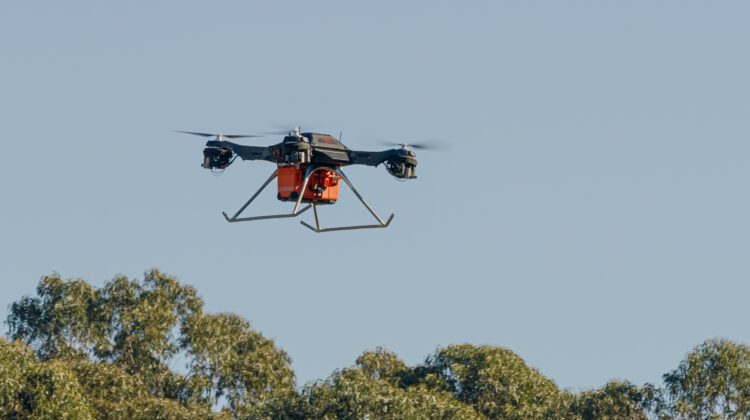
Parallel Flight Technologies has received a 49 U.S.C. §44807 exemption from the Federal Aviation Administration, authorizing domestic commercial operations of its Firefly heavy-lift UAS. The approval removes a critical regulatory barrier for the La Selva Beach, California-based company and its industrial customers.
What the FAA 44807 Exemption Means
The FAA’s Section 44807 governs unmanned aircraft systems exceeding 55 pounds at takeoff — systems that fall outside the standard Part 107 small UAS rule. Obtaining this exemption requires operators to demonstrate rigorous safety architecture, operational procedures, and system maturity before receiving authorization to fly in the National Airspace System.
“This is an important step for our team and our customers,” said Craig Stevens, CEO of Parallel Flight. “The 44807 exemption validates the safety architecture, system design, and maturity of our platform. We are ready to support customers as demand for heavy-lift, long-endurance UAS continues to grow.”
Firefly: A Group 3 Heavy-Lift UAS Built for Industry
Firefly is a U.S.-manufactured, NDAA-compliant Group 3 quadcopter designed for industrial and expeditionary missions. Two people can transport and deploy the aircraft — it fits in the back of a standard pickup truck.
At the core of the platform sits Parallel Flight’s patented Parallel Hybrid Electric Multirotor (PHEM) propulsion system. PHEM enables Firefly to carry payloads up to 100 lb (45 kg) while delivering endurance up to 10x greater than all-electric UAS of comparable size. The system also supplies 2 kW of continuous in-flight power to onboard payload systems — a meaningful advantage for sensor-heavy missions.
Five patents protect the platform. Firefly has received support from the Defense Innovation Unit (DIU), USDA, NASA, NSF, and the Office of Naval Research.
Target Applications for Commercial Heavy-Lift UAS Operations
With the exemption in place, Parallel Flight can now actively pursue commercial contracts across several demanding sectors. Target use cases include:
-
Wildland fire management — delivering heavy sensors or suppression payloads to remote terrain
-
Heavy sensor integration — powering onboard instruments continuously during extended flight
-
Industrial logistics — moving high-mass cargo in austere environments where ground vehicles cannot operate
Firefly has undergone rigorous reliability testing over several years, and the company expects to ship initial customer units this summer.
Scaling Production to Meet Demand
Parallel Flight plans to continue expanding Firefly’s approved flight envelopes while scaling production to serve growing industrial market demand. The exemption also positions the company to convert its qualified pipeline into active customer programs.
“Firefly has undergone rigorous reliability testing over the past several years,” Stevens noted, “and the company expects to begin shipping initial customer units this summer.”
More information on Parallel Flight and the Firefly is available from their website.
Read More

