


You have full access to this article via your institution.
Hello Nature readers, would you like to get this Briefing in your inbox free every day? Sign up here.

Patterns made on thin polymer films using an electron beam affect how the texture of the surface changes when exposed to water.Credit: Siddharth Doshi, Neerav Soneji, Katie Richards
Researchers have created a synthetic ‘skin’ that can change colour and texture on demand. The material can switch from matte to shiny and display a variety of other effects, before reverting to its initial state. The team used an electron beam to make a ‘landscape’ of bumps on the surface of a polymer that reversibly swells on contact with water. The bumps absorb varying amounts of water, which resulted in a material that could drastically change its appearance when wet. The flow of liquid can be controlled by covering the material with a transparent film.
Traces of toxic compounds have been found on 60,000-year-old arrowheads, providing the oldest chemical evidence that Palaeolithic hunter-gatherers used poison to bring down prey. Chemical analysis revealed a compound called buphandrine, derived from the poison bulb plant (Boophone disticha), on arrowheads discovered in KwaZulu-Natal, South Africa. The use of poisons “shows advanced planning, strategy and causal reasoning” among hunter-gatherers, says archaeologist Justin Bradfield. It also suggests that they had a complex understanding of the properties of plants, says archaeologist April Nowell.
Reference: Science Advances paper
As mpox continues to spark localized outbreaks in Africa and elsewhere, researchers are racing to understand more about the virus that has caused two public-health emergencies in the past three years. In December, a preprint study found that one mpox strain seems to lurk in the testes of infected male mice. And health officials in the United Kingdom reported that a person had been infected with a never-before-seen strain that is a mashup of two other types. “We should not underestimate what it can do if it’s allowed to become firmly entrenched in human populations and continue to adapt,” says infectious-disease physician Boghuma Titanji.
Reference: bioRxiv preprint (not peer reviewed) & UK Health Security Agency report
Features & opinion
Scientists have recovered DNA from Holy Child, a more than 500-year-old artwork that is thought to have been drawn by Leonardo da Vinci. After analysis, the team suggests that the DNA could be da Vinci’s, which hints that the artwork is in fact his, and not one of his students’. Their current findings aren’t definitive proof, but could demonstrate the promise of ‘arteomics’, an emerging technique that uses DNA and other biological traces to authenticate artworks rather than relying on expert opinion. If proven to be reliable, arteomics “doesn’t just open a new window, it opens a whole new world” for authenticating art, says chemist Stefan Simon.
Reference: bioRxiv preprint (not peer reviewed)
Last year, scientists conducted a small test of a new, controversial geoengineering technique to combat ocean acidification: pumping the strongly alkaline sodium hydroxide into the water. If kept at a normal pH, the ocean could continue to absorb carbon from the atmosphere, and marine life would be spared the devastated effects of acidification. Early results suggest the method, called ocean alkalinity enhancement, can work, with negligible effects on marine ecosystems. But tackling ocean acidification globally would require the technique to be rolled out on a huge scale, which could have far more unpredictable impacts in the long term, say some researchers.
The New York Times | 14 min read
Rather than wrangling over an ever-changing definition of ‘ultra-processed foods’ (UPFs), policymakers should draw up a universal definition of ‘non-ultra-processed foods’, argue three health-policy researchers. Using this static definition in health policies will make the regulatory decisions surrounding food products more clear-cut and prevent manufacturers from reformulating their products to avoid being designated as ultra-processed. “Instead of encouraging manufacturers to switch one ingredient for another, we need a definition that will incentivize the production and distribution of non-ultra-processed foods,” the authors write.
Image of the week

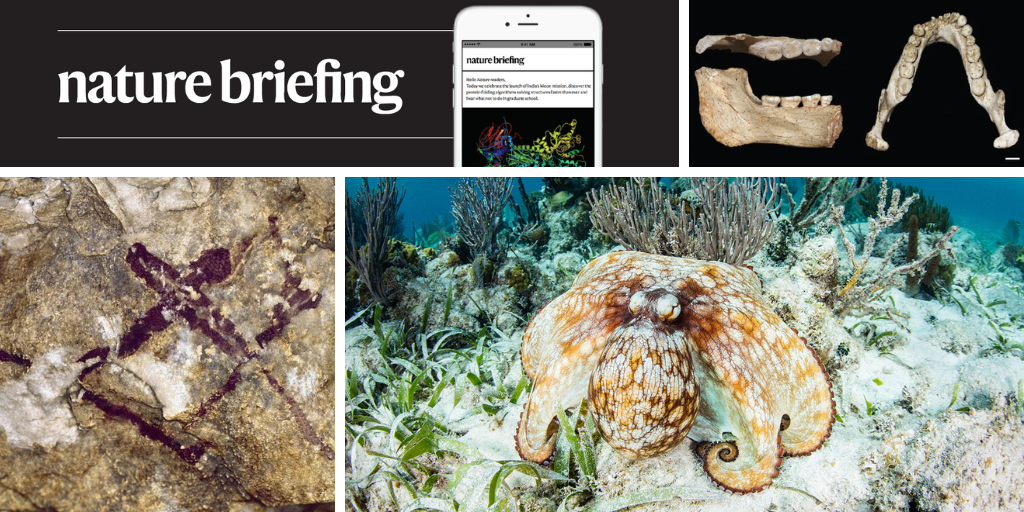
These 773,000-year-old fossils, recovered from a quarry in Morocco, could give researchers clues about the last common ancestor (LCA) — the ancient lineage we share with Neanderthals, whose exact identity has long eluded scientists. Researchers found that the fossils are similar in age to those of Homo antecessor, another proto-human species discovered in Spain, but are morphologically distinct. The age of the fossils fills a crucial gap from around 1,000,000 to 600,000 years ago in which few similar fossils have been discovered in Africa. (Nature News & Views | 7 min read)
Today I’m marvelling at footage of a giant phantom jelly (Stygiomedusa gigantea) recorded deep below the surface of the Pacific Ocean. The video, captured in December, is somewhat of a holiday miracle — the species has only been spotted around 120 times since it was discovered in 1899.
We don’t want receiving your feedback to be a rare event. Please send any thoughts you have about this newsletter to [email protected].
Thanks for reading,
Jacob Smith, associate editor, Nature Briefing
With contributions by Flora Graham
• Nature Briefing: Careers — insights, advice and award-winning journalism to help you optimize your working life
• Nature Briefing: Microbiology — the most abundant living entities on our planet — microorganisms — and the role they play in health, the environment and food systems
• Nature Briefing: Anthropocene — climate change, biodiversity, sustainability and geoengineering
• Nature Briefing: AI & Robotics — 100% written by humans, of course
• Nature Briefing: Cancer — a weekly newsletter written with cancer researchers in mind
• Nature Briefing: Translational Research — covers biotechnology, drug discovery and pharma

