


The importance of tides is embodied in the origins of the word ‘estuary’, which comes from the Latin word ‘aestuarium’, meaning the place of the tide. Along coastlines, where tides are typically magnified11, they profoundly affect navigation, commerce, coastal flooding, water properties and sediment transport12. Tides impact the flooding of rivers and, thus, influence the extent of their floodplain, which has cascading effects on biogeochemical and ecological processes13. Flood cycles, modulated by tides and sea-level rises, are a key factor in the dieback or persistence of saltmarsh systems14. Tidal flooding also accelerates both nitrification and denitrification in soils, leading to variable effects on nutrient levels and coastal water quality15,16. Tides enhance the mixing of saline and freshwater along river channels, which affects water security in coastal cities and food security for agricultural deltas that use river water for irrigation17. Moreover, tides are a critical factor in compound coastal flooding, as demonstrated by the devastating combination of storm surge and high tide that hit New York City during Hurricane Sandy in 201218. Despite their importance, the extent of tides in coastal rivers is poorly known on a global scale because tidal propagation depends on the unique morphologic and hydrologic conditions of each river as well as the magnitude of the tidal signal at the river mouth19. The relative importance of these controls on tidal extent—indeed, the extent itself—has not been unravelled on a global scale, primarily due to limitations of observational coverage.
The combination of numerical modelling and satellite altimetry20 now gives us the ability to predict tidal elevations anywhere in the open ocean with accuracies approaching 1 cm (ref. 21). However, coastal regions and connected inland water bodies remain the Achilles heel for tidal prediction6. The challenge largely stems from two constraints of traditional nadir altimetry: land contamination of radar returns and inadequate density of satellite overpasses. Moreover, nonlinear effects of the shallow water in rivers and estuaries drive complex tidal behaviours22,23, which are best described with physics-based models. Yet adequately resolved models exist only for a handful of locations, owing to the scarcity of bathymetric and water-level data to constrain models and the complexity of the dynamics, which vary from river to river19,24,25.
The highly anticipated Surface Water and Ocean Topography (SWOT) satellite provides two-dimensional swath observations of both ocean and inland water surfaces26. SWOT has the potential to revolutionize the scientific understanding of water-related physical processes27 and to open new avenues of scientific research across the land–ocean–aquatic continuum28,29. Early studies have shown that SWOT can improve the accuracy of tidal estimates in coastal regions, and they have hinted at the potential of using these data to study tidal processes within inland water bodies, including rivers30,31.
The question then becomes, can SWOT be used to pioneer a deeper understanding of tidal dynamics within coastal rivers worldwide? If so, could these insights support the creation of the first-ever global atlas of tidal extent within rivers? By exploiting the observational capabilities of SWOT at the land–ocean interface, we address both these questions and produce a global atlas of tidal rivers, which could radically expand our understanding of the fundamental tidal force that controls land–ocean interactions.
Observing river tides from space
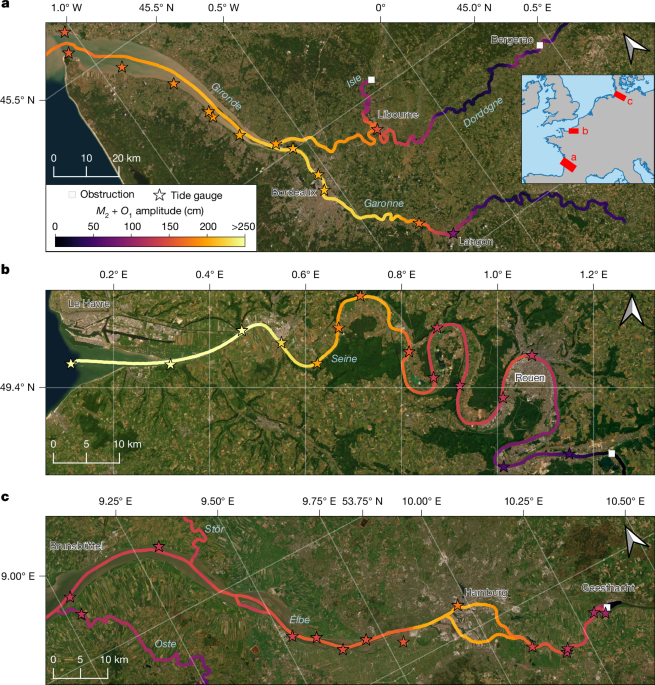
To assess the feasibility of using SWOT data to estimate tides within rivers, we conducted a harmonic analysis on the SWOT River Single-Pass Vector Data Product (RiverSP) from March 2023 to May 2025 to estimate the diurnal O1 and semi-diurnal M2 tidal constituents for all observed rivers. Global amplitude results are available at the Database for Hydrological Time Series of Inland Waters (DAHITI): https://dahiti.dgfi.tum.de/en/products/river-tides/map/. Selected rivers are presented in Fig. 1.

a–c, The three selected regions are the Gironde Estuary (a), the Seine River (b) and the Elbe River (c). Stars with black borders along the trajectory of the rivers represent the summed M2 and O1 amplitude calculated from in situ river gauge observations. The white squares mark the location of dams. Satellite base maps powered by Esri.
We validated our tidal amplitude estimates from SWOT data using records from 622 globally distributed, in situ tide and river gauge stations. Median and mean amplitude differences for the 622 sites were only 5.53 cm and 9.23 cm for M2 and 3.23 cm and 5.75 cm for O1. In Fig. 2 we present a scatter plot of both SWOT and tide gauge estimates for both constituents, as well as the median error as a function of distance to river mouth. Additionally, we present the respective tide gauge amplitude errors in Fig. 3 for M2. The error for O1 is in Extended Data Fig. 1. We observe errors ranging between 0 cm and 30 cm across the globe, with the largest errors being observed at higher latitudes, where the effects of sea ice may influence the estimates. Amplitude errors of both constituents consistently increase the further upstream the observations are made (Fig. 2), which is expected due to the decreasing signal-to-noise ratio as tidal amplitudes diminish19.

a,b, Scatter of M2 (a) and O1 (b) amplitude estimates from tide gauges (x-axis) and SWOT observations (y-axis). c, The median error as a function of distance to the river mouth. d, The number of in situ observations used in the distance to mouth bins.

a–d, Regional zooms are provided into the west coast (a) and east coast (b) of the USA, the northern coastline of Europe (c) and the coast of Japan (d). The error for O1 can be found in Extended Data Fig. 1. Base map from Natural Earth.
The expectation, particularly with the current length of the SWOT time series, is that the M2 tidal component can be estimated with better relative accuracy due to its large amplitude. For context, based on in situ observations, M2 is on average 5.5 times larger than the O1 tide. Although retrieval of the O1 signal is possible from an aliasing perspective, its estimates are potentially more influenced by noise contributions from other (non-tidal) processes. Indeed, the M2 tidal component has a median error of 15% whereas O1 has a median error of 58%. Compared with the apparent 68th percentile error of individual SWOT water surface elevations (WSEs) at the reach scale (10 cm to 18 cm)32, tidal amplitude estimates are highly accurate, especially considering the potential for uncertainties due to aliasing, which will only diminish as the SWOT record grows with time. These results confirm the possibility of deriving tides from RiverSP.
SWOT has orbited in two phases: (1) calibration and validation (Cal/Val) orbits and (2) science orbits. Some RiverSP nodes contain data from both types of orbit by the satellite. The Cal/Val phase of the satellite allowed the retrieval of tidal constituents using very few observations based on tidal aliasing with relatively high levels of accuracy30. The median amplitude errors in reaches that contain both Cal/Val and science orbit observations are 5.74 cm and 4.28 cm for M2 and O1, respectively, whereas the errors are 5.54 cm and 3.29 cm when using only the science orbits. These differences between the median amplitude errors indicate that, although the combined Cal/Val and science orbits provide more observations, the results derived from RiverSP data from the science orbits alone are comparable with those combined with the Cal/Val orbits. An important caveat is that the Cal/Val phase does not provide a global perspective, as only 73 river tide reaches with in situ tide gauge measurements were covered, compared with the full dataset with 622 tide gauges.
The fidelity and unprecedented resolution of river tides from SWOT are evident in the dominant M2 amplitude along three well-gauged rivers: the Gironde, Seine and Elbe Rivers (Fig. 1). The three selected rivers are sixth-order rivers33,34 with a mean annual discharge around 500 m3 s−1 (refs. 35,36), and they have slopes between 10 mm km−1 and 60 mm km−1 over the studied sections37. The M2 signal clearly persists over long distances in all three rivers. For example, the Elbe River has amplitudes greater than 50 cm at a distance more than 100 km upstream of the river mouth (Fig. 1c). Interestingly, the tidal amplitude in the Elbe River increases upstream of the river mouth near Hamburg in both the SWOT estimates and the tide gauge data. This amplification is well documented and is a result of the convergence of river branches upstream of the river mouth38. Another example of complex tidal variations is evident in the Seine River (Fig. 1b). The tidal amplitude slowly decreases from the mouth, increases again in the meanders further upstream and then declines sharply near a dam, which coincides with the in situ observations. These tidal amplitudes demonstrate the complexity of the propagation of tidal waves in channelized water bodies and the need for observational approaches that can be coupled with tide modelling strategies.
A direct comparison between the reconstructed water levels from SWOT and in situ observations from these three rivers further illustrates the fidelity of the SWOT analysis (Extended Data Fig. 2). We selected four gauges and associated SWOT time series where we have a combination of Cal/Val and science orbit data as well as profiles classified as ‘tidal’, ‘likely tidal’ and ‘not tidal’ (these classifications are described in Methods). Using the appropriate tidal amplitudes and phases, we derived estimates of tidal height and compared these against the tide gauge and raw RiverSP time series. Two of the three profiles, identified as tidal, match reasonably well for all three time series, indicating a clear dominance of the ocean tides in these regions. In the likely tidal region, the tidal signal is still observable, but this time series is more influenced by non-tidal effects. In the not tidal series, no substantial tidal variability is observed or calculated from our dataset. This comparison exemplifies the importance of the new SWOT dataset for estimating tidal heights, which can be used in combination with ground-based data to help understand the role of tides on local river processes or to correct time series to study non-tidal processes.
The analysis of the Seine and Elbe Rivers also illustrates the effects of dams (white squares in Fig. 1). Tidal amplitudes before the dams exceed 50 cm in both regions, whereas the tidal amplitudes upstream of the dams are below our detection limit of 10 cm. The Garonne River within the Gironde Estuary (Fig. 1a) is unique as it does not contain an obstacle affecting the tidal extent. The tidal amplitude naturally dissipates to below 10 cm at approximately 230 km from the mouth upstream of Langon due to friction with the riverbed19.
Global classification of tidal rivers
Worldwide, we studied 51,627 river branches and identified more than 165,000 km of river extent that contain the pulse of the tide (Fig. 4). The rivers are classified as tidal, likely tidal, likely not tidal and not tidal (Methods). Tides are shown to extend for hundreds of kilometres in many of the world’s rivers and are particularly evident in the Hudson River (Fig. 4a), Amazon River (Fig. 4b) and Yangtze River (Fig. 4e). The Amazon River is an extremely complex river system and is well known to be influenced by ocean tides39. In situ measurements within the Amazon show tidal amplitudes exceeding 10 cm over large sections40, with the M2 amplitude dropping to 2.3 cm near the Óbidos region, about 892 km upstream of the river mouth. Our automatic approach determined that the tide within the Amazon stops between the Santarém and Prainha regions. This correlates with the tide gauge results40, which show that the tidal amplitude drops below 10 cm in the same region. This result demonstrates the suitability of this approach and the RiverSP data in determining tidal extents, even in complicated river systems with extensive floodplains, dense vegetation and branching channel networks.

a–e, Rivers were divided into four classes (tidal, likely tidal, likely not tidal and not tidal), as described in Methods. Only the first three classes are plotted. An interactive map version is available at https://dahiti.dgfi.tum.de/en/products/river-tides/map/. Open-ocean tidal ranges were extracted from the EOT20 empirical tide model6. Red dots mark principal cities. Regional zooms are presented in the east coast of the USA (a), the northeast Brazilian coast (b), the northern coastline of Europe (c), part of south east Asia (d), and part of eastern China (e). Base map from Natural Earth.
Within the European region (Fig. 4c), tidal rivers are more pervasive and longer in the north-western part of the continent than in the southern and eastern parts, consistent with the larger tidal ranges in the Irish Sea, English Channel, North Sea and the Bay of Biscay compared with the Baltic Sea, Mediterranean and Skagerrak Channel. Notably, the estimated tidal likelihood, which is based on a set of threshold conditions, is reduced in Dutch rivers compared with French, British and German rivers due to the considerable effort by the Dutch government to implement flood protection methods, like barriers and dykes, along the coastline to reduce the impact of sea-level rise41. The sensor capability of SWOT limits observations to rivers with widths of at least 30–90 m. This results in the undersampling of smaller streams in our analysis. For comparison, Tagestad et al.7 used static river elevation profiles to infer that 106,000 km of tidal rivers may exist in the contiguous USA alone, over half of which are small streams (first and second order). Although our estimated 165,000 km of tidal and likely tidal rivers is conservative, the analysis provides a record of tidal dynamics in thousands of ungauged coastal rivers worldwide.
For the 3,172 tidal and likely tidal river systems with sufficient data in the SWOT River Database (SWORD), we examined the relations between the tidal extent and the hydraulic and morphologic characteristics of the river system. Tidal extent was estimated as the distance from the tidal river mouth to the farthest head of tides in any of its upstream tributaries. We also estimated the amplitude of ocean tides at the mouth as defined by RiverSP, the river width at the mouth, the average slope of the mean WSE of the tidal river from river mouth to head of tides, and the Strahler stream order at the mouth (a measure of the size of the river network, where larger numbers indicate exponentially more upstream confluences) based on the MERIT-Basins dataset34 (Fig. 5). Overall, the largest rivers, like the Mississippi, Amazon and Nile (Strahler stream orders over 7), have a median likely tidal extent of 161 km, whereas the smallest rivers (Strahler orders under 3) have a median likely tidal extent of only 13 km (Fig. 5a). Within a given Strahler classification, tidal extents vary broadly due to the unique characteristics of each river. The tidal amplitude at the river mouth and slope both exert important controls, as bigger ocean tides propagate farther along low-gradient rivers42,43 (Fig. 5b,c). For example, the median likely tidal extent in rivers with a slope of over 400 mm km−1 is only 10 km, whereas the median likely extent in rivers with a slope of under 25 mm km−1 is 44 km (Fig. 5c). The interaction of the tidal wave with steep gradients causes a faster dissipation of the tidal energy. Similarly, narrower channels also dissipate tidal energy over shorter distances. The median likely tidal extent is 67 km for river mouths wider than 1,000 m but only 17 km for river mouth widths under 125 m (Fig. 5d).

a–d, Cumulative density functions of tidal extent per estuary grouped by tidal likelihood and Strahler stream size (a), tidal amplitude at the river mouth (b), average tidal river slope (c) and river mouth width (d) obtained from SWORD. Tidal extent was determined as the distance along the river from its mouth to the farthest head of tides in any of its tributaries.
Across the entire global catalogue of tidal rivers, the extent of tidal influence scales roughly with Strahler order and, to a lesser degree, slope and river mouth amplitude (Extended Data Fig. 3). It is somewhat surprising that these network-scale river characteristics account for much of the global variability in tidal extent across small to large rivers. Much of the remaining variation arises from local complexities in tidal wave propagation, which depend on changes in slope and river width and the partitioning of flow between branching channels19. Interestingly, within our global assessment, the investigated rivers exhibit complex tidal characteristics, like upstream amplification, which occurs in approximately 25% of tidal rivers, including the Elbe and the Gironde (Fig. 1). Despite these local complexities, the general relation between tidal extent and easily measured river characteristics, like Strahler order, reveals an underlying self-similarity among tidally influenced rivers. This result highlights the utility of observing patterns in tidal propagation in rivers globally based on SWOT wide-swath measurements.
River regulation and management also have a profound impact on tidal extent. Based on a comparison of our tidal river atlas and the database of dams and other river obstructions built into SWORD, 16% of the observed estuaries have an artificial or natural structure that limits the tidal extent (Extended Data Fig. 4). For comparison, approximately half of all rivers globally (both inland and coastal) have diminished connectivity due to dams and other structures10.
Many of the known obstructions lie in the interior of river basins within the likely tidal or likely not tidal classes, where the tidal signal is less prominent. Tides in the smallest (first order) and largest (eighth to ninth order) rivers are relatively unimpeded, whereas tides in rivers of intermediate size are more typically impeded. There may be practical reasons why the largest rivers seem to have disproportionately fewer obstructions near the coast: structures that impede tides would also tend to restrict traffic along these important trade routes. Meanwhile, in small streams, impoundments may be less commonplace and also more difficult to detect where they do exist. For all obstructed tidal rivers, the mean amplitude immediately downstream of the obstruction is 54 cm. In some rivers, such as the Elbe River (Fig. 1c), the tidal amplitude immediately downstream exceeds 100 cm. These changes in tidal amplitude indicate abrupt human-driven changes in the hydrology and connectivity of coastal rivers, particularly those of moderate size.
Implications for tidal rivers
The observation of tides has wide implications across the land–ocean–aquatic continuum and opens new doors in the study of coastal processes, including the analysis of extreme flows in sparsely gauged coastal rivers. As an example, we performed an analysis of extreme high and low flows on the Congo River near the west coast of Africa using a 15-year dataset of remotely sensed water levels from DAHITI (see Methods for more details). One challenge of the nadir-altimetry-based DAHITI record is its relatively low sample frequency and inconsistent timing with respect to river tides, which obscure the assessment of flood severity and timing. To address this challenge, we corrected the coastal Congo water-level record for tides using amplitude and phase information derived from SWOT (Fig. 6) and then identified the three highest and lowest water-level events in the corrected and uncorrected time series for comparison. In the uncorrected data, three extremely low flow events and two extremely high flow events were sampled at low tide and high tide, respectively. A correction for the tides indicates that more extreme events occurred within the record (July 2024 and December 2014). Moreover, a well-documented flood in December 2023 caused by heavy rainfall upstream of the Congo River44 was identified as an extreme event in both records, but the timing of the peak was obscured by tides. The corrected time series identifies the peak 2 weeks earlier (23 December 2023) than the uncorrected time series, which correlates better with the documented flooding in the region. SWOT, thus, opens new pathways for improving the observation of historical floods and droughts and for determining their recurrence statistics along tidally influenced rivers like the Congo.

a–d, A time series of satellite observations from DAHITI (purple lines). The tidal height is derived based on SWOT observations (grey lines), with this applied to the DAHITI time series to correct the M2 and O1 contributions (red). An extreme analysis was used to identify extreme low (dashed) and extreme high (solid) water levels based on uncorrected (purple) and corrected (red) time series. In places where both purple and red are present, the colour of the bars is indigo. Panel a presents the full time-series, while panels b–d are focused zooms into identified extreme water events.
By combining SWOT observations with river discharge or water quality information, SWOT also creates opportunities to monitor and predict saltwater intrusion in coastal rivers. Saltwater intrusion is increasing in frequency due to intense water withdrawals and drought in a changing climate45. Saltwater intrusion threatens the drinking water supplies for large cities, irrigated agriculture and industries that depend on fresh water. Tidal signals from SWOT are critical inputs for the development of new hydrodynamic models and artificial intelligence algorithms that can help predict and manage saltwater intrusion in sparsely instrumented rivers.
Compared to worldwide population statistics46, we determine that approximately 10% of the global population, or 715 million people, live within 10 km of a tidal-influenced river. For comparison, Edmonds et al.8 estimated that approximately 340 million people live in river deltas, and global studies indicate that approximately 1 billion people live within 10 km of a coast47. Globally, 110,410 km2 of agricultural cropland, or 2.5% of the global total in the Copernicus landcover data48, lies within 3 km of a tidal-influenced river and is probably affected by ocean tides, which highlights the potential implications for cropland flooding, saltwater intrusion and landscape change as sea levels rise. Given the threats to freshwater resources in these valuable tidal waterways45, SWOT provides a powerful dataset that can be used to understand water and food security for large portions of the global population.

