


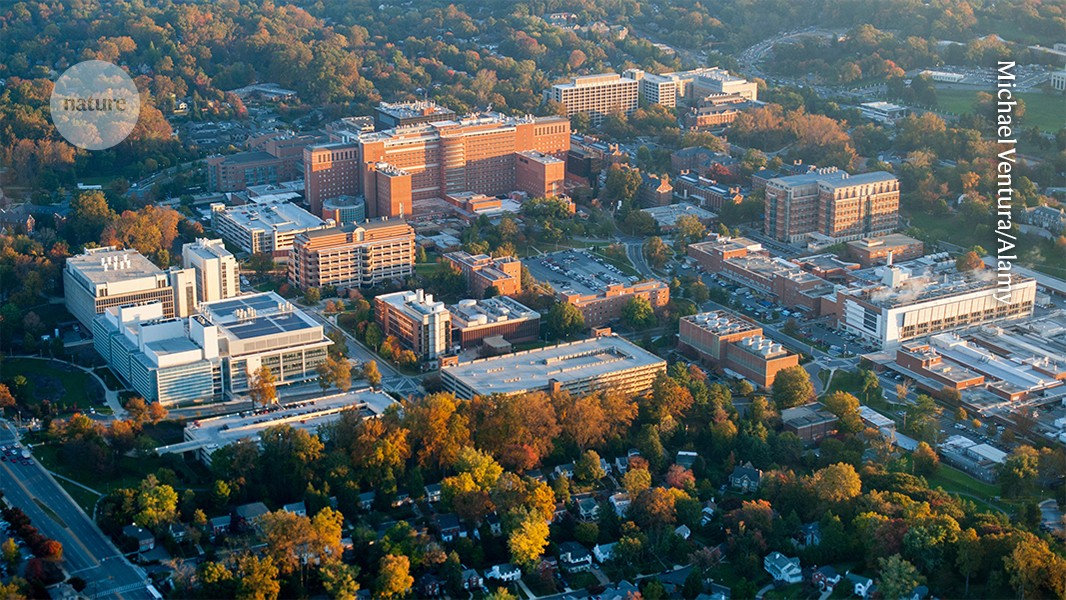

The main campus of the US National Institutes of Health is located in Bethesda, Maryland.Credit: Michael Ventura/Alamy
A striking change in how the world’s largest biomedical funding agency solicits research proposals has sparked debate about how it should fund science.

US science after a year of Trump: what has been lost and what remains
For decades, the US National Institutes of Health (NIH) has funded a significant chunk of its grants by asking researchers to submit proposals that address specific scientific problems that the agency’s specialists deemed important. But in the past year, the agency — under new leadership since the return of US President Donald Trump to office in January 2025 — has sharply cut the number of these ‘solicited’ calls for funding, and instead directed the agency to increase its spending on ‘unsolicited’ research proposals driven by individual scientists’ interests.
This move, the NIH has said, will save the agency money on managing all of its funding calls — otherwise known as ‘notices of funding opportunities’ — while also offering scientists more flexibility to choose the direction of their investigations, a change that some researchers welcome.
But others worry that this will mean fewer large, special collaborative projects that require agency coordination — for instance, initiatives such as the Human Genome Project or multi-laboratory clinical trials — that have often been financed through specialized funding calls and cannot be initiated by any one investigator or group. And NIH employees told Nature that the change could widen knowledge gaps in understudied areas of science, such as rare and neglected diseases.
White House stalls release of approved US science budgets
The change in strategy has also contributed to funding delays this year because the Trump administration officials have been scrutinizing all funding calls before they are issued by the NIH, to make sure they align with the administration’s priorities. Agency staff members say that some of these delayed calls are for programmes and research areas, such as diabetes, that the US Congress has directed the NIH to fund.
The reduction in the number of specific funding calls has been “striking”, says Michael Lauer, who for about ten years ran the NIH’s extramural research programme, which financially supports researchers at institutions across the United States. “There are certain projects that are clearly worthwhile that can’t be done with unsolicited proposals,” he says. But he adds that the precise balance of how many applications should be funded through unsolicited calls versus solicited calls is open to debate.
The NIH did not respond to Nature’s queries about the changes to the funding scheme or the delays in posting funding calls. But a website for the NIH says that broad, unsolicited funding calls are “a proven, efficient model”. It adds: “Our intent is to reduce the number [sic] opportunity announcements without reducing an applicant’s opportunity to submit investigator-initiated applications to NIH.”
Calling all researchers
Under previous presidential administrations, funding calls were approved by advisory councils composed of independent scientists at 24 of the NIH’s institutes and centres. But in changes introduced under the second Trump administration, the calls must also be approved by the leadership of the NIH; its parent agency, the US Department of Health and Human Services; and the White House budget office, say NIH employees who spoke to Nature on the condition of anonymity to protect their jobs.
This lengthy review process means that some projects requiring ‘requests for applications’ (RFAs) — specialized funding calls — are now stalled. The NIH employees say that some RFAs, for example, calls for type 1 diabetes research, have been pending approval for months.

Source: Data from grants.nih.gov
This stricter scrutiny, plus the move towards broader funding calls, has caused the total number of calls by the NIH to plummet over the past year (see ‘Funding calls plummet’). Between 2016 and 2024, the agency annually issued about 780 funding calls on average — around 400 of which were RFAs. In the year after Trump took office on 20 January 2025, the NIH issued 73 funding calls — which is only about 10% of the average of the previous 13 years. Preliminary data for 2026 suggest that the frequency of funding calls has slowed even further: the agency has released only 11 calls since 21 January.
There is about a year-long delay between when funding calls are posted and when grants are awarded to researchers, so the full impact of the strategy change on how much funding is distributed and to what projects is still unclear. But a Nature analysis reveals that last year, the agency, which has a US$47-billion budget, devoted about 18% of the funds it normally spends on new research and training to projects submitted under RFAs, compared with an average of about 25% in the previous ten years.

