


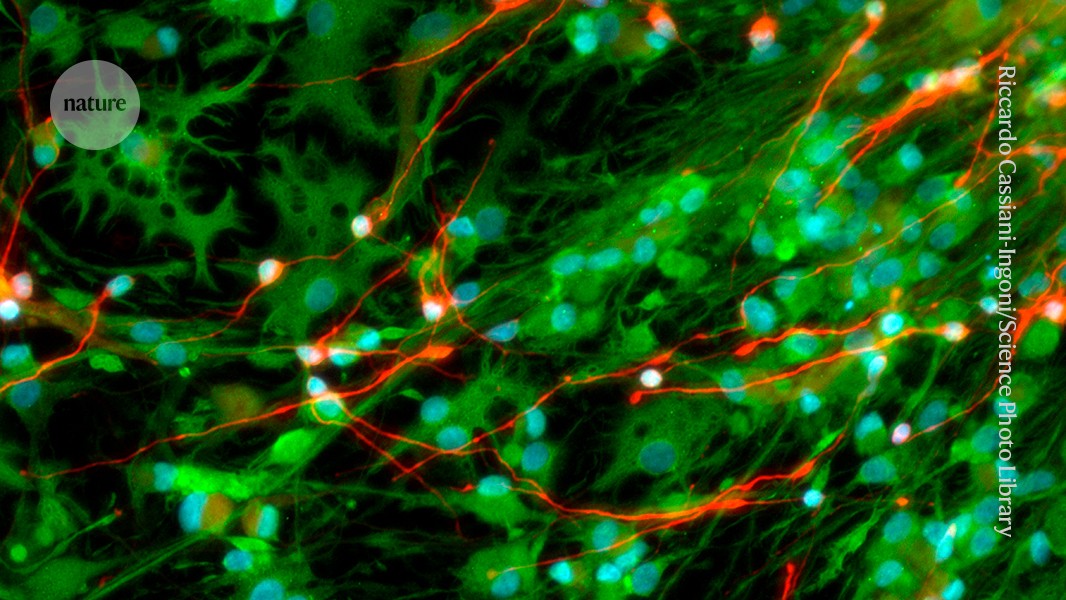

Research on fetal tissue (pictured, fetal neurons) from elective abortions will no longer be funded by the US National Institutes of Health. Credit: Riccardo Cassiani-Ingoni/Science Photo Library
The world’s largest public funder of biomedical research will no longer support studies that use human fetal tissue derived from elective abortions.
The US National Institutes of Health (NIH) will continue to fund research on fetal tissue from miscarriages and stillbirths, according to an announcement made on 22 January. But researchers say the new restrictions, which were applauded by opponents of abortion, will make it more difficult to study fetal development and stem cell biology, and will slow the hunt for new medical treatments.
“It’s clearly a political decision, not a scientific one,” says Lawrence Goldstein, a neuroscientist at the University of California, San Diego.
How Trump 2.0 is slashing NIH-backed research — in charts
But it is also not a dead end for all such research, he adds: some scientists will turn to a much smaller pool of private funding in lieu of government grants. “Research is going to go ahead, [the decision is] just slowing it down,” Goldstein says.
The NIH says that it funded 77 projects involving human fetal tissue in the fiscal year that began in September 2023, and that researchers can harness recent technological advances in alternative methods, such as computational biology and three-dimensional cell cultures, to conduct their studies.
Goldstein says that not all research can be done using alternative methods. “If you want to make fetal kidney cell types for further development for a disease study, you have to have actual fetal kidney to compare the stuff you made,” he says. “To not realize that reflects a complete lack of understanding of the field.”
A researcher who had a grant in fiscal year 2024 that included a proposal for fetal-tissue research echoes Goldstein. Steven Finkbeiner, a neurologist at the University of California, San Francisco, says his team uses stem cells to study Alzheimer’s disease. “The human fetal tissue work is also critical because it remains the gold standard,” he says. Stem cells are useful, “but it remains very difficult to fully recapitulate the complexity of human tissue.”
The NIH did not immediately respond to a request for comment.
The agency also suggested that it might be considering future changes to funding for some stem cell research. “NIH will soon seek public comment on the robustness of emerging biotechnologies to reduce or potentially replace reliance on human embryonic stem cells,” NIH director Jayanta Bhattacharya said in a statement.
Changes of course
The policy shift is the latest salvo in a long-running political battle over the funding of fetal tissue research. In 2019, during US President Donald Trump’s first term in office, the NIH halted fetal tissue research by federal scientists and placed restrictions on grants to academics in the field. Those changes were reversed two years later, after Trump left office.

