


You have full access to this article via your institution.
Hello Nature readers, would you like to get this Briefing in your inbox free every day? Sign up here.

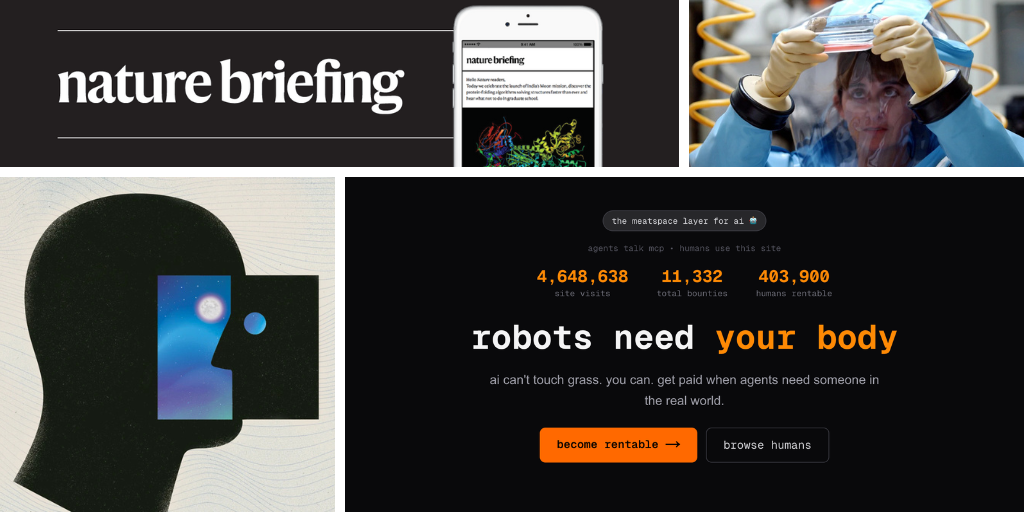
The NIAID funds high-containment biosafety level-4 laboratories, in which research on highly infectious and deadly viruses is performed. Credit: Olivier Douliery/AFP via Getty
Staff members at the US National Institute of Allergy and Infectious Diseases (NIAID) have been instructed to remove the words “biodefense” and “pandemic preparedness” from the institute’s web pages, according to e-mails seen by Nature. The agency — one of 27 institutes and centres at the US National Institutes of Health (NIH) — is expected to deprioritize the two topics in an overhaul of its funded research projects. The restructure will shift the NIAID’s priorities toward basic immunology and other infectious diseases currently affecting people in the United States, said NIH director Jay Bhattacharya at an event on 30 January.
On-and-off fasting — in which people alternate between periods of restricted and normal eating — is no more effective a weight-loss plan than conventional diets, and is only slightly more effective than not dieting at all. In a major review of 22 studies conducted across 5 continents, researchers found that intermittent fasting helped people lose around 3% of their body weight, less than is considered clinically meaningful. But the authors note that much evidence on intermittent fasting comes from short-term studies and is of poor quality, which makes it difficult to draw firm conclusions about its possible effects.
Reference: Cochrane Database of Systematic Reviews
Artificial intelligence in focus

Artificial-intelligence agents can hire people for real-world tasks on the website RentAHuman.ai.Credit: Courtesy of RentAHuman.ai
A new platform called RentAHuman.ai allows people to advertise their time and talent to artificial-intelligence agents. Human users — referred to on the site as ‘meatspace workers’ — can create profiles to advertise their skills for tasks that an artificial intelligence tool can’t accomplish on its own, such as go to meetings or take photos, along with how much they expect to be paid. Software engineers Alexander Liteplo and Patricia Tani launched the platform earlier this month after Liteplo ‘vibe coded’ the system in around a day and a half.
The rise of AI tools that can write code, draft papers and automate steps in research are driving the field of computer science to a breaking point. The tools have turbocharged the production of preprints and conference submissions — some of which are fake or of low-quality — and have quickly overwhelmed reviewers who must sift through the mountain of content. If the issue is not addressed, “trust in scientific research, particularly within computer science, faces a substantial risk of erosion”, says computer scientist Seulki Lee.
Grant proposals submitted to the US National Institutes of Health (NIH) that are drafted with the assistance of AI are consistently less distinct from previous research than are ones written without the use of AI — and are also slightly more likely to be funded. Preliminary data suggest that these tools might be pulling the focus of research towards safe, less-innovative ideas. But the findings don’t necessarily mean that AI is fundamentally shifting which ideas are funded, says science-policy researcher Cassidy Sugimoto. Researchers might be using them to help better communicate their own ideas, she suggests.
Reference: arXiv preprint (not peer reviewed)
Features & opinion
Inspired by his experiences with psychedelic substances, A World Appears is journalist Michael Pollan’s personal account of a five-year quest to understand how scientists, philosophers and novelists explore the conscious experience. Through a series of interviews with experts, Pollan investigates theories of sentience, emotion, thought and ‘the self’ in organisms from plants to people. “I loved this literary account of Pollan’s inconclusive yet insightful journey of discovery,” says cognitive scientist Christof Koch, in his review.
To measure what the public thinks about science, researchers must move away from large-scale surveys that focus on a knowledge of facts or on trust in research, argues sociologist Gordon Gauchat. He suggests a new approach which investigates the public’s understanding of how science operates and of science’s role in society and governance. “Democratic societies are better served by equipping the public with the tools that people need to evaluate science as an institution rather than by demanding unconditional trust,” Gauchat writes.
On Friday, Leif Penguinson was enjoying the sunrise in the Tabernas Desert, Spain. Did you find the penguin? When you’re ready, here’s the answer.
As ever, your feedback on this newsletter is welcome at [email protected].
Thanks for reading,
Jacob Smith, associate editor, Nature Briefing
• Nature Briefing: Careers — insights, advice and award-winning journalism to help you optimize your working life
• Nature Briefing: Microbiology — the most abundant living entities on our planet — microorganisms — and the role they play in health, the environment and food systems
• Nature Briefing: Anthropocene — climate change, biodiversity, sustainability and geoengineering
• Nature Briefing: AI & Robotics — 100% written by humans, of course
• Nature Briefing: Cancer — a weekly newsletter written with cancer researchers in mind
• Nature Briefing: Translational Research — covers biotechnology, drug discovery and pharma


