


By Dronelife Features Editor Jim Magill
A start-up Houston-based drone and software developer is aiming to serve a large looming market demand for drone infrastructure inspections, which could one day grow to involve tens of thousands of UAV flights every day.
Horizon Aerobotics, which recently emerged from stealth mode to begin commercial operations, has targeted railyard inspectors as its initial avenue for growth, leaders of the company said in an interview with DroneLife.
“One of the things that … has surprised us, is just how much demand there appears to actually be out there when you start talking to these types of enterprises, critical infrastructure operators,” Denver Hopkins, the company’s CEO and co-founder, said.
Hopkins said that one of Horizon Aerobics’ largest railroad customers envisions a future in which drones fly 24 hours a day conducting inspections of the company’s multiple railyards across the country. The potential demand from just two major railroads would call for 9,000 daily drone flights, double the number of flights that United Airlines oversees in a day, he said.
“They know what that would cost, and they mean it because the alternative to them is much more expensive,” Hopkins said. “And there’re so many other customers of similar scale out there.”
Hopkins, a licensed pilot and self-described “serial entrepreneur” with a background in software development, was looking for his next big business development opportunity, when he started a conversation with Nick Sammons, Horizon Aerobotics’ co-founder who currently serves as vice president of flight operations.
Two years ago, Sammons, retired from the Air Force where he had served as a pilot, flying fixed-wing cargo planes. There he worked with the Air Force’s drone program, which operated MQ1 and MQ-9 drones, commonly used in surveillance and combat missions. He also served in the Texas Air National Guard where he flew drones as well as a fixed-wing, counter-drug aircraft.
The two men discussed what the combination of artificial intelligence (AI) tools, rapidly developing UAS technology and an aviation regulatory environment on the precipice of significant change would mean for the future of the drone industry, and decided to form a company to be on the cutting edge of that future.
“With him coming from that military operations background, and I, coming from an AI product background at IBM, we thought the two together would be a very exciting combination. Those things together create something wholly new that hasn’t existed at maturity, ever at this point,” Hopkins said.
“Denver and I were having a conversation a number of years ago, projecting forward as to what the drone industry on the commercial side was going to be,” Sammons said. Given the regulatory environment at the time, creating a commercial drone industry to operate at scale would have been very difficult.
“It was a very limited scope of visual line of sight only,” he said. In addition, many-to-one operations, in which a single operator would be responsible for the flight of multiple drones, was impossible. The two future colleagues realized that the FAA would inevitably move toward a system allowing regular BVLOS flights, which would help usher in a new era of tremendous growth for the commercial drone industry.
“That’s what drove us to begin this company with the vision of really skating to where the puck was going to be, in relation to customer need and in relation to the FAA’s appetite and ability to support the technology as well,” Sammons said.
Railyards Future of Drones in Infrastructure
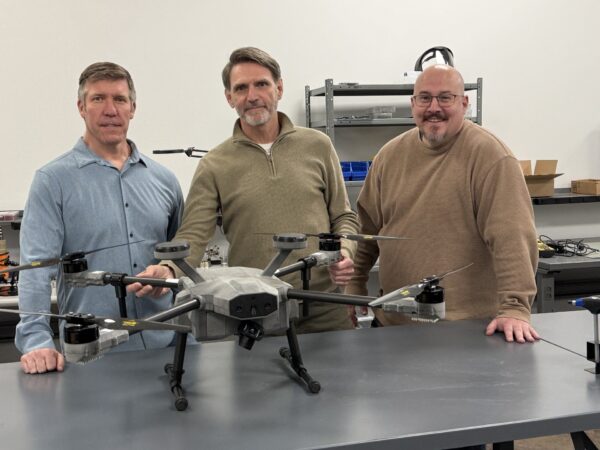
In its early days, Horizon Aerobotics focused on designing and building the tools that it would need to begin providing inspection services to infrastructure customers. The company developed its own drone and dock, and crafted its products through a number of iterations.
“For the last year and a half, we have been really heads-down, doing the engineering work and building the foundations of the infrastructure,” Hopkins said. “Sometimes I’d remind our team, ‘Guys, this is just table stakes. This is not really what we exist to do. This is so we can get started.’”
The company then began launching pilot programs with potential customers, all Fortune 100 customers. The largest pilot program to date has involved inspecting railyards for Norfolk Southern railroad. “We’re wrapping that up in the June-July timeframe, which is just about the time we’ll start the next one,” Hopkins said.
In the program, Horizon Aerobotics uses its drones and machine-learning models to spot the potential causes of derailments — an all-too common problem in massive and busy railyards — and solve the problem before it starts. The railroad has identified the root causes responsible for 70% derailments “and we can see those in real time while flying a railyard,” Hopkins said.
“Our focus is on site-specific projects, say a rail yard that is five to six miles across.” It’s in these railyards, where cars are coupled with one another to form trains to carry good across the country, that potential problems arise, such as when two or more cars fail to couple correctly.
“There’re different failure modes where you can maybe even still pull a train out of a railyard. You can imagine the problems that this could create when you start to brake in the next city.”
A drone flying in a predetermined pattern over the railyard can collect hundreds of images of the couplings linking the multiple cars together and the AI tools can analyze those images and identify possible points of failure, which can then be addressed before the train leaves the yard.
Because of the data-intensive nature of the process, Horizon Aerobotics tries to operate the AI tools as close to the edge as possible to avoid “bumping up against physics,” Hopkins said.
“(We’re) trying to move so much data, visual data, video data, over bandwidth-constrained radio networks. So, we do as much on the drone as it can handle,” he said. “We do have some pretty complex use cases where the drone will do the first stages of the AI, for instance to identify a particular feature. Then we’ll send that to the dock where the dock has Nvidia processors with much more capacity on them.”
The dock will do much of the intensive processing work and can communicate with the drone to work in tandem to it. “Then the next and ultimate level is at the cloud. If the workload becomes too much or too heavy for the dock — which we haven’t experienced yet, we have the option to offload some of that workload also to the cloud.”
New Operations Center
Recently Horizon Aerobotics announced plans to site a remote operations center in western Pennsylvania. The facility, to be located at Mid-Atlantic Opportunity Park at John Murtha Johnstown-Cambria County Airport, is being built in collaboration with Aerium, a Pennsylvania nonprofit dedicated to catalyzing aviation innovation and workforce development.
The Pennsylvania facility will serve as the company’s primary operations center, with Horizon Aerobotics’ headquarters serving as a back-up center. Having two operations centers will give the company a fail-safe backup capability, in case one of the center’s is hit with a disaster that knocks it offline, such as a flood in Johnstown, or a hurricane in Houston, Hopkins said.
He said the western Pennsylvania region has provided a welcoming atmosphere for an emerging drone industry.
“There are people there that see a future in modern aviation that includes advanced air mobility, that includes drone operations at scale and fully integrated into the national airspace system.
“And so, they’ve been laying a lot of groundwork up there with everything from university-level and outside training programs and actual infrastructure, public-use infrastructure that includes detect-and-avoid sensor networks,” he said.
Read More
 Jim Magill is a Houston-based writer with almost a quarter-century of experience covering technical and economic developments in the oil and gas industry. After retiring in December 2019 as a senior editor with S&P Global Platts, Jim began writing about emerging technologies, such as artificial intelligence, robots and drones, and the ways in which they’re contributing to our society. In addition to DroneLife, Jim is a contributor to Forbes.com and his work has appeared in the Houston Chronicle, U.S. News & World Report, and Unmanned Systems, a publication of the Association for Unmanned Vehicle Systems International.

