


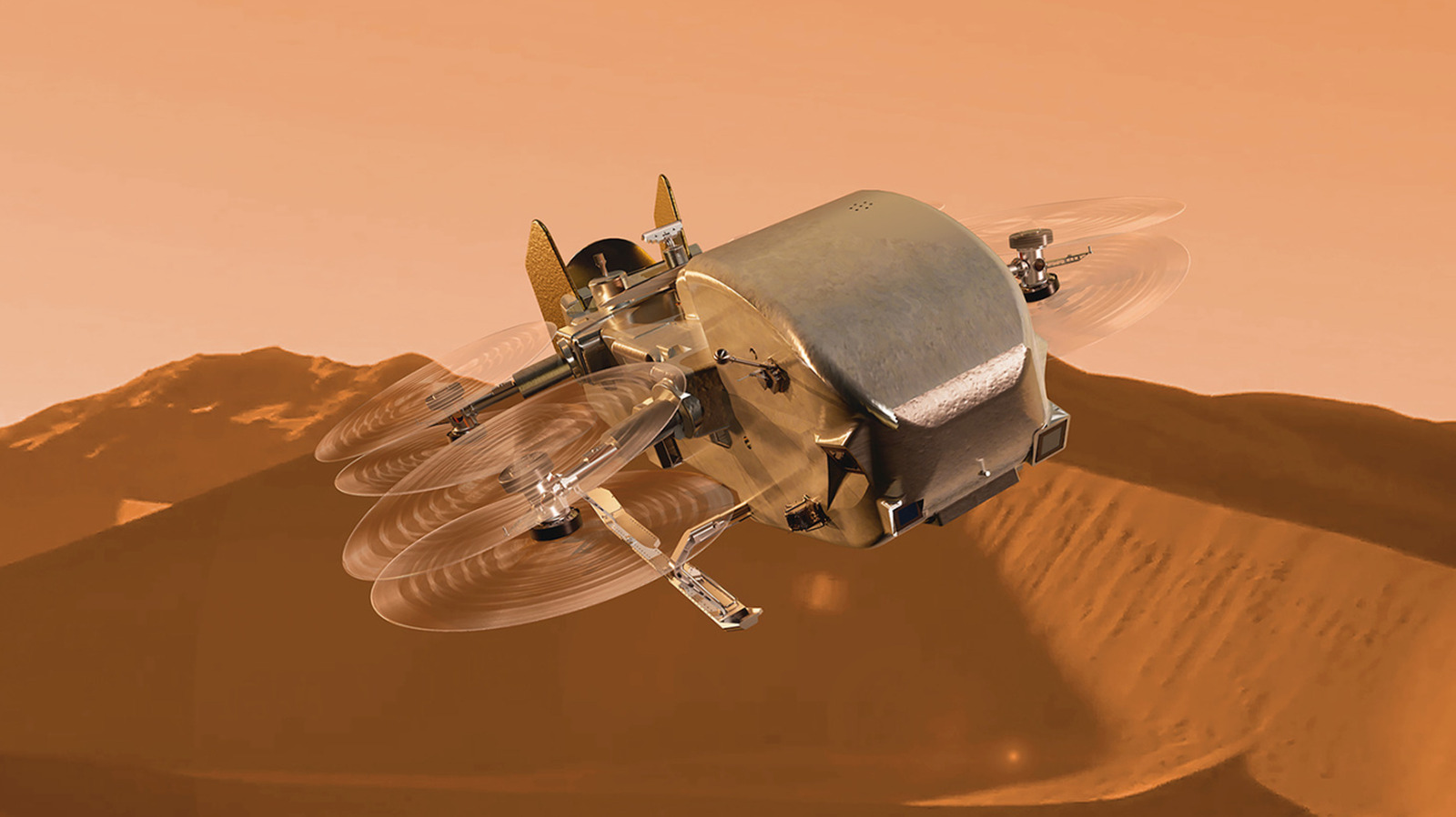
The Applied Physics Laboratory (APL) at Johns Hopkins University, on behalf of NASA’s New Frontiers Program, has begun construction of a nuclear-powered rotorcraft drone named Dragonfly. Appearing for all the world like an ornithopter from the classic sci-fi novel Dune, the airborne explorer will not go to Arrakis, but instead Saturn’s largest moon Titan in 2028. According to the APL itself, Titan is a world with… “vast expanses of sand dunes.” I put the odds of it detecting a giant sandworm at 100%.
When it’s finished, Dragonfly will be a car-sized flying science robot, capable of covering more distance than any rover to date. Once on Saturn’s moon, it will take atmospheric, spectrometric, and seismic readings while also examining chemical samples. The last part is potentially the most exciting, because Titan has a saltwater ocean underneath its ice crust. Combined with a dense atmosphere (the only one on a moon in our solar system), and you have a fully functioning water cycle. That said, rain is a little weird on Titan; because the air is four times denser even though the gravity is seven times lighter, raindrops only fall in slow-motion. And there might be centuries between showers. An alien world, indeed.
Signs of life
Might there actually be aliens on Titan? This is why the chemistry is so exciting — these conditions are perfect for the formation of the organic building blocks of life. In other words, this is the closest we’re ever going to get to what Earth looked like before life began. NASA says that the mission will even “search for chemical indicators of water-based or hydrocarbon-based life.”
Titan has long been a celestial body of interest for NASA for this reason, but the moon has apparently guarded its secrets closely. Its thick, hazy atmosphere bedeviled attempts by telescopes to learn much about it. In 2004, NASA’s Cassini spacecraft arrived to get some better imaging; a year later, Cassini dropped the Huygens probe on the surface, but the poor guy didn’t even last a whole day. So at a total projected cost of $3 billion, the Dragonfly mission is hoping to give humanity its best look at Titan ever.
Launching on a SpaceX Falcon Heavy in 2028 and making moonfall in 2034, the explorer will propel itself over rivers, lakes, and (of course) dunes in the name of science. In this case, that thick atmosphere is a double-edged sword: it makes it easy for the rotors to carry Dragonfly around, but it’s so dense as to make solar power unfeasible. Instead, this Dragonfly will go nuclear. Specifically, it will use a multi-mission radioisotope thermoelectric generator (MMRTG), containing plutonium fuel rods that heat up one junction of a close circuit to create an electric current. This is the same technology used in the current generation of Mars rovers.
So, a dragonfly-helicopter on a dune-covered world looking for signs of life? The spice must flow. Just watch out for the slow-moving rain.

