


During a recent interview with Autocar India, Ferrari CEO Benedetto Vigna spoke about the upcoming Luce EV — the first-ever fully electric vehicle to wear a prancing horse — and how his team approached its acceleration and handling. According to Vigna, EV acceleration can be too linear, and also “too much, because it is disturbing our brain.” So Ferrari reached out to medical centers and even NASA to determine “what is the level of acceleration that is disturbing people.”
He didn’t say what that level is, or how Ferrari applied its aerospace lessons, but I guess Vigna is holding his cards close to the vest until the Luce’s official reveal. However, it’s nice to know that Ferrari is taking a typically Ferrari-like approach to the Luce and doing things its own way. It isn’t just chasing wild performance figures to keep up with Lucid or Rimac. Instead, at least as far as Vigna says, the Luce will be dish out its acceleration in a more exciting and emotional way.
It isn’t only about straight-line speed, though
Vigna says there are five generators of driving thrills, one of which being longitudinal, straight-line acceleration. Since electric motors make instantaneous peak torque, without the need to rev, and typically have no gears to shuffle through, EVs are often faster than their comparable gas-powered sports cars. However, for Ferrari, supercar performance isn’t just about the technology or the numbers, but how that performance is “perceived by the human being.”
Longitudinal acceleration isn’t the only kind of acceleration Ferrari is concerned with, though. It’s also concerned with cornering. “For transversal acceleration, there is one point that is very important, it’s the weight.” EVs are famously heavy, thanks to hulking battery packs in their bellies. And that weight can make EVs feel odd to the human experience when cornering.
“When you are cornering, the eyes want to corner but the gyroscope in the ears, because of the weight of the car, feels that you are drifting.” So it seems that not only does Ferrari want to make the Luce as light as possible, but perhaps even redistribute the battery’s weight more traditionally, so it feels better? Maserati built its battery pack into the GranTurismo Folgore more closely to where an engine and transmission are placed, giving it a more traditional performance car feel. Maybe Ferrari is doing something similar.
Paddle shifters are going to play a role
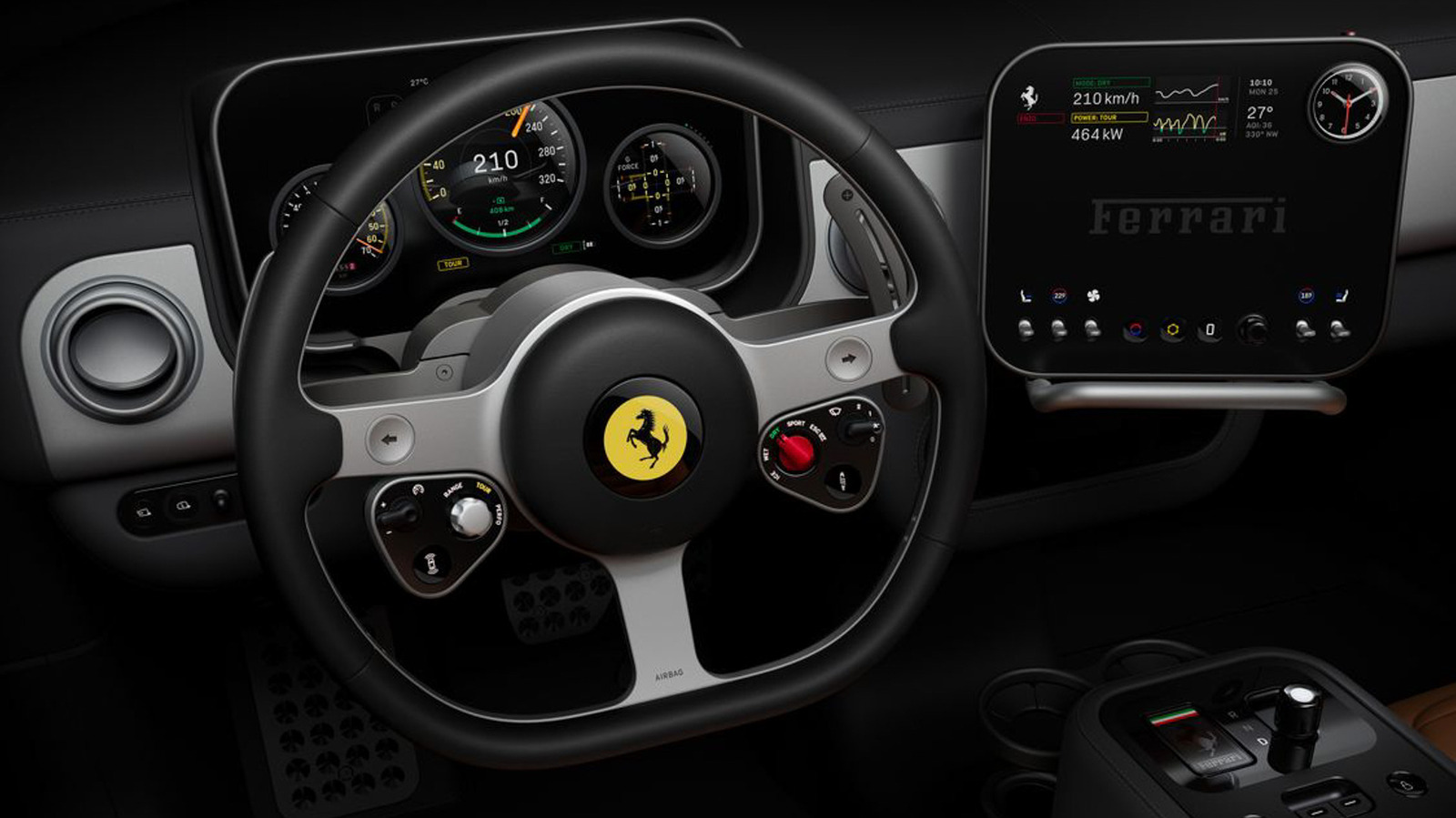
Ferrari recently revealed the Luce’s Apple-inspired interior, which showed off its big metal paddle shifters. The Luce will be far from the first EV to sport steering wheel paddles, but they’re usually used for some form of regenerative braking. Sometimes the paddles adjust the level of regen, sometimes they actively deploy it, like on many of GM’s Ultium EVs. However, Vigna says that the Luce’s paddles will play a role in how it accelerates, and was very clear that they have nothing to do with braking.
He stopped short of saying if it has an actual gearbox, but instead said that the paddles will provide a “true torque shift engagement.” Who the hell knows what that means, but it’ll be interesting to find out just how successful the Luce’s NASA-inspired acceleration feels when Ferrari finally shows the car off.

