


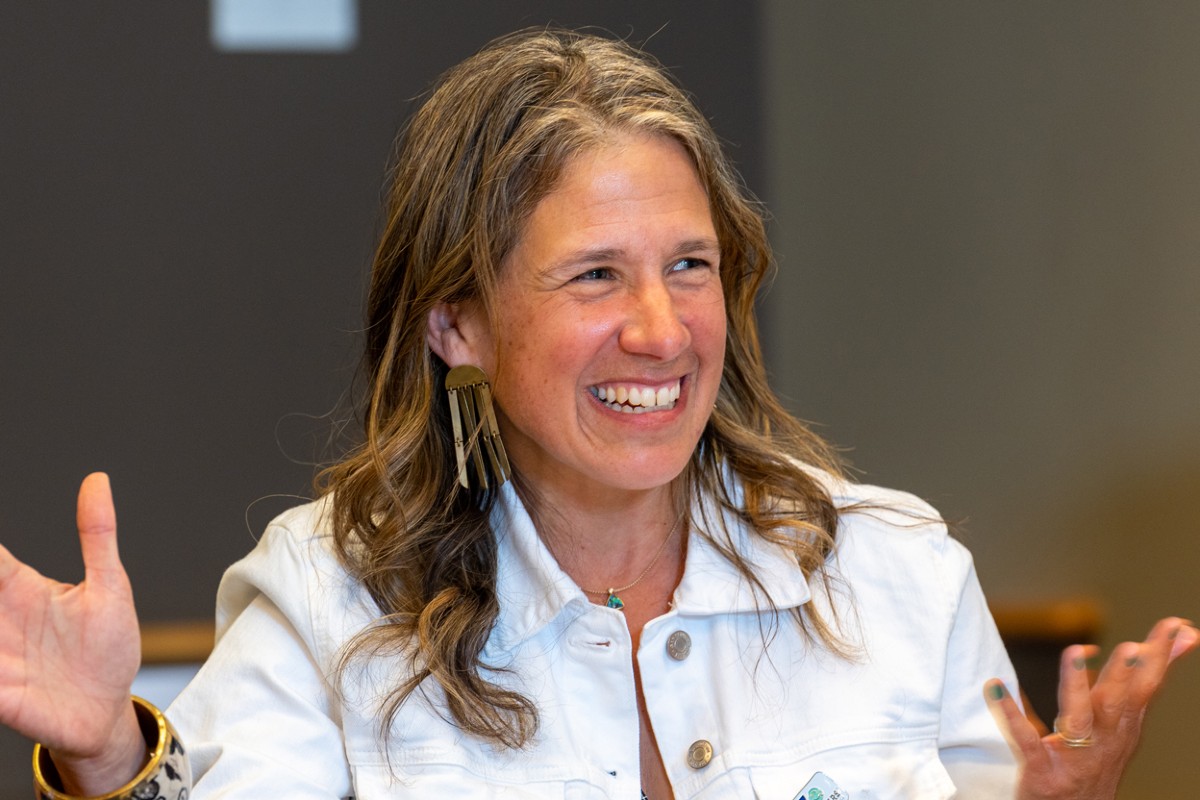

Eileen Faucher found her niche running a consultancy that helps pharmaceutical companies to size up their market competition.Credit: Jeff Luke
In the late 2000s, Eileen Faucher was a postdoctoral researcher at Columbia University in New York City, studying immuno-oncology and nanotechnology. She was drawn to the intersection of science and business, or working in business development — informing a company’s strategic decisions about which therapies to pursue — so she decided to transition to the drug-development industry. Through networking, she landed a job at Dendreon, a pharmaceutical company in Seattle, Washington, specializing in cancer immunotherapies. There, she collected and analysed information about competitors, customers and the market — also known as competitive intelligence — to inform the firm’s strategic decisions. She loved that her job focused broadly on the full competitive landscape of therapies in development.
In 2016, after about eight years at several companies, she started her own consulting firm, Brass Tacks Insights in Seattle. She now has six employees, all with PhDs, who work together to provide competitive intelligence for pharmaceutical companies. Faucher tells Nature how her work helps drug developers to prepare for a fast-changing landscape, so they can get new treatments to patients who need them.
How I’m helping to cultivate science entrepreneurship in Brazil
What does ‘competitive intelligence’ mean for pharmaceutical companies?
We provide thought partnership. When a company is developing a drug, there’s a lot of work involved, such as understanding the science, designing a study and generating good data. We come in and explain what the standard of care looks like today for their patient population, and what we think it will look like in five to eight years or whenever they plan to launch their therapy. In oncology, in particular, the treatment and regulatory guidelines are updated several times a year, and there are different accelerated pathways to approval, so things change quickly. The overarching challenge is designing a study that will still be clinically meaningful when it reports its final results in three to four years, when the standard of care might be totally different.
It’s fun because it’s a puzzle with many pieces. You have to understand the science behind the drug — the modality and disease mechanism, the class of therapy and what the historical successes and failures are. But you also have to understand clinical design and clinical data, regulatory strategy, real-world data and commercial feasibility — and practical things, such as how to change physicians’ behaviour.
Why do pharma companies hire consultants for this work, instead of doing it in-house?
They could do it themselves, but we save them a lot of time and bring a fresh perspective. They understand their technology best, and we join forces to tell them about who else is working on similar potential treatments, and how to make their messaging and positioning competitive. We go to conferences and investor events, track clinical trials and news releases and tune into other companies’ public financial filings and quarterly earnings calls. It can be hard for companies to keep track of all this, so they rely on us for current knowledge and trust that we know how to distill it into what they need to know.

Eileen Faucher (left) and Brass Tacks team member Kelsey Lynch take a break while covering the 2025 annual meeting of the American Society of Clinical Oncology in Chicago, Illinois.Credit: Eileen Faucher
What makes consulting a better fit than industry for you?
I love to wear a lot of hats. That’s not the best way to advance in industry, in which it’s better to pick one role — market planning, business development or medical affairs, for example. Then, you work your way up the ladder in that role: manager, senior manager, associate director, director, vice-president. People working at a company are focused on its technology and pipeline, and bringing its therapies to a particular patient population. People rally around the notion that their technology or therapy is the best, and maybe it is.
But the way my brain works, I always find myself wondering: is it? Who else is developing something similar that physicians might view as more clinically meaningful? Or easier to administer logistically? I’m drawn to understanding how it all fits into the big picture, and it’s best to do that thought exercise from a neutral, unbiased perspective.
Meet the biotech-company founders driven by their child’s rare disease
What does your typical day look like?
At this point, I mostly secure the projects, shape the scope of the consulting agreement and then guide my staff. The first thing I did today was revise a budget for a potential project in endometrial cancer next year — thinking about what the cadence of our reports will be, what conferences we’re going to cover, how much it’s all going to cost. Next, I reviewed a slide deck covering the non-small-cell lung cancer landscape, which we’re presenting to another client at the end of the week. Some team members are working on that, and they’ve incorporated new clinical trials that have begun and data from a recent conference into the presentation. I added some more attention to launch timelines — such as which competitors are we telling them are likely to launch their products in the next five years, and what’s changed since the last time we talked to the client. It’s reviewing a mix ofworks in progress.
What skills are essential for success as a consultant in this field?
A growth mindset is key because you need to believe you can achieve more, challenge yourself and be creative. Also important are proactive communication, a passion for excellence, being an exceptional listener and being comfortable acknowledging what you don’t know. You also must be able to explain complex data in a way that is relatable and trustworthy — stakeholders from all backgrounds, from medical affairs to investor relations, learn from our competitive-intelligence narratives. Competitive-readiness planning is most effective when those stakeholders feel comfortable enough with the information to authentically contribute to strategy discussions.

