


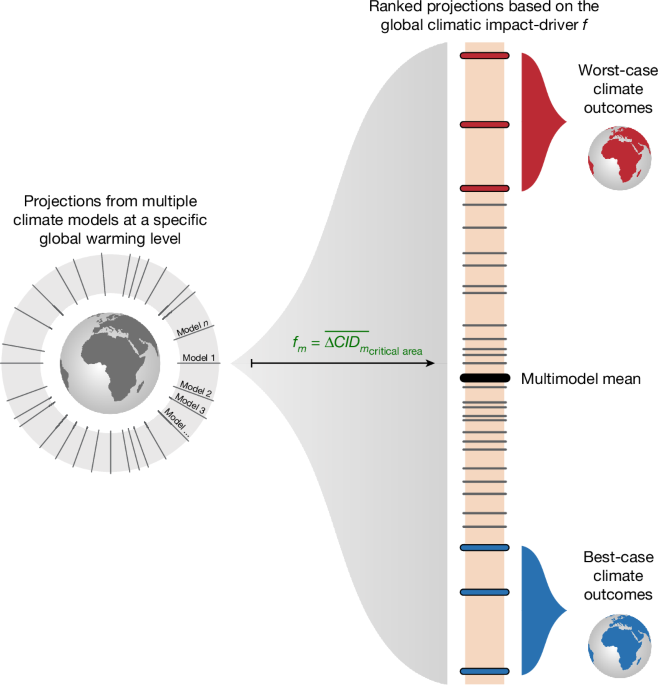
Sutton, R. T. Climate science needs to take risk assessment much more seriously. Bull. Am. Meteorol. Soc. 100, 1637–1642 (2019).
Kemp, L. et al. Climate endgame: exploring catastrophic climate change scenarios. Proc. Natl Acad. Sci. USA 119, e2108146119 (2022).
Sillmann, J. et al. Event-based storylines to address climate risk. Earths Future 9, e2020EF001783 (2021).
van den Hurk, B. J. et al. Climate impact storylines for assessing socio-economic responses to remote events. Clim. Risk Manag. 40, 100500 (2023).
Sutton, R. T. ESD Ideas: a simple proposal to improve the contribution of IPCC WGI to the assessment and communication of climate change risks. Earth Syst. Dyn. 9, 1155–1158 (2018).
Zappa, G. & Shepherd, T. G. Storylines of atmospheric circulation change for European regional climate impact assessment. J. Clim. 30, 6561–6577 (2017).
Bevacqua, E., Zappa, G., Lehner, F. & Zscheischler, J. Precipitation trends determine future occurrences of compound hot–dry events. Nat. Clim. Change 12, 350–355 (2022).
IPCC Climate Change 2023: Synthesis Report (eds Core Writing Team, Lee, H. & Romero J.) (IPCC, 2023).
Lee, J.-Y. et al. in Climate Change 2021: The Physical Science Basis (eds Masson-Delmotte, V. et al.) 553–672 (IPCC, Cambridge Univ. Press, 2021).
Bevacqua, E., Schleussner, C.-F. & Zscheischler, J. A year above 1.5 °C signals that Earth is most probably within the 20-year period that will reach the Paris Agreement limit. Nat. Clim. Change 15, 262–265 (2025).
Pfahl, S., O’Gorman, P. & Fischer, E. Understanding the regional pattern of projected future changes in extreme precipitation. Nat. Clim. Change 7, 423–427 (2017).
Bevacqua, E., Zappa, G. & Shepherd, T. G. Shorter cyclone clusters modulate changes in European wintertime precipitation extremes. Environ. Res. Lett. 15, 124005 (2020).
Deser, C. Certain uncertainty: the role of internal climate variability in projections of regional climate change and risk management. Earths Future 8, e2020EF001854 (2020).
Bhowmik, A., McCaffrey, M. S. & Rooney Varga, J. From climate endgame to climate long game. Proc. Natl Acad. Sci. USA 119, e2214975119 (2022).
Seneviratne, S. I. et al. The many possible climates from the Paris Agreement’s aim of 1.5 °C warming. Nature 558, 41–49 (2018).
Caretta, M. A. et al. in Climate Change 2022: Impacts, Adaptation and Vulnerability (eds Pörtner, H.-O. et al.) 551–712 (IPCC, Cambridge Univ. Press, 2022).
Ruane, A. C. & McDermid, S. P. Selection of a representative subset of global climate models that captures the profile of regional changes for integrated climate impacts assessment. Earth Perspect. 4, 1–20 (2017).
Sikorska-Senoner, A. E., Rajczak, J., Zappa, M. & Kotlarski, S. User-tailored sub-selection of climate model ensemble members for impact studies. Sci. Total Environ. 952, 175769 (2024).
Ruane, A. C. et al. The climatic impact-driver framework for assessment of risk-relevant climate information. Earths Future 10, e2022EF002803 (2022).
Nelson-Mercer, B., Kim, T., Tran, V. N. & Ivanov, V. Pluvial flood impacts and policyholder responses throughout the United States. npj Nat. Hazards 2, 8 (2025).
Seneviratne, S. I. et al. in Climate Change 2021: The Physical Science Basis (eds Masson-Delmotte, V. et al.) 1513–1766 (IPCC, Cambridge Univ. Press, 2021).
Fischer, E. M., Sedláček, J., Hawkins, E. & Knutti, R. Models agree on forced response pattern of precipitation and temperature extremes. Geophys. Res. Lett. 41, 8554–8562 (2014).
Ciullo, A., Strobl, E., Meiler, S., Martius, O. & Bresch, D. N. Increasing countries’ financial resilience through global catastrophe risk pooling. Nat. Commun. 14, 922 (2023).
Anderson, W. B., Seager, R., Baethgen, W., Cane, M. & You, L. Synchronous crop failures and climate-forced production variability. Sci. Adv. 5, eaaw1976 (2019).
Gaupp, F., Hall, J., Hochrainer-Stigler, S. & Dadson, S. Changing risks of simultaneous global breadbasket failure. Nat. Clim. Change 10, 54–57 (2020).
Singh, J. et al. Enhanced risk of concurrent regional droughts with increased ENSO variability and warming. Nat. Clim. Change 12, 163–170 (2022).
Jones, M. W. et al. Global rise in forest fire emissions linked to climate change in the extratropics. Science 386, eadl5889 (2024).
Andela, N. et al. A human-driven decline in global burned area. Science 356, 1356–1362 (2017).
Burton, C. et al. Global burned area increasingly explained by climate change. Nat. Clim. Change 14, 1186–1192 (2024).
Jones, M. W. et al. Global and regional trends and drivers of fire under climate change. Rev. Geophys. 60, e2020RG000726 (2022).
IPCC. Global Warming of 1.5 °C. An IPCC Special Report on the Impacts of Global Warming of 1.5 °C Above Pre-industrial Levels and Related Global Greenhouse Gas Emission Pathways, in the Context of Strengthening the Global Response to the Threat of Climate Change, Sustainable Development, and Efforts to Eradicate Poverty (eds Masson-Delmotte, V. et al.) (Cambridge Univ. Press, 2018).
Winsemius, H. C. et al. Disaster risk, climate change, and poverty: assessing the global exposure of poor people to floods and droughts. Environ. Dev. Econ. 23, 328–348 (2018).
Cheung, W. W. et al. Marine high temperature extremes amplify the impacts of climate change on fish and fisheries. Sci. Adv. 7, eabh0895 (2021).
Frölicher, T. L. & Laufkötter, C. Emerging risks from marine heat waves. Nat. Commun. 9, 650 (2018).
Gruber, N., Boyd, P. W., Frölicher, T. L. & Vogt, M. Biogeochemical extremes and compound events in the ocean. Nature 600, 395–407 (2021).
Fredston, A. L. et al. Marine heatwaves are not a dominant driver of change in demersal fishes. Nature 621, 324–329 (2023).
Le Grix, N., Cheung, W. L., Reygondeau, G., Zscheischler, J. & Frölicher, T. L. Extreme and compound ocean events are key drivers of projected low pelagic fish biomass. Glob. Change Biol. 29, 6478–6492 (2023).
Zscheischler, J. et al. A typology of compound weather and climate events. Nat. Rev. Earth Environ. 1, 333–347 (2020).
Shaw, T. A. et al. Regional climate change: consensus, discrepancies, and ways forward. Front. Clim. 6, 1391634 (2024).
Hall, A., Cox, P., Huntingford, C. & Klein, S. Progressing emergent constraints on future climate change. Nat. Clim. Change 9, 269–278 (2019).
Mankin, J. S., Lehner, F., Coats, S. & McKinnon, K. A. The value of initial condition large ensembles to robust adaptation decision-making. Earths Future 8, e2012EF001610 (2020).
Simpson, I. R. et al. Observed humidity trends in dry regions contradict climate models. Proc. Natl Acad. Sci. USA 121, e2302480120 (2024).
Blackport, R. & Fyfe, J. C. Climate models fail to capture strengthening wintertime North Atlantic jet and impacts on Europe. Sci. Adv. 8, eabn3112 (2022).
Vautard, R. et al. Heat extremes in Western Europe increasing faster than simulated due to atmospheric circulation trends. Nat. Commun. 14, 6803 (2023).
Borodina, A., Fischer, E. M. & Knutti, R. Models are likely to underestimate increase in heavy rainfall in the extratropical regions with high rainfall intensity. Geophys. Res. Lett. 44, 7401–7409 (2017).
Shaw, T. A. & Stevens, B. The other climate crisis. Nature 639, 877–887 (2025).
Ban, N. et al. The first multi-model ensemble of regional climate simulations at kilometer-scale resolution, part I: evaluation of precipitation. Clim. Dyn. 57, 275–302 (2021).
Farjad, B., Gupta, A., Sartipizadeh, H. & Cannon, A. A novel approach for selecting extreme climate change scenarios for climate change impact studies. Sci. Total Environ. 678, 476–485 (2019).
Sillmann, J. et al. Climate extremes and risks: links between climate science and decision-making. Front. Clim. 6, 1499765 (2024).
Sweet, L., Müller, C., Jägermeyr, J. & Zscheischler, J. A data-driven method for identifying climate drivers of agricultural yield failure from daily weather data. EGUsphere 2025, 1–56 (2025).
Eyring, V. et al. Overview of the Coupled Model Intercomparison Project Phase 6 (CMIP6) experimental design and organization. Geosci. Model Dev. 9, 1937–1958 (2016).
Center for International Earth Science Information Network – CIESIN – Columbia University Gridded Population of the World, Version 4 (GPWv4): Population Count (NASA Socioeconomic Data and Applications Center, 2016).
Quilcaille, Y., Batibeniz, F., Ribeiro, A. F., Padrón, R. S. & Seneviratne, S. I. Fire weather index data under historical and shared socioeconomic pathway projections in the 6th phase of the Coupled Model Intercomparison Project from 1850 to 2100. Earth Syst. Sci. Data 15, 2153–2177 (2023).
Defourny, P., Lamarche, C., Brockmann, C., Boettcher, M. & Kirches, G. Product User Guide Specification—CDR Land Cover (brokered from CCI LandCover) Technical Report (Copernicus Climate Change Service, 2018).
Defourny, P. et al. Product User Guide and Specification—CDR and ICDR Sentinel-3 Land Cover (v2.1.1) Technical Report (Copernicus Climate Change Service, 2024).
Feng, S., Zscheischler, J., Hao, Z. & Bevacqua, E. Growing human-induced climate change fingerprint in regional weekly fire extremes. npj Clim. Atmos. Sci. 8, 152 (2025).
Abatzoglou, J. T. et al. Climate change has increased the odds of extreme regional forest fire years globally. Nat. Commun. 16, 6390 (2025).
Deser, C. et al. Insights from Earth system model initial-condition large ensembles and future prospects. Nat. Clim. Change 10, 277–286 (2020).
Bevacqua, E. et al. Advancing research on compound weather and climate events via large ensemble model simulations. Nat. Commun. 14, 2145 (2023).
Hyndman, R. J. & Fan, Y. Sample quantiles in statistical packages. Am. Stat. 50, 361–365 (1996).
Santoro, M. et al. ESA Land Cover CCI Product User Guide Version 2 Technical Report (European Space Agency, 2017); http://maps.elie.ucl.ac.be/CCI/viewer/download/ESACCI-LC-Ph2-PUGv2_2.0.pdf.
Anand, M. et al. Winter climate preconditioning of summer vegetation extremes in the Northern Hemisphere. Environ. Res. Lett. 19, 094045 (2024).
Cissé, G. et al. in Climate Change 2022: Impacts, Adaptation and Vulnerability (eds Pörtner, H.-O. et al.) 1041–1170 (IPCC, Cambridge Univ. Press, 2022).
Union of the ESRI Country shapefile and the exclusive economic zones (version 3). Flanders Marine Institute https://doi.org/10.14284/403 (2020).
Bezner Kerr, R. et al. in Climate Change 2022: Impacts, Adaptation and Vulnerability (eds Pörtner, H.-O. et al.) 713–906 (IPCC, Cambridge Univ. Press, 2022).
Kelley, D., Richards, C. & Layton, C. oce: analysis of oceanographic data. R package version 1.7-10 (2022).
Becker, R. A., Wilks, A. R., Brownrigg, R., Minka, T. P. & Deckmyn, A. maps: draw geographical maps. R package version 3.4.1 (2023).
Schulzweida, U. CDO user guide. Zenodo https://doi.org/10.5281/zenodo.10020800 (2023).
Bevacqua, E. Code for paper: Bevacqua et al. (2026) [v1.0.1]. Zenodo https://doi.org/10.5281/zenodo.17864854 (2025).

