


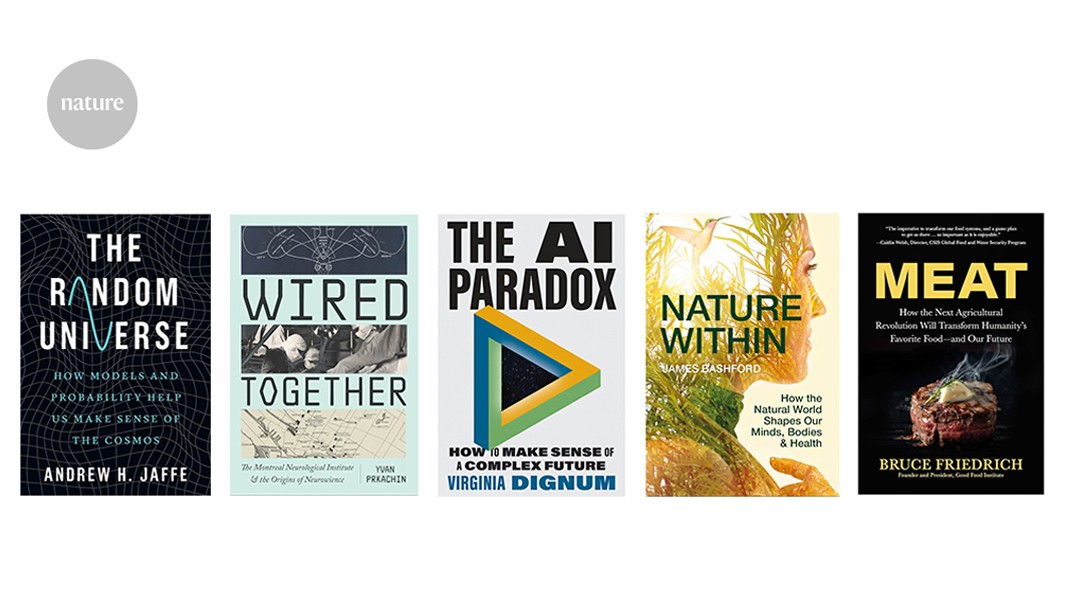

The AI Paradox
Virginia Dignum Princeton Univ. Press (2026)
Some leading thinkers on artificial intelligence regard AI models as neither artificial nor intelligent. Virginia Dignum — who has contributed to AI initiatives for organizations such as the United Nations — agrees. AI systems “lack true comprehension and depend heavily on human input and material resources”, she writes in her stimulating analysis of the many paradoxes that are raised by the development of AI tools. She argues that governments must scrutinize technology companies as rigorously as they do pharmaceutical ones.

The Random Universe
Andrew H. Jaffe Yale Univ. Press (2025)
“The sun and the stars and the edge of the Universe are inaccessible, but no more so than the interior lives of other people,” writes astrophysicist Andrew Jaffe in his intriguing book about epistemology, probability and cosmology. We can observe the Universe in detail with scientific instruments — but without devising plausible models of how it works, such as the theory of relativity, quantum mechanics and even the interpretation of our Universe as one component of a ‘multiverse’, we cannot understand it.

Meat
Bruce Friedrich BenBella (2026)
Global meat consumption has been rising for decades. Today, humans eat more than 500 million tonnes of meat and seafood each year, damaging both people’s health and the environment. But an alternative is on the way, argues Bruce Friedrich, who founded the Good Food Institute in Washington DC in 2016. The institute supports the development of plant-based and cultivated meat that closely replicates animal meat but contains less saturated fat and cholesterol and more fibre. His campaigning book on this project has wide appeal.

Nature Within
James Bashford Pelagic (2026)

