


Science was once the domain of researchers toiling in solitude. Today, however, research thrives through collaboration, and is perhaps at its best when scientists recognize their colleagues’ contributions.
To celebrate International Women’s Day, held each year on 8 March, Nature asked six previous winners of awards given in partnership with Nature to name a woman who has had a positive impact on their career and well-being.
This year, Nature has focused on winners of the Estée Lauder Companies’ annual Inspiring Women in Science award, the inaugural Sony Women in Technology award — given to women who are using technology to drive positive change for society and the planet — and the annual John Maddox Prize, which is awarded in partnership with the UK charity Sense about Science to individuals who stand up for sound science despite challenges or hostility.
The six winners describe how the individuals that they nominate have not only advanced cutting-edge science but also improved the lives of those around them. These women, who span locations around the globe and several scientific disciplines, attest to how kindness, generosity and perseverance remain crucial to best practice in science.
ANITA MAHADEVAN-JANSEN

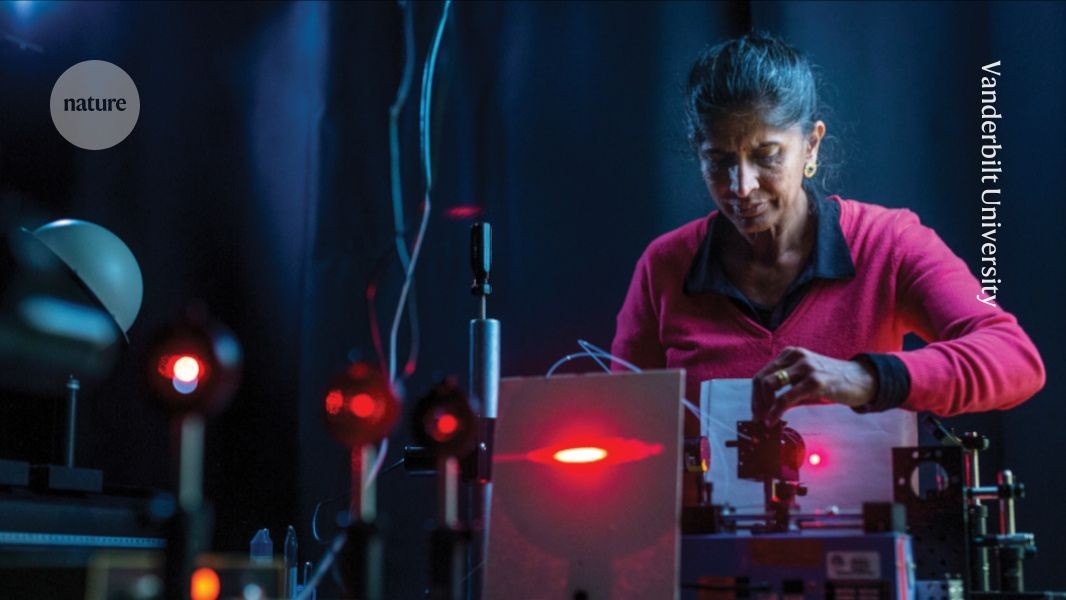
Biomedical engineer Anita Mahadevan-Jansen inspires others in how she balances professional success and personal joys — nominated by Jiawen Li (inset).Credit: Vanderbilt University (Main image), The University of Adelaide (Inset)
Job: biomedical engineer at Vanderbilt University in Nashville, Tennessee.
Research focus: optical diagnostics, neurophotonics and image-guided surgical techniques.
Nominated by: Jiawen Li, a biomedical engineer at the University of Adelaide, Australia, and commendation recipient of the 2025 Sony Women in Technology award.
J.L.: I had the privilege of sharing an office with Anita during her sabbatical at the University of Adelaide in 2019, the same year I gave birth to my first child. I have been fortunate to be mentored by many outstanding women, but meeting Anita at this crucial stage of my career had a profound impact. Her guidance helped me to navigate the challenging early years of academic motherhood, and her example gave me the confidence to push forward.
Women in science
Anita taught me how to set priorities, build practical to-do lists, share childcare responsibilities with my partner and, perhaps most importantly, be selective about when to say ‘yes’. For example, as women in a male-dominated field, we are often invited to serve on committees to improve gender representation. Although these opportunities are valuable, Anita demonstrated to me the importance of being selective: saying yes only when I can genuinely add value and create impact. She also showed me that it is possible to care deeply for one’s children while continuing to enjoy and thrive in a scientific career. Interacting with her and her adult children and seeing their pride in her reinforced my belief that we can ‘have it all’ in a smart and realistic way.
Over the past seven years, I have continued to witness how Anita embraces opportunities: translating her inventions from the laboratory to clinical trials, serving as president of the international society in our field and developing a medical device.
What has always stood out to me is how she balances these roles: she focuses on doing her best, rather than striving to be the best. Through her example, she has taught me to do this while continuing to enjoy what I do, rather than comparing myself to others or being consumed by self-doubt.
ANNA ABALKINA

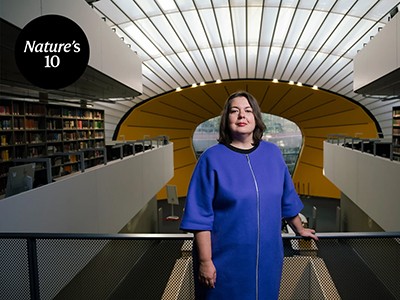
Anna Abalkina hunts down fraud in publishing — nominated by Elisabeth Bik (inset).Credit: Stefanie Loos (Main image), Michel N Co, San Jose, CA, USA (Inset)
Job: integrity researcher at the Free University of Berlin.
Research focus: Russian governance, plagiarism and scientific publication fraud.
Nominated by: Elisabeth Bik, a microbiologist and scientific-integrity consultant in San Francisco, California, and winner of the John Maddox Prize in 2021.
E.B.: I have met Anna several times online and in person, and what always stands out to me is how approachable and generous with her time she is, even while tackling some of the hardest problems in science publishing.
Anna Abalkina: Fraud buster
Anna is now one of the leading experts in uncovering ‘paper mills’ that churn out fake manuscripts, plagiarism among doctoral theses, predatory publishers and ‘hijacked journals’. Her investigations have helped to remove fraudulent journals and papers from major databases, and have led to many corrections and retractions. She also co-founded the Retraction Watch Hijacked Journal Checker, which is widely used to help scientists avoid fake journals that mimic legitimate ones.
This work has come at personal cost. Through her earlier work exposing plagiarism and dissertation fraud in Russia, and through her continued investigations, she has faced intimidation and was even placed on a watch list by Russian authorities. She now lives in Germany and might never be able to return to her own country. Despite this, she continues to speak openly and work to improve scientific standards worldwide.
On a lighter note, however: last summer, Anna organized a visit for fellow science sleuths to a supposed paper-mill headquarters, which, it turned out, didn’t exist. We were attending a meeting in a European city, and Anna found a paper-mill company with headquarters listed at an address in that city. On Google Maps it looked like a small, nondescript office building. It turned into a fun side excursion showing that these companies can run out of fake addresses to use.
MAHA YUSUF

Mechanical engineer Maha Yusuf is an ‘unapologetically visible’ leader — nominated by Maheera Ghani (inset).Credit: Sundus Zahra (Main image), Maheera Abdul Ghani (Inset)
Job: mechanical engineer at Princeton University in New Jersey.
Research focus: advanced materials characterization and battery technologies.
Nominated by: Maheera Ghani, a materials scientist at the University of Cambridge, UK, and winner of the 2025 Inspiring Women in Science award.
M.G.: I first encountered Maha during my PhD, when I was still shaping my academic identity. Our initial connection wasn’t face-to-face, but when she travelled to the United Kingdom to conduct experiments — temporarily leaving her family behind — it became more personal. I remember being struck not only by her scientific focus, but also by the determination it took to make that journey.
As our conversations deepened, we realized how much we had in common: navigating male-dominated environments, balancing cultural expectations with ambition and building credibility in global research institutions. What began as professional admiration evolved into a genuine friendship marked by guidance and encouragement, and we remain in regular contact.
What stands out the most about Maha is her commitment to science with purpose. She was the first Pakistani woman to receive a PhD in chemical engineering from Stanford University, California — a milestone that carries both academic and symbolic weight. Her scientific contributions to energy materials are rigorous and have had an impact, but equally important is how she uses her platform. By remaining unapologetically visible, having work published at the highest level, mentoring generously and supporting younger women entering science and engineering fields, she quietly but firmly expands what leadership in science can look like.
KEI MAY LAU

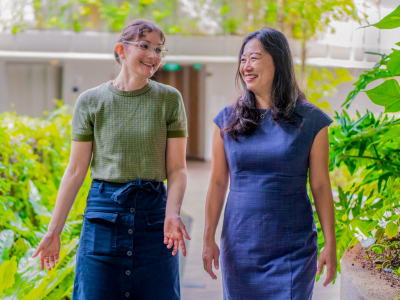
Kei May Lau shapes semiconductor innovations and students — nominated by Yating Wan (inset).Credit: HKUST School of Engineering (Main image), Martins Bruvelis (Inset)
Job: electrical engineer at The Hong Kong University of Science and Technology in China.
Research focus: semiconductor materials and devices, photonics devices and power semiconductor devices.
Nominated by: Yating Wan, an electrical and computer engineer at the King Abdullah University of Science and Technology in Thuwal, Saudi Arabia, and winner of the 2025 Sony Women in Technology award.
Y.W.: I joined Kei’s group as a PhD student, and she has shaped the way I think as a researcher more than anyone else. She is known internationally for her pioneering work on semiconductor devices on silicon. This work helps make faster, more energy-efficient computing systems by enabling computers to communicate using light instead of electrical wires. Silicon chips run our computers, but silicon is very bad at producing light. Kei pioneered ways to grow laser materials directly on silicon, instead of attaching them later, which is more complex and expensive.
Behind every great woman in science, there’s another great woman in science
What I’ve learnt from her, however, goes far beyond technical skills. She taught me what it looks like to work with long-term vision and discipline, even when the field moves quickly and the challenges of achieving reliable, scalable and low-cost devices are enormous.
Kei has high standards and a very direct mentoring style. She trained me to think from first principles, starting from fundamental physics and material properties rather than relying on established assumptions or existing device templates. Under her mentorship, I learnt to ask why a device should work before asking how to fabricate it. This approach trained me to build solutions that were physically grounded and robust, and when experiments did not behave as expected, she pushed me to handle setbacks with resilience and professionalism. Those lessons have stayed with me through every stage of my career.

