


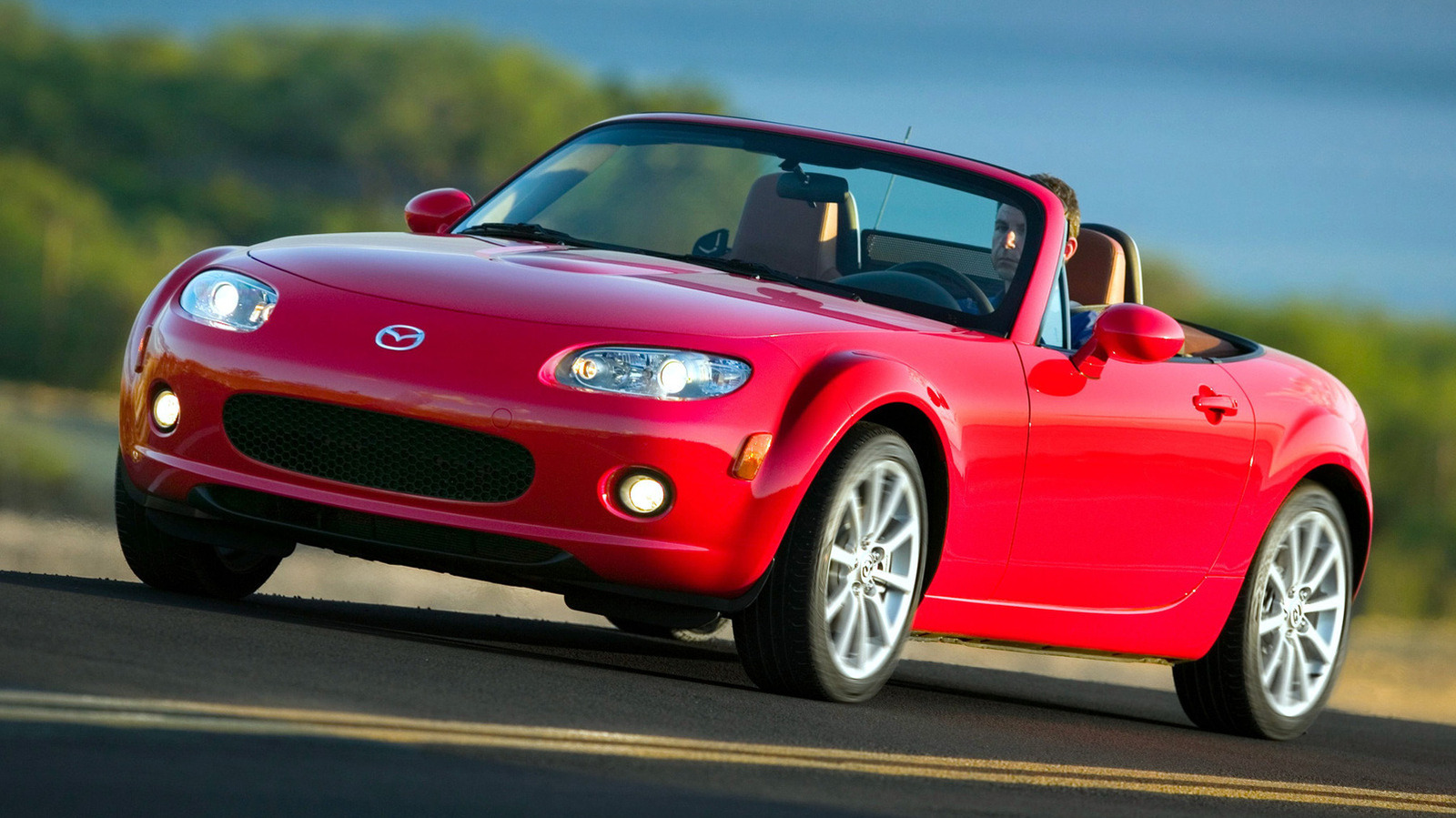
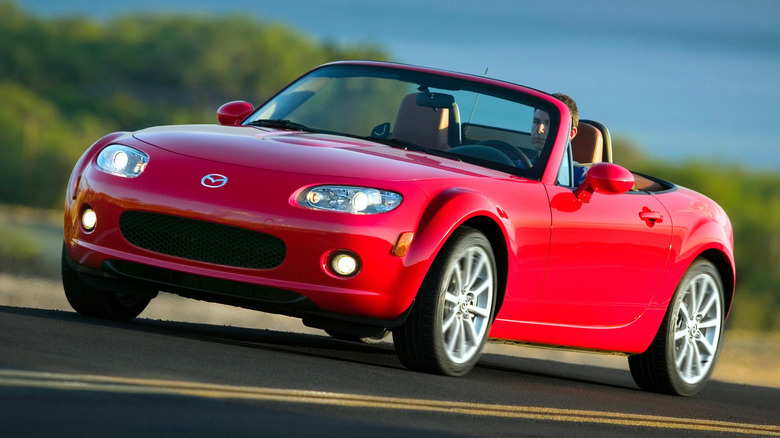
Aside from the short-lived turbocharged MazdaSpeed MX-5 Miata, the little convertible has always been a bit lacking in the power department, and it caused enthusiasts to shoehorn all sorts of motors under the car’s tiny hood to varying degrees of success. As it turns out, in a quest for more power, Mazda engineers did just that two decades ago. An interview with a senior Mazda executive on the future of the Miata also shed some light on its past, and it revealed some of the crazier things the company tried with the car — on and off the clock. One of those things just so happened to be putting a V6 engine under the hood. Sadly for everyone involved, it wasn’t meant to be for a variety of reasons.
Christian Schultze, Mazda’s European Director of Research and Operations, told Dutch car outlet AutoRAI that engineers worked on a V6 Miata “about twenty years ago,” which means it was probably during the development of the NC Miata. If there was ever a Miata that a V6 would make sense in, it was surely the NC.
The conversation started when Schultze was asked what the chances of a next-generation Miata getting a 2.5-liter engine were. Apparently, the V6 that Mazda engineers worked out “purely out of enthusiasm” displaced 2.5 liters.
“[I]nterestingly enough, we already tried something like this about twenty years ago. Back then, our engineers built a prototype with a 2.5-liter V6 in their spare time. They did it here in the workshop, purely out of enthusiasm,” Schultze told AutoRAI. “Technically, it was a fascinating project.”
Not meant to be
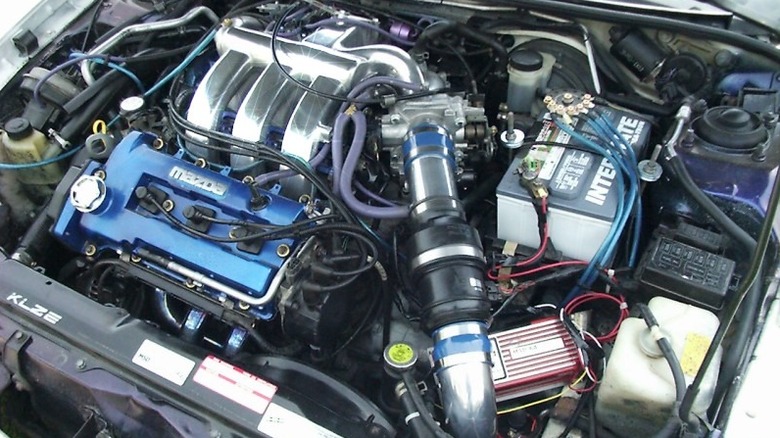
There was just one real problem, though: the engine was too big. Schultze told AutoRAI that the V6 “didn’t fit well under the hood,” because it was too high. The results of that gave the prototype Miata a look that “wasn’t visually appealing.” I can see how that makes sense. The Miata needs its low-slung hood, and a V6 with a power-bulge could certainly mess with that.
It’s too bad, though, because its driving experience was described as “interesting” by Schultze. I’ll assume that means it was good.
Schultze also pointed to the simple fact that a bigger motor means more weight and worse balance. After all, the Miata is all about low weight and great balance. By nature, a 2.5-liter engine is going to weigh more than a 1.5- or 2.0-liter engine.
“Extra weight up front directly affects balance and steering response,” he told AutoRAI. “These are precisely the elements that make the MX-5 so special. So it’s not an easy choice.”
He didn’t give any indication of what V6 might have been used in this prototype Miata, but with a little digging, we can make some educated guesses. More likely than not, engineers borrowed a K-series V6, which was around from 1991 to 2002, and — what do you know — it came in 2.5-liter guise. It was used in cars like the Mazda Millenia, 626, MX-6 and Ford Probe. In its most-powerful form, the Japan-only KL-ZE, it made 200 horsepower and 165 pound-feet of torque.
Of course, these aren’t huge numbers, but when you consider the fact that it would have been the most powerful Miata ever, eclipsing the current Miata by 19 hp, it was nothing to sneeze at. Oh well. C’est la vie.

