



Updated edge-to-cloud architecture supports early warning, threat assessment, and unified airspace awareness
MatrixSpace has announced a major update to its MatrixSpace AI Software Platform, expanding its ability to support multi-sensor, multi-drone detection in real time for counter-UAS operations.
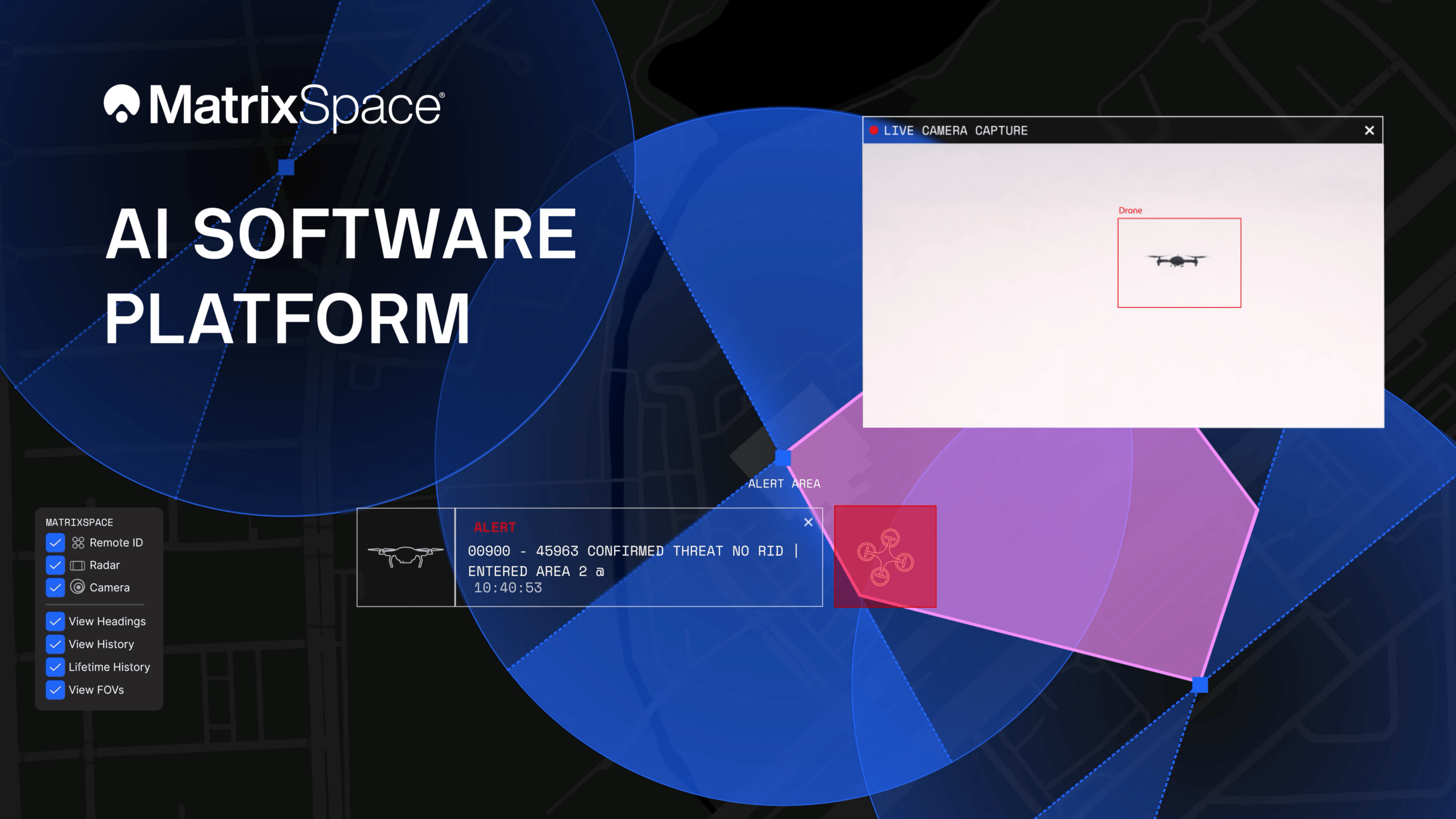
The update builds on the company’s portable AI-sensing radar technology and extends it into a broader edge-to-cloud architecture. The platform now delivers early warning and true threat assessment by detecting, tracking, and identifying airborne objects. This capability supports both on-site and remote operators who must make rapid decisions about airspace activity.
The platform is sensor agnostic and integrates into existing systems through open APIs. According to the company, this approach improves the ability to assess risk from small, low-flying drones in complex environments such as public events, critical infrastructure sites, and operational battlespaces.
AI-Native Architecture Designed for Real-Time Decisions
The MatrixSpace AI Software Platform consists of two core components: MatrixSpace AiEdge and MatrixSpace AiCloud.
AiEdge serves as the company’s intelligent sensor operating system. It runs directly on sensors and provides actionable intelligence at the point of data collection. Unlike platforms adapted later for artificial intelligence, both AiEdge and AiCloud are designed as AI-native systems. This design aims to make information faster to interpret and easier to act on.
Matt Kling, Vice President and General Manager of AI Systems at MatrixSpace, explained the motivation behind the update:
“Most traditional systems rely on noisy, exotic sensors with siloed, cumbersome command and control (C2) structures that hinder decisive action. But as threats of drone detection get only more complex, they require instant “threat truth”. Using AI to corroborate multiple inputs into one clear signal is the beauty of the MatrixSpace AI Software Platform, empowering customers to fully meet the threats we’re seeing today and in the future.”
AiEdge detects, classifies, and tracks multiple object types while filtering out clutter. The goal is to present operators with a relevant picture of aerial activity rather than raw sensor feeds.
Fusing Radar, Remote ID, ADS-B, and Optical Sensors at the Edge
AiEdge fuses detections from MatrixSpace radars with complementary sensors such as Remote ID and ADS-B. It correlates these inputs into a single, real-time track.
By combining data at the edge, AiEdge creates a common data representation and can cue pan-tilt-zoom (PTZ) cameras for fast visual confirmation. High-confidence tracks are then passed to the cloud for enterprise-level analysis.
This edge-based fusion allows local systems to continue operating even if cloud connectivity is lost. When connectivity is restored, activity data synchronizes automatically for later review.
Unified Airspace View Across Distributed Sites
MatrixSpace AiCloud sits above distributed AiEdge deployments. It simplifies the management of geographically diverse sensor networks into one unified view.
Instead of monitoring multiple individual sensor screens, operators can see low-altitude airspace activity, alerts, and warnings for all protected sites through a single interface. The system is accessible on any device.
AiCloud combines fused, real-time data from radar, optical, ADS-B, and Remote ID sensors. It supports consistent object tracking and actionable threat intelligence at scale. Within the platform, whitelisting and threat classification determine whether an object is friendly, unknown, or hostile. This enables faster and more coordinated responses.
Addressing Growing Counter-Drone Requirements
The update reflects growing demand for accurate, portable, and scalable counter-drone detection systems. Public safety agencies, infrastructure operators, and defense users increasingly need persistent awareness of low-altitude airspace. They also need systems that integrate into existing workflows rather than replace them.
MatrixSpace states that its AI-enabled platform is designed to provide persistent detection and classification for airspace, perimeter, and object monitoring in dynamic outdoor environments.
More information is available at www.matrixspace.com.
Read more:

Miriam McNabb is the Editor-in-Chief of DRONELIFE and CEO of JobForDrones, a professional drone services marketplace, and a fascinated observer of the emerging drone industry and the regulatory environment for drones. Miriam has penned over 3,000 articles focused on the commercial drone space and is an international speaker and recognized figure in the industry. Miriam has a degree from the University of Chicago and over 20 years of experience in high tech sales and marketing for new technologies.
For drone industry consulting or writing, Email Miriam.
TWITTER:@spaldingbarker
Subscribe to DroneLife here.

