


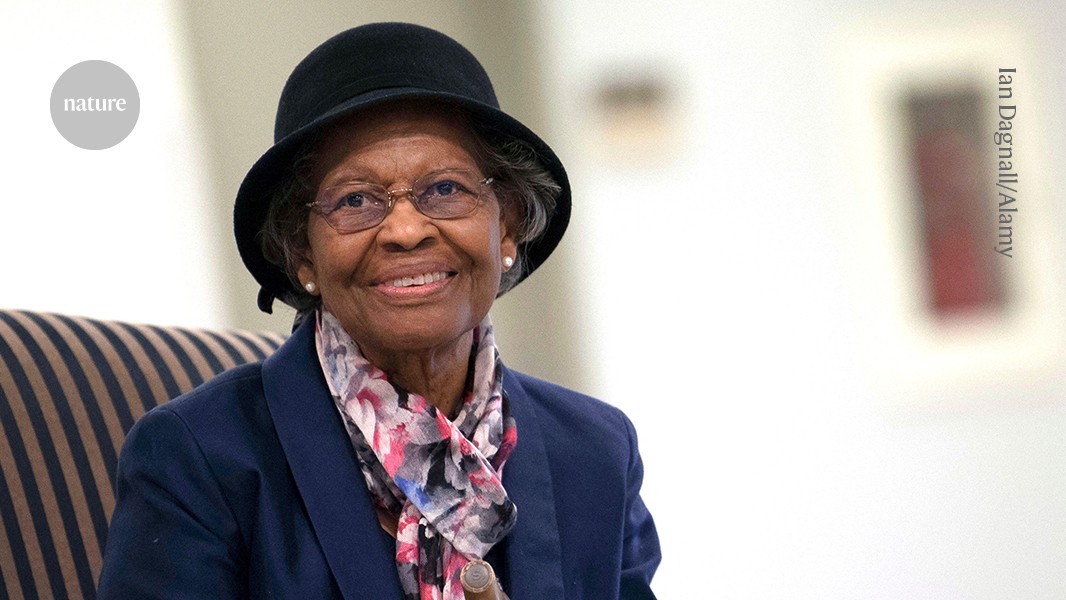

Credit: Ian Dagnall/Alamy
US mathematician Gladys Mae West was best known for her foundational work on GPS systems. As an African American woman, West overcame huge barriers to contribute to this key technology. She was one of many women of her generation whose talents helped to propel the mid-twentieth-century cold-war technology boom in the United States. Programming some of the most powerful computers of the time, West pushed the horizons of computation and communication. She has died, aged 95.
West was born in a farming family in rural Virginia. She excelled in her studies, but because of the Jim Crow laws that barred Black children from the well-funded schools that white students enjoyed, she attended a vocational-training school rather than an academically oriented secondary school. She earned a scholarship to Virginia State College, a historically Black college in Petersburg, where she was one of the few women to study mathematics. West obtained her master’s degree there in 1955.
West’s desire to find a profession that would open up possibilities for her propelled her to take up a position at a research and development centre, then called the Naval Proving Ground, Dahlgren, in Virginia. When she started, she was one of only two Black women and four Black professionals. The double burden of discrimination made West feel like an outsider among both the white women who worked at the centre — whose conversations, she recalled, would often fall silent as she approached — and her male co-workers. She was keenly aware that she should keep her head down and never “allude to the fact she had different ideas”. West was unable to travel with her colleagues because of segregation laws and missed out on opportunities as a result.
These women helped to shape quantum mechanics — it’s time to recognize them
Moreover, secrecy sometimes hid the full impact of her work from her. “We didn’t know exactly where it was going because we worked for the military where everything is secret,” West recalled. Nevertheless, she embarked on research at the centre that shaped her later accomplishments. In 1962, West worked on Project 29V in the computational division’s scientific programming and analysis branch. Her job was to calculate the orbit of Pluto in relation to Neptune. She was part of a team that programmed a computer to perform more than five billion calculations, taking nearly 100 hours of computer time. Ultimately, in 1964, the work proved the regularity of Pluto’s orbit. The research won a merit award for group achievement.
West next took a job in the Defense Mapping Agency at Dahlgren. There, she managed the SEASAT radar altimetry project — a system for data collection and processing that would model Earth’s environmental and oceanographic features. Orbiting Earth from June to October 1978, the SEASAT satellite used cutting-edge technology to help researchers to create a model of the planet’s shape, measuring sea-ice levels, the oceans’ topography and other characteristics of Earth’s largest water bodies.
After this success, West and her team used data from a US Navy satellite called GEOSAT, launched in March 1985, to create a geodetic Earth model with improved accuracy. West used an IBM 7030 Stretch supercomputer to analyse these data, accounting for variations in gravitational and tidal forces that change Earth’s shape. Stretch was an intimidating machine: so big that it would take up “the first floor of a house”, West noted.

