


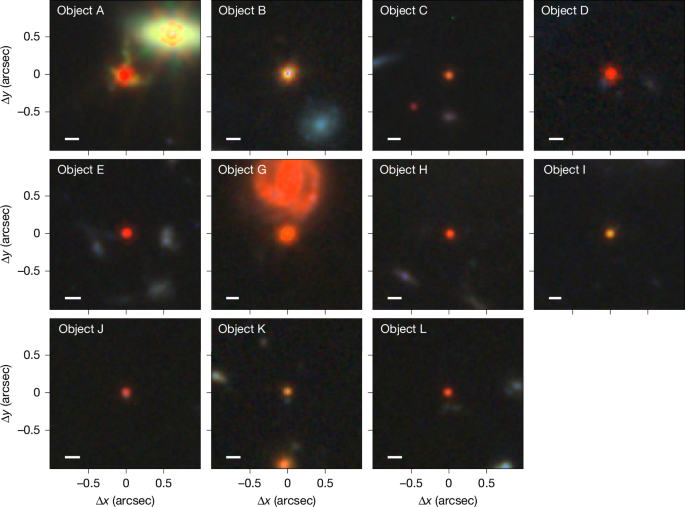
Greene, J. E. et al. UNCOVER spectroscopy confirms the surprising ubiquity of active galactic nuclei in red sources at z > 5. Astrophys. J. 964, 39 (2024).
Matthee, J. et al. Little red dots: an abundant population of faint active galactic nuclei at z ~ 5 Revealed by the EIGER and FRESCO JWST surveys. Astrophys. J. 963, 129 (2024).
Harikane, Y. et al. A JWST/NIRSpec first census of broad-line AGNs at z = 4-7: detection of 10 faint AGNs with MBH ~ 106–108 M⊙ and their host galaxy properties. Astrophys. J. 959, 39 (2023).
Maiolino, R. et al. JADES: the diverse population of infant black holes at 4 < z < 11: merging, tiny, poor, but mighty. Astron. Astrophys. 691, A145 (2024).
Baggen, J. F. W. et al. The small sizes and high implied densities of “Little Red Dots” with Balmer breaks could explain their broad emission lines without an active galactic nucleus. Astrophys. J. Lett. 977, L13 (2024).
Akins, H. B. et al. COSMOS-Web: the overabundance and physical nature of “little red dots”—implications for early galaxy and SMBH assembly. Astrophys. J. 991, 37 (2025).
Ananna, T. T., Bogdán, Á., Kovács, O. E., Natarajan, P. & Hickox, R. C. X-ray view of little red dots: do they host supermassive black holes? Astrophys. J. Lett. 969, L18 (2024).
Kokubo, M. & Harikane, Y. Challenging the AGN scenario for JWST/NIRSpec broad Hα emitters/little red dots in light of non-detection of NIRCam photometric variability and X-ray. Preprint at arxiv.org/abs/2407.04777 (2024).
Yue, M. et al. Stacking X-ray observations of “little red dots”: implications for their active galactic nucleus properties. Astrophys. J. Lett. 974, L26 (2024).
Maiolino, R. et al. JWST meets Chandra: a large population of Compton thick, feedback-free, and intrinsically X-ray weak AGN, with a sprinkle of SNe. Mon. Not. R. Astron. Soc. 538, 1921–1943 (2025).
Mazzolari, G. et al. The radio properties of the JWST-discovered AGN. Preprint at arxiv.org/abs/2412.04224 (2024).
Gloudemans, A. J. et al. Another piece to the puzzle: radio detection of a JWST-detected active galactic nucleus candidate. Astrophys. J. 986, 130 (2025).
Setton, D. J. et al. A confirmed deficit of hot and cold dust emission in the most luminous little red dots. Astrophys. J. Lett. 991, L10 (2025).
Inayoshi, K. & Maiolino, R. Extremely dense gas around little red dots and high-redshift active galactic nuclei: a nonstellar origin of the Balmer break and absorption features. Astrophys. J. Lett. 980, L27 (2025).
Ji, X. et al. BlackTHUNDER—a non-stellar Balmer break in a black hole-dominated little red dot at z = 7.04. Mon. Not. R. Astron. Soc. 544, 3900–3935 (2025).
Kocevski, D. D. et al. The rise of faint, red active galactic nuclei at z > 4: a sample of little red dots in the JWST extragalactic legacy fields. Astrophys. J. 986, 126 (2025).
Juodžbalis, I. et al. A dormant overmassive black hole in the early Universe. Nature 636, 594–597 (2024).
de Graaff, A. et al. RUBIES: a complete census of the bright and red distant Universe with JWST/NIRSpec. Astron. Astrophys. 697, A189 (2025).
Heintz, K. E. et al. The JWST-PRIMAL archival survey: a JWST/NIRSpec reference sample for the physical properties and Lyman-α absorption and emission of ~600 galaxies at z = 5.0 − 13.4. Astron. Astrophys. 693, A60 (2025).
Killi, M. et al. Deciphering the JWST spectrum of a ‘little red dot’ at z ~ 4.53: an obscured AGN and its star-forming host. Astron. Astrophys. 691, A52 (2024).
Setton, D. J. et al. Little red dots at an inflection point: ubiquitous “v-shaped” turnover consistently occurs at the Balmer limit. Preprint at arxiv.org/abs/2411.03424 (2024).
Lambrides, E. et al. The case for super-Eddington accretion: connecting weak X-ray and UV line emission in JWST broad-line AGN during the first Gyr of cosmic time. Preprint at https://arxiv.org/abs/2409.13047 (2024).
Tang, M. et al. JWST/NIRSpec observations of high-ionization emission lines in galaxies at high redshift. Astrophys. J. 991, 217 (2025).
Weymann, R. J. Electron-scattering line profiles in nuclei of Seyfert galaxies. Astrophys. J. 160, 31 (1970).
Laor, A. Evidence for line broadening by electron scattering in the broad-line region of NGC 4395. Astrophys. J. 643, 112–119 (2006).
Huang, C. & Chevalier, R. A. Electron scattering wings on lines in interacting supernovae. Mon. Not. R. Astron. Soc. 475, 1261–1273 (2018).
Kollatschny, W. & Zetzl, M. The shape of broad-line profiles in active galactic nuclei. Astron. Astrophys. 549, A100 (2013).
Storchi-Bergmann, T. et al. Double-peaked profiles: ubiquitous signatures of disks in the broad emission lines of active galactic nuclei. Astrophys. J. 835, 236 (2017).
Juodžbalis, I. et al. JADES – the Rosetta stone of JWST-discovered AGN: deciphering the intriguing nature of early AGN. Mon. Not. R. Astron. Soc. 535, 853–873 (2024).
Castor, J. I. & Lamers, H. J. G. L. M. An atlas of theoretical P Cygni profiles. Astrophys. J. Suppl. Ser. 39, 481–511 (1979).
Greene, J. E. & Ho, L. C. Estimating black hole masses in active galaxies using the Hα emission line. Astrophys. J. 630, 122–129 (2005).
Gieles, M., Padoan, P., Charbonnel, C., Vink, J. S. & Ramírez-Galeano, L. Globular cluster formation from inertial inflows: accreting extremely massive stars as the origin of abundance anomalies. Mon. Not. R. Astron. Soc. 544, 483–512 (2025).
Cho, H. et al. The Seoul National University AGN Monitoring Project. IV. Hα reverberation mapping of six AGNs and the Hα size-luminosity relation. Astrophys. J. 953, 142 (2023).
Reines, A. E. & Volonteri, M. Relations between central black hole mass and total galaxy stellar mass in the local Universe. Astrophys. J. 813, 82 (2015).
Watson, D. et al. Helium in natal H ii regions: the origin of the X-ray absorption in gamma-ray burst afterglows. Astrophys. J. 768, 23 (2013).
Malizia, A. et al. First high-energy observations of narrow-line Seyfert 1s with INTEGRAL/IBIS. Mon. Not. R. Astron. Soc. 389, 1360–1366 (2008).
Done, C., Davis, S. W., Jin, C., Blaes, O. & Ward, M. Intrinsic disc emission and the soft X-ray excess in active galactic nuclei. Mon. Not. R. Astron. Soc. 420, 1848–1860 (2012).
Condon, J. J. Radio emission from normal galaxies. Annu. Rev. Astron. Astrophys. 30, 575–611 (1992).
Katz, H. et al. 21 Balmer Jump Street: the nebular continuum at high redshift and implications for the bright galaxy problem, UV continuum slopes, and early stellar populations. Open J. Astrophys. 8, 104 (2025).
Strateva, I. V. et al. Double-peaked low-ionization emission lines in active galactic nuclei. Astron. J. 126, 1720–1749 (2003).
de Graaff, A. et al. A remarkable ruby: absorption in dense gas, rather than evolved stars, drives the extreme Balmer break of a little red dot at z = 3.5. Astron. Astrophys. 701, A168 (2025).
Naidu, R. P. et al. A “black hole star” reveals the remarkable gas-enshrouded hearts of the little red dots. Preprint at arxiv.org/abs/2503.16596 (2025).
Juodžbalis, I. et al. JADES: comprehensive census of broad-line AGN from reionization to cosmic noon revealed by JWST. Preprint at arxiv.org/abs/2504.03551 (2025).
Netzer, H. Physical conditions in active nuclei-I. The Balmer decrement. Mon. Not. R. Astron. Soc. 171, 395–406 (1975).
Nikopoulos, G. P. et al. Evidence of violation of case B recombination in little red dots. Preprint at arxiv.org/abs/2510.06362 (2025).
D’Eugenio, F. et al. Irony at z = 6.68: a bright AGN with forbidden Fe emission and multi-component Balmer absorption. Preprint at arxiv.org/abs/2510.00101 (2025).
Fujimoto, S. et al. A dusty compact object bridging galaxies and quasars at cosmic dawn. Nature 604, 261–265 (2022).
Pounds, K. A., Done, C. & Osborne, J. P. RE 1034+39: a high-state Seyfert galaxy? Mon. Not. R. Astron. Soc. 277, L5–L10 (1995).
Reines, A. E., Greene, J. E. & Geha, M. Dwarf galaxies with optical signatures of active massive black holes. Astrophys. J. 775, 116 (2013).
Akins, H. B. et al. Tentative detection of neutral gas in a little red dot at z = 4.46. Preprint at https://arxiv.org/abs/2503.00998 (2025).
Planck Collaboration. et al. Planck 2018 results. VI. Cosmological parameters. Astron. Astrophys. 641, A6 (2020).
Jakobsen, P. et al. The Near-Infrared Spectrograph (NIRSpec) on the James Webb Space Telescope. I. Overview of the instrument and its capabilities. Astron. Astrophys. 661, A80 (2022).
Finkelstein, S. L. et al. CEERS key paper. I. An early look into the first 500 Myr of galaxy formation with JWST. Astrophys. J. Lett. 946, L13 (2023).
Eisenstein, D. J. et al. Overview of the JWST Advanced Deep Extragalactic Survey (JADES). Preprint at arxiv.org/abs/2306.02465 (2023).
Bunker, A. J. et al. JADES NIRSpec initial data release for the Hubble Ultra Deep Field: redshifts and line fluxes of distant galaxies from the deepest JWST cycle 1 NIRSpec multi-object spectroscopy. Astron. Astrophys. 690, A288 (2024).
D’Eugenio, F. et al. JADES Data Release 3: NIRSpec/microshutter assembly spectroscopy for 4000 galaxies in the GOODS fields. Astrophys. J. Suppl. Ser. 277, 4 (2025).
Arrabal Haro, P. et al. Environmental effects on Galaxy Evolution in a z = 5.2 Proto-cluster. Cycle 1, JWST Proposal 2674 (2023).
Eisenstein, D. J. et al. The JADES origins field: a new JWST deep field in the JADES second NIRCam data release. Preprint at arxiv.org/abs/2310.12340 (2023).
Nelson, E. et al. Extremely Massive Galaxies in the Early Universe: A Challenge to Lambda-CDM? Cycle 2, ID. JWST Proposal 4106 (2023).
Glazebrook, K. et al. How Many Quiescent Galaxies Are There at 3. Cycle 1, JWST Proposal 2565 (2021).
Arrabal Haro, P. et al. Spectroscopic Follow-up of Ultra-High-z Candidates in CEERS: Characterizing True z > 12 Galaxies and z 4–7 Interlopers in Preparation for JWST Cycle 2. Cycle 1, ID. JWST Proposal 2750 (2022).
Egami, E. et al. JWST NIRSpec/NIRCam Follow-Up of the High-Redshift Transients Discovered in the GOODS-S JADES-Deep Field. Cycle 2, ID. JWST Proposal 6541 (2023).
Brammer, G. msaexp: NIRSpec analyis tools. v.0.6.17. Zenodo. https://doi.org/10.5281/zenodo.8319596 (2023).
Hviding, R. E. et al. RUBIES: a spectroscopic census of little red dots; all v-shaped point sources have broad lines. Astron. Astrophys. 702, A57 (2025).
Salvatier, J., Wiecki, T. & Fonnesbeck, C. Probabilistic programming in Python using pymc. PeerJ Comp. Sci. 2, e55 (2016).
Foreman-Mackey, D., Hogg, D. W., Lang, D. & Goodman, J. emcee: the MCMC hammer. Publ. Astron. Soc. Pac. 125, 306 (2013).
de Graaff, A. et al. Ionised gas kinematics and dynamical masses of z ≳ 6 galaxies from JADES/NIRSpec high-resolution spectroscopy. Astron. Astrophys. 684, A87 (2024).
Dojčinović, I., Kovačević-Dojčinović, J. & Popović, L. Č. The flux ratio of the [N II] λλ 6548, 6583 Å lines in sample of active galactic nuclei type 2. Adv. Space Res. 71, 1219–1226 (2023).
Goad, M. R., Korista, K. T. & Ruff, A. J. The broad emission-line region: the confluence of the outer accretion disc with the inner edge of the dusty torus. Mon. Not. R. Astron. Soc. 426, 3086–3111 (2012).
D’Eugenio, F. et al. BlackTHUNDER strikes twice: rest-frame Balmer-line absorption and high Eddington accretion rate in a little red dot at z = 7.04. Preprint at arxiv.org/abs/2503.11752 (2025).
Eracleous, M. & Halpern, J. P. Double-peaked emission lines in active galactic nuclei. Astrophys. J. Suppl. Ser. 90, 1 (1994).
Zheng, W., Binette, L. & Sulentic, J. W. A double-stream model for line profiles. Astrophys. J. 365, 115 (1990).
Zhu, L., Zhang, S. N. & Tang, S. Evidence for an intermediate line region in active galactic nuclei’s inner torus region and its evolution from narrow to broad line Seyfert I galaxies. Astrophys. J. 700, 1173–1189 (2009).
Puerto-Sánchez, C. et al. Large-scale dual AGN in large-scale cosmological hydrodynamical simulations. Mon. Not. R. Astron. Soc. 536, 3016–3040 (2025).
Santos, D. J. D. et al. Spectroscopic active galactic nucleus survey at z ~ 2 with NTT/SOFI for GRAVITY+ observations. Astron. Astrophys. 696, A30 (2025).
Grier, C. J. et al. Stellar velocity dispersion measurements in high-luminosity quasar hosts and implications for the AGN black hole mass scale. Astrophys. J. 773, 90 (2013).
Bennert, V. N. et al. A local baseline of the black hole mass scaling relations for active galaxies. IV. Correlations between MBH and host galaxy σ, stellar mass, and luminosity. Astrophys. J. 921, 36 (2021).
Netzer, H. Revisiting the unified model of active galactic nuclei. Annu. Rev. Astron. Astrophys. 53, 365–408 (2015).
Shen, Y. The mass of quasars. Bull. Astron. Soc. India 41, 61–115 (2013).
Dunlop, J. S. et al. PRIMER: Public Release IMaging for Extragalactic Research. Cycle 1, JWST Proposal 1837 (2021).
Egami, E. et al. Complete NIRCam Grism Redshift Survey (CONGRESS). Cycle 2, JWST Proposal 3577 (2023).
Brammer, G. grizli. GitHub. github.com/gbrammer/grizli (2023).
Carnall, A. C., McLure, R. J., Dunlop, J. S. & Davé, R. Inferring the star formation histories of massive quiescent galaxies with BAGPIPES: evidence for multiple quenching mechanisms. Mon. Not. R. Astron. Soc. 480, 4379–4401 (2018).
Calzetti, D. et al. The dust content and opacity of actively star-forming galaxies. Astrophys. J. 533, 682–695 (2000).
Arnaud, K. A. XSPEC: the first ten years. In Proc. Astronomical Data Analysis Software and Systems V, Vol. 101 of Astronomical Society of the Pacific Conference Series (eds Jacoby, G. H. & Barnes, J.), 17 (Astronomical Society of the Pacific, 1996).
Kumar, R., Carroll, C., Hartikainen, A. & Martin, O. ArviZ a unified library for exploratory analysis of Bayesian models in Python. J. Open Source Softw. 4, 1143 (2019).
Astropy Collaboration. et al. The Astropy Project: building an open-science project and status of the v2.0 core package. Astron. J. 156, 123 (2018).
Astropy Collaboration. et al. Astropy: a community Python package for astronomy. Astron. Astrophys. 558, A33 (2013).
Hunter, J. D. Matplotlib: A 2D graphics environment. Comput. Sci. Eng. 9, 90–95 (2007).
Harris, C. R. et al. Array programming with numpy. Nature 585, 357–362 (2020).
pandas development team, T. pandas-dev/pandas: Pandas. Zenodo. https://doi.org/10.5281/zenodo.3509134 (2020).
Virtanen, P. et al. SciPy 1.0: fundamental algorithms for scientific computing in Python. Nat. Methods 17, 261–272 (2020).
Jeffery, D. J. & Branch, D. In Supernovae, Jerusalem Winter School for Theoretical Physics (eds Wheeler, J. C. et al.) Vol. 6, 149 (World Scientific, 1990).
Thomas, R. C., Nugent, P. E. & Meza, J. C. SYNAPPS: data-driven analysis for supernova spectroscopy. Publ. Astron. Soc. Pac. 123, 237 (2011).
Sneppen, A. et al. Spherical symmetry in the kilonova AT2017gfo/GW170817. Nature 614, 436–439 (2023).
Sneppen, A. et al. Measuring the Hubble constant with kilonovae using the expanding photosphere method. Astron. Astrophys. 678, A14 (2023).
Kokorev, V. et al. A census of photometrically selected little red dots at 4 < z < 9 in JWST blank fields. Astrophys. J. 968, 38 (2024).
Wang, B. et al. RUBIES: evolved stellar populations with extended formation histories at z ~ 7–8 in candidate massive galaxies identified with JWST/NIRSpec. Astrophys. J. Lett. 969, L13 (2024).

