


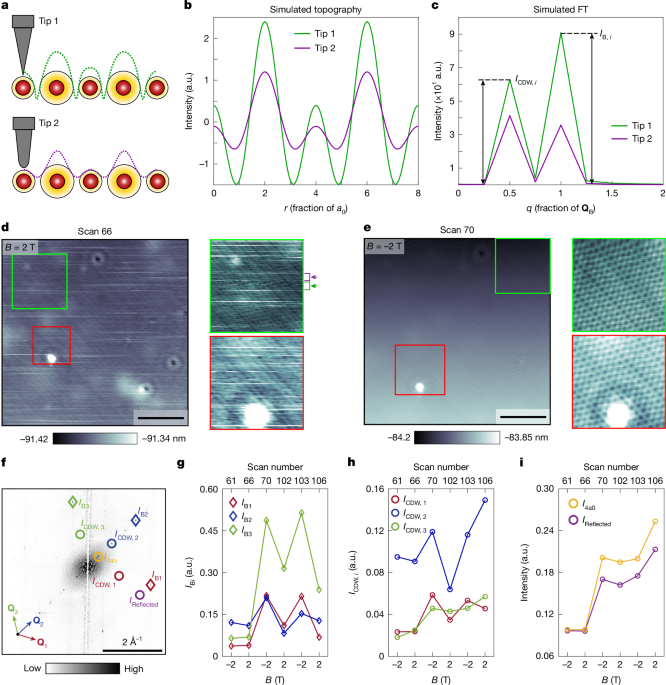
a-f, A sample of six plane-subtracted STM topographs used for figure 3 in Xing et al.7. Insets to the right show their Fourier transform (top inset) as well as a region common to all topographs (bottom inset). Fourier transform in (a) indicates CDW peaks by circles and Bragg peaks by diamonds, with Q1, Q2, and Q3 directions represented by red, blue, and green, respectively. (a) Shows the first scan used as the “initial condition”. (b-c) show the first transition going from illumination along Q3 to along Q1. (d-e) two topographs taken successively along Q1, and (f) switching back to Q3 illumination. Notice how going from (a) to (b) the tip becomes double, as apparent from the QPI ring disappearing in the Fourier transform (top insets) and the number of impurities doubling (bottom insets, though present throughout topograph (b)). The tip is changed again going from (b) to (c) as shown by the change in shape of the impurities (bottom inset). Notice also the qualitative differences of (d) and (e), which were taken with the same illumination direction Q1. The QPI ring again disappears between the two Fourier transforms, and the vacancies appear glaringly different (bottom insets). g, Bragg lengths along Q1 (red), Q2 (blue), and Q3 (green) as a function of laser illumination direction from topographs used in figure 3 of Xing et al.7. Lengths were determined by 5 × 5 COM fitting of the Bragg peaks. h, CDW intensity along Q1 (red), Q2 (blue), and Q3 (green) as a function of laser illumination direction acquired by using the Fourier transform of the raw data. i, Bragg intensity along Q1 (red), Q2 (blue), and Q3 (green) as a function of laser illumination direction acquired by analysing the Fourier transform of the raw data. Note the large variations in the ICDW,2 in (h) and atomic Bragg peak intensities in (i).

