



You have full access to this article via your institution.

A considerable amount of research has focused on preventing harm from static-electricity phenomena, such as lightning.Credit: Paul Williams/NPL
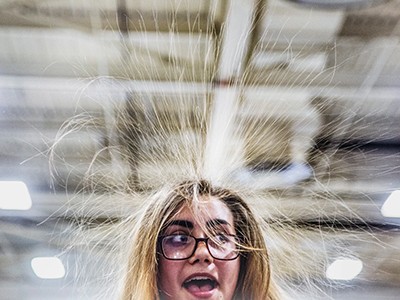
It’s the basis of some of the best-known classroom demonstrations: a phenomenon that literally makes your hair stand on end. Static electricity — or contact electrification or triboelectricity, to use some of the terms favoured by researchers — is beloved of science teachers and science communicators the world over.
Static electricity is a big mystery — a jolt of fresh research could help to solve it
It is also one of science’s oldest mysteries, as a News Feature in Nature reminds us this week. This is often under-emphasized in the classroom. Perhaps science teachers and science influencers are missing a trick. The fact that there is still so much we don’t know about this seemingly simple natural effect illustrates that, despite the advances of today’s high-tech world, fundamental scientific questions remain to be answered.
The phenomenon of static electricity has been observed for more than two millennia. It has long been known that it occurs when electric charge is transferred between two materials that come into contact with each other and then get separated. However, how this transfer happens, and why, remain unclear. Is the charge transferred by electrons or ions? And what part do the materials involved play in the accumulation and loss of charge? In a Nature News and Views article published last year, researchers described scientists’ understanding of the underlying processes of contact electrification as “almost nil”1.
One aspect of the phenomenon that has been the focus of considerable research is how to control static electricity, for the simple reason that people’s lives depend on it being safely harnessed. Lightning, for example, occurs as a result of the build-up of static electricity in the atmosphere, and lightning conductors are needed to protect people from electrocution. Meanwhile, ways of preventing static charge from accumulating and causing an explosion are required in industrial plants in which materials constantly come into contact. However, this work would also benefit from a greater knowledge of the underlying mechanisms.
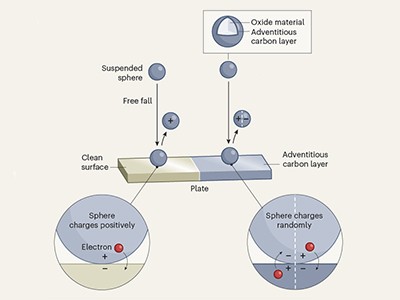
Hair-raising: how carbon contamination can drive static charging
A rough scale called the triboelectric series is used to organize various materials (‘tribo’ is derived from Greek and means ‘to rub’), with those higher up the list becoming positively charged when they rub against those lower down. The scale was created in 1757 by the Swedish physicist Johan Carl Wilcke2, but it is difficult to assess its accuracy, and tests have inconsistent results. Researchers have known for more than a century that the outcomes of experiments to measure static electric discharge vary depending on factors such as the ambient temperature, moisture and the nature of the surfaces in contact3.
There’s now an active community of researchers trying to get to the bottom of many ‘how’ and ‘why’ questions. Why do some materials charge positively and others negatively? How does charge transfer between samples of the same material? And how can experiments be designed so that the results are replicable? This is a fiendish problem, because so many variables — the ambient conditions, the materials’ structures and even their histories — need to match as closely as possible.
Last year, physicists Juan Carlos Sobarzo and Scott Waitukaitis, both at the Institute of Science and Technology Austria in Klosterneuburg, and their colleagues discovered that when new materials were rubbed against samples used in previous experiments, the used material tended to charge negatively, as a result of a kind of memory effect4. In a study published this week, Waitukaitis and his co-workers reveal5 the discovery of surface effects: molecules of oxides that have carbon on their surface are more likely to charge positively6.
In 1917, the physicist P. E. Shaw wrote that “little exact knowledge of tribo-electricity has yet been accumulated, and this subject has certainly not been raised to the dignity of a quantitative science”3. Static electricity remains a puzzle to this day. It is also a perfect example of the fact that science is as much about mystery and the unknown as it is a wondrous spectacle.

