


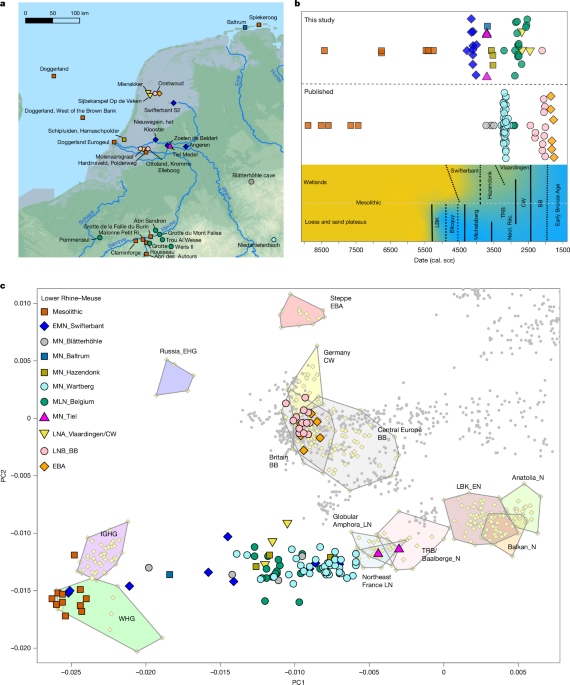
Lipson, M. et al. Parallel palaeogenomic transects reveal complex genetic history of early European farmers. Nature 551, 368–372 (2017).
Allentoft, M. E. et al. Population genomics of Bronze Age Eurasia. Nature 522, 167–172 (2015).
Amkreutz, L. W. S. W. Persistent traditions. A Long-Term Perspective on Communities in the Process of Neolithisation in the Lower Rhine Area (5500–2500 Cal BC) (Sidestone Press, 2013).
Lazaridis, I. et al. Ancient human genomes suggest three ancestral populations for present-day Europeans. Nature 513, 409–413 (2014).
Haak, W. et al. Massive migration from the steppe was a source for Indo-European languages in Europe. Nature 522, 207–211 (2015).
Olalde, I. et al. The Beaker phenomenon and the genomic transformation of northwest Europe. Nature 555, 190–196 (2018).
Papac, L. et al. Dynamic changes in genomic and social structures in third millennium BCE central Europe. Sci. Adv. 7, eabi6941 (2021).
Robb, J. Material culture, landscapes of action, and emergent causation: a new model for the origins of the European Neolithic. Curr. Anthropol. 54, 657–683 (2013).
Mittnik, A. et al. The genetic prehistory of the Baltic Sea region. Nat. Commun. 9, 442 (2018).
Skoglund, P. et al. Genomic diversity and admixture differs for Stone-Age Scandinavian foragers and farmers. Science 344, 747–750 (2014).
Hofmann, D. in Something Out of the Ordinary? Interpreting Diversity in the Early Neolithic Linearbandkeramik and Beyond (eds Amkreutz, L. W. S. W. et al.) 191–226 (Cambridge Scholars Press, 2016).
Kirschneck, E. The phenomena la Hoguette and Limburg—technological aspects. Open Archaeol. 7, 1295–1344 (2021).
Crombé, P. et al. New evidence on the earliest domesticated animals and possible small-scale husbandry in Atlantic NW Europe. Sci. Rep. 10, 20083 (2020).
Brusgaard, N. Ø et al. Early animal management in northern Europe: multi-proxy evidence from Swifterbant, the Netherlands. Antiquity 98, 654–671 (2024).
Kooijmans, L. P. L. & Jongste, P. F. B. A Neolithic Settlement on the Dutch North Sea Coast c. 3500 CAL BC (Analecta Praehistorica Leidensia, 2006).
Dreshaj, M., Dee, M., Brusgaard, N., Raemaekers, D. & Peeters, H. High-resolution Bayesian chronology of the earliest evidence of domesticated animals in the Dutch wetlands (Hardinxveld-Giessendam archaeological sites). PLoS ONE 18, e0280619 (2023).
Menne, J. & Brunner, M. Transition from Swifterbant to Funnelbeaker: a Bayesian chronological model. Open Archaeol. 7, 1235–1243 (2021).
Goossens, T. A. Opgraving Hellevoetsluis-Ossenhoek. Een Nederzetting van de Vlaardingen-Groep op een Kwelderrug in de Gemeente Hellevoetsluis (ARCHOL, 2009).
Bourgeois, Q. Monuments on the Horizon: The Formation of the Barrow Landscape throughout the 3rd and 2nd Millennium BC (Sidestone Press, 2013).
Beckerman, S. M. Corded Ware Coastal Communities: Using Ceramic Analysis to Reconstruct Third Millennium BC Societies in the Netherlands (Sidestone Press, 2015).
Fokkens, H., Steffens, B. J. W. & van As, S. F. M. Farmers, fishers, fowlers, hunters: knowledge generated by development-led archaeology about the Late Neolithic, the Early Bronze Age and the start of the Middle Bronze Age (2850–1500 cal BC) in the Netherlands. Ned. Archeol. Rapp. 53, 978–990 (2016).
Furholt, M. Re-integrating archaeology: a contribution to aDNA studies and the migration discourse on the 3rd millennium BC in Europe. Proc. Prehist. Soc. 85, 115–129 (2019).
Kroon, E. J. Serial Learners. Interactions between Funnel Beaker West and Corded Ware Communities in the Netherlands during the Third Millennium BCE from the Perspective of Ceramic Technology (Sidestone Press, 2024).
Wentink, K. Stereotype. The Role of Grave Sets in Corded Ware and Bell Beaker Funerary Practices (Sidestone Press, 2020).
Dyselinck, T. et al. Gent-Hogeweg, Vlakdekkende Opgraving. Mariakerke BAAC-Rapport A-11.0045 (BAAC, 2013).
Vander Linden, M. What linked the Bell Beakers in third millennium BC Europe? Antiquity 81, 343–352 (2007).
Lanting, J. N. De NO-Nederlandse/NW-Duitse Klokbekergroep: culturele achtergrond, typologie van het aardewerk, datering, verspreiding en grafritueel. Palaeohistoria 49–50, 11–326 (2008).
Posth, C. et al. Palaeogenomics of Upper Palaeolithic to Neolithic European hunter-gatherers. Nature 615, 117–126 (2023).
Immel, A. et al. Genome-wide study of a Neolithic Wartberg grave community reveals distinct HLA variation and hunter-gatherer ancestry. Commun. Biol. 4, 113 (2021).
Veselka, B. et al. Assembling ancestors: the manipulation of Neolithic and Gallo-Roman skeletal remains at Pommerœul, Belgium. Antiquity 98, 1576–1591 (2024).
Patterson, N. et al. Large-scale migration into Britain during the Middle to Late Bronze Age. Nature 601, 588–594 (2021).
ten Anscher, T. J., Knippenberg, S., van der Linde, C. M., Roessingh, W. & Willemse, N. W. Doorbraken aan de Rijn. Een Swifterbant-Gehucht, een Hazendonk-Nederzetting en Erven en Graven uit de Bronstijd in Medel-De Roeskamp RAAP-Rapport 6519, Archol Rapport 742, ADC Rapport A-16.0207 (BAAC, 2023).
Arzelier, A. et al. Neolithic genomic data from southern France showcase intensified interactions with hunter-gatherer communities. iScience 25, 105387 (2022).
Seguin-Orlando, A. et al. Heterogeneous hunter-gatherer and steppe-related ancestries in Late Neolithic and Bell Beaker genomes from present-day France. Curr. Biol. 31, 1072–1083 (2021).
Rivollat, M. et al. Ancient genome-wide DNA from France highlights the complexity of interactions between Mesolithic hunter-gatherers and Neolithic farmers. Sci. Adv. 6, aaz5344 (2020).
Mathieson, I. et al. The genomic history of southeastern Europe. Nature 555, 197–203 (2018).
Olalde, I. et al. Derived immune and ancestral pigmentation alleles in a 7,000-year-old Mesolithic European. Nature 507, 225–228 (2014).
Gelabert, P. et al. Social and genetic diversity in first farmers of central Europe. Nat. Hum. Behav. https://doi.org/10.1038/s41562-024-02034-z (2024).
Ringbauer, H. et al. Accurate detection of identity-by-descent segments in human ancient DNA. Nat. Genet. 56, 143–151 (2023).
Bourgeois, Q. P. J. et al. Spatiotemporal reconstruction of Corded Ware and Bell Beaker burial rituals reveals complex dynamics divergent from steppe ancestry. Sci. Adv. 11, eadx22622262 (2025).
Lazaridis, I. et al. The genetic origin of the Indo-Europeans. Nature https://doi.org/10.1038/s41586-024-08531-5 (2025).
Linderholm, A. et al. Corded Ware cultural complexity uncovered using genomic and isotopic analysis from south-eastern Poland. Sci. Rep. 10, 6885 (2020).
Allentoft, M. E. et al. Population genomics of post-glacial western Eurasia. Nature 625, 301–311 (2024).
Brunel, S. et al. Ancient genomes from present-day France unveil 7, 000 years of its demographic history. Proc. Natl Acad. Sci USA https://doi.org/10.1073/pnas.1918034117 (2020).
Parasayan, O. et al. Late Neolithic collective burial reveals admixture dynamics during the third millennium BCE and the shaping of the European genome. Sci. Adv. 10, eadl2468 (2024).
Heyd, V. in Yamnaya Interactions. Proceedings of the International Workshop held in Helsinki, 25–26 April 2019. The Yamnaya Impact on Prehistoric Europe (eds Heyd, V. et al.) 383–414 (Archaeolingua Alapítvány, (2021).
Jeunesse, C. The dogma of the Iberian origin of the Bell Beaker: attempting its deconstruction. J. Neolit. Archaeol. 16, 158–166 (2015).
Price, T. D., Knipper, C., Grupe, G. & Smrcka, V. Strontium isotopes and prehistoric human migration: The Bell Beaker period in Central Europe. Eur. J. Archaeol. 7, 9–40 (2004).
Parker Pearson, M. et al. The Beaker People: Isotopes, Mobility and Diet in Prehistoric Britain Vol. 7 (Oxbow Books, 2019).
Zvelebil, M. in Archaeogenetics: DNA and the Population Prehistory of Europe (eds Renfrew, C. & Boyle, K.) 57–79 (McDonald Institute Monographs, 2000).
Armit, I. & Reich, D. The return of the Beaker folk? Rethinking migration and population change in British prehistory. Antiquity 95, 1464–1477 (2021).
Cleal, R. M. J. & Pollard, J. in Is There a British Chalcolithic? People, Place and Polity in the Later 3rd Millennium (eds Allen, M. J. et al.) Vol. 4, 317–332 (Oxbow Books, 2012).
Booth, T. J., Brück, J., Brace, S. & Barnes, I. Tales from the supplementary information: ancestry change in Chalcolithic–Early Bronze Age Britain was gradual with varied kinship organization. Camb. Archaeol. J. https://doi.org/10.1017/s0959774321000019 (2021).
Gibson, A. Beakers in Britain. The Beaker package reviewed. Préhist. Méd. 8, 32 (2020).
Adler, C. J., Haak, W., Donlon, D. & Cooper, A. Survival and recovery of DNA from ancient teeth and bones. J. Archaeol. Sci. 38, 956–964 (2011).
Pinhasi, R., Fernandes, D. M., Sirak, K. & Cheronet, O. Isolating the human cochlea to generate bone powder for ancient DNA analysis. Nat. Protoc. 14, 1194–1205 (2019).
Rohland, N., Glocke, I., Aximu-Petri, A. & Meyer, M. Extraction of highly degraded DNA from ancient bones, teeth and sediments for high-throughput sequencing. Nat. Protoc. 13, 2447–2461 (2018).
Dabney, J. et al. Complete mitochondrial genome sequence of a Middle Pleistocene cave bear reconstructed from ultrashort DNA fragments. Proc. Natl Acad. Sci. USA 110, 15758–15763 (2013).
Korlević, P. et al. Reducing microbial and human contamination in DNA extractions from ancient bones and teeth. BioTechniques 59, 87–93 (2015).
Dulias, K. et al. Ancient DNA at the edge of the world: continental immigration and the persistence of Neolithic male lineages in Bronze Age Orkney. Proc. Natl Acad. Sci. USA 119, e2108001119 (2022).
Briggs, A. W. et al. Removal of deaminated cytosines and detection of in vivo methylation in ancient DNA. Nucleic Acids Res. 38, e87 (2009).
Rohland, N., Harney, E., Mallick, S., Nordenfelt, S. & Reich, D. Partial uracil–DNA–glycosylase treatment for screening of ancient DNA. Philos. Trans. R. Soc. Lond. B 370, 20130624 (2015).
Gansauge, M. T., Aximu-Petri, A., Nagel, S. & Meyer, M. Manual and automated preparation of single-stranded DNA libraries for the sequencing of DNA from ancient biological remains and other sources of highly degraded DNA. Nat. Protoc. 15, 2279–2300 (2020).
Fu, Q. et al. An early modern human from Romania with a recent Neanderthal ancestor. Nature 524, 216–219 (2015).
Rohland, N. et al. Three assays for in-solution enrichment of ancient human DNA at more than a million SNPs. Genome Res. 32, 2068–2078 (2022).
Kircher, M., Sawyer, S. & Meyer, M. Double indexing overcomes inaccuracies in multiplex sequencing on the Illumina platform. Nucleic Acids Res. 40, e3 (2012).
Li, H. & Durbin, R. Fast and accurate short read alignment with Burrows–Wheeler transform. Bioinformatics 25, 1754–1760 (2009).
Fu, Q. et al. A revised timescale for human evolution based on ancient mitochondrial genomes. Curr. Biol. 23, 553–559 (2013).
Korneliussen, T. S., Albrechtsen, A. & Nielsen, R. ANGSD: analysis of next generation sequencing data. BMC Bioinform. 15, 356 (2014).
Patterson, N. et al. Ancient admixture in human history. Genetics 192, 1065–1093 (2012).
Biagini, S. A. et al. People from Ibiza: an unexpected isolate in the Western Mediterranean. Eur. J. Hum. Genetics 27, 941–951 (2019).
Schönherr, S., Weissensteiner, H., Kronenberg, F. & Forer, L. Haplogrep 3—an interactive haplogroup classification and analysis platform. Nucleic Acids Res. 51, W263–W268 (2023).
Lazaridis, I. et al. The genetic history of the Southern Arc: a bridge between West Asia and Europe. Science 377, eabdm4247 (2022).
Fowler, C. et al. A high-resolution picture of kinship practices in an Early Neolithic tomb. Nature 601, 584–587 (2021).
Rubinacci, S., Ribeiro, D. M., Hofmeister, R. J. & Delaneau, O. Efficient phasing and imputation of low-coverage sequencing data using large reference panels. Nat. Genet. 53, 120–126 (2021).
The 1000 Genomes Project Consortium. An integrated map of genetic variation from 1,092 human genomes. Nature 491, 56–65 (2012).
Rivollat, M. et al. Extensive pedigrees reveal the social organization of a Neolithic community. Nature https://doi.org/10.1038/s41586-023-06350- (2023).
Ringbauer, H., Novembre, J. & Steinrücken, M. Parental relatedness through time revealed by runs of homozygosity in ancient DNA. Nat. Commun. 12, 5425 (2021).
Patterson, N., Price, A. L. & Reich, D. Population structure and eigenanalysis. PLoS Genet. 2, e190 (2006).
Fournier, R., Fulton, A. P. & Reich, D. A SNP panel for co-analysis of capture and shotgun ancient DNA data. Preprint at bioRxiv https://doi.org/10.1101/2025.07.30.667733 (2025).
Narasimhan, V. M. et al. The formation of human populations in South and Central Asia. Science 365, eaat7487 (2019).
Fenner, J. N. Cross-cultural estimation of the human generation interval for use in genetics-based population divergence studies. Am. J. Phys. Anthropol. 128, 415–423 (2005).
Reimer, P. J. et al. The IntCal20 Northern Hemisphere radiocarbon age calibration curve (0–55 cal kBP). Radiocarbon 62, 725–757 (2020).
Philippsen, B. The freshwater reservoir effect in radiocarbon dating. Herit. Sci. 1, 24 (2013).
van der Plicht, J. & Streurman, H. J. A new model for radiocarbon dating of marine shells from the Netherlands. Radiocarbon 67, 378–411 (2025).
Kamjan, S., Gillis, R. E., Cakirlar, C. & Raemaekers, D. C. M. Specialized cattle farming in the Neolithic Rhine-Meuse Delta: results from zooarchaeological and stable isotope (δ18O, δ13C, δ15N) analyses. PLoS ONE 15, e0240464 (2020).
Massicotte, P. & South, A. rnaturalearth: World Map Data from Natural Earth (2024); docs.ropensci.org/rnaturalearth.

