


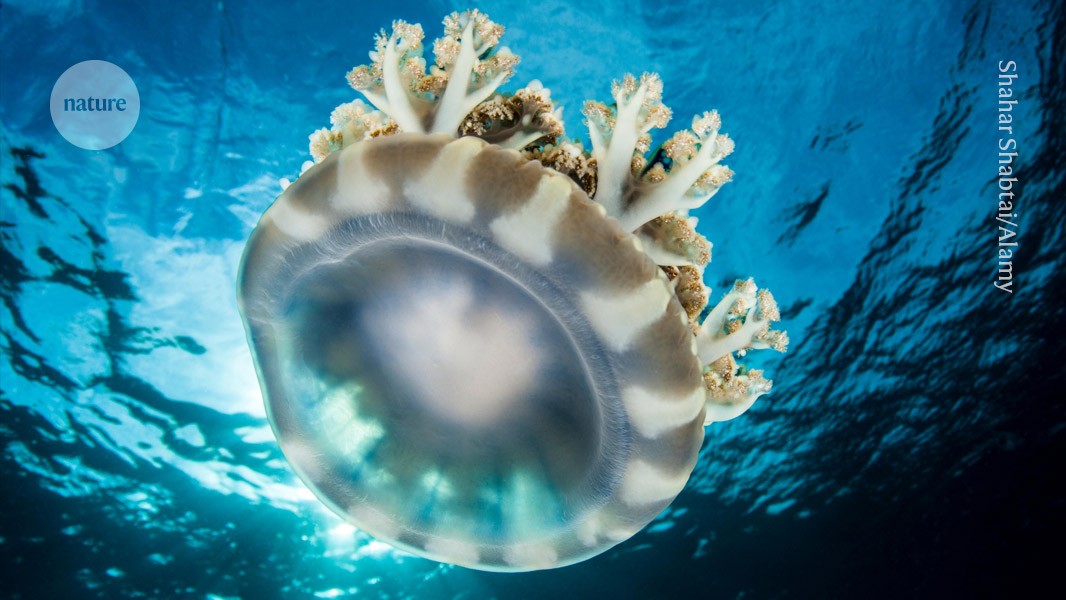

The upside-down jellyfish Cassiopea andromeda sleeps for roughly 8 hours a day.Credit: Shahar Shabtai/Alamy
Neither jellyfish nor sea anemones have brains. But these animals sleep in ways strikingly similar to humans, according to a study published today in Nature Communications1. The findings bolster a theory that sleep evolved, at least in part, to protect the DNA in individual nerve cells, helping to repair damage that builds up while animals are awake.
“Neurons are very precious,” says study co-author Lior Appelbaum, a molecular neuroscientist at Bar-Ilan University in Ramat Gan, Israel. “They don’t divide, so you need to keep them intact.”
Previous work has shown that jellyfish enter a sleep-like state, but this study is the first to characterize the phenomenon in sea anemones, and the first to describe both creatures’ sleep patterns in detail. “Every time somebody adds to the list of species that sleep, it is a very important step for the field,” adds Chiara Cirelli, a sleep researcher at the University of Wisconsin–Madison.
Restorative rest
Sleep is a risky state for animals. It leaves them vulnerable to predators and environmental hazards, and it cuts into time that could otherwise be spent foraging, mating or caring for offspring. Scientists broadly agree that sleep must serve a fundamental biological function, because evolution has preserved it across all animals with nervous systems studied so far.
The idea that sleep might actually predate the evolution of a centralized nervous system gained traction in 2017, when Ravi Nath, now a postdoctoral neuroscientist at Stanford University in California, and his colleagues demonstrated the sleep-like state in jellyfish2. “There is good evidence that sleep emerged with neurons,” he says. “There is likely a core function, but each species has also adapted sleep to meet its own needs.”
How to get the best night’s sleep: what the science says
The latest study builds on that insight by defining sleep more precisely and inspecting what effect it might have at the cellular level in animals that have neurons, but no brain. In both the laboratory and in a natural habitat in Key Largo, Florida, Appelbaum and his colleagues found that, like humans, the upside-down jellyfish (Cassiopea andromeda) sleeps for roughly eight hours a day. Most of that sleep occurs at night time. But the jellyfish also had a short midday nap. The team also studied the starlet sea anemone (Nematostella vectensis) in the lab, characterizing its sleep for the first time. It, too, slept for about one-third of the day, although its rest was concentrated around dawn.

