


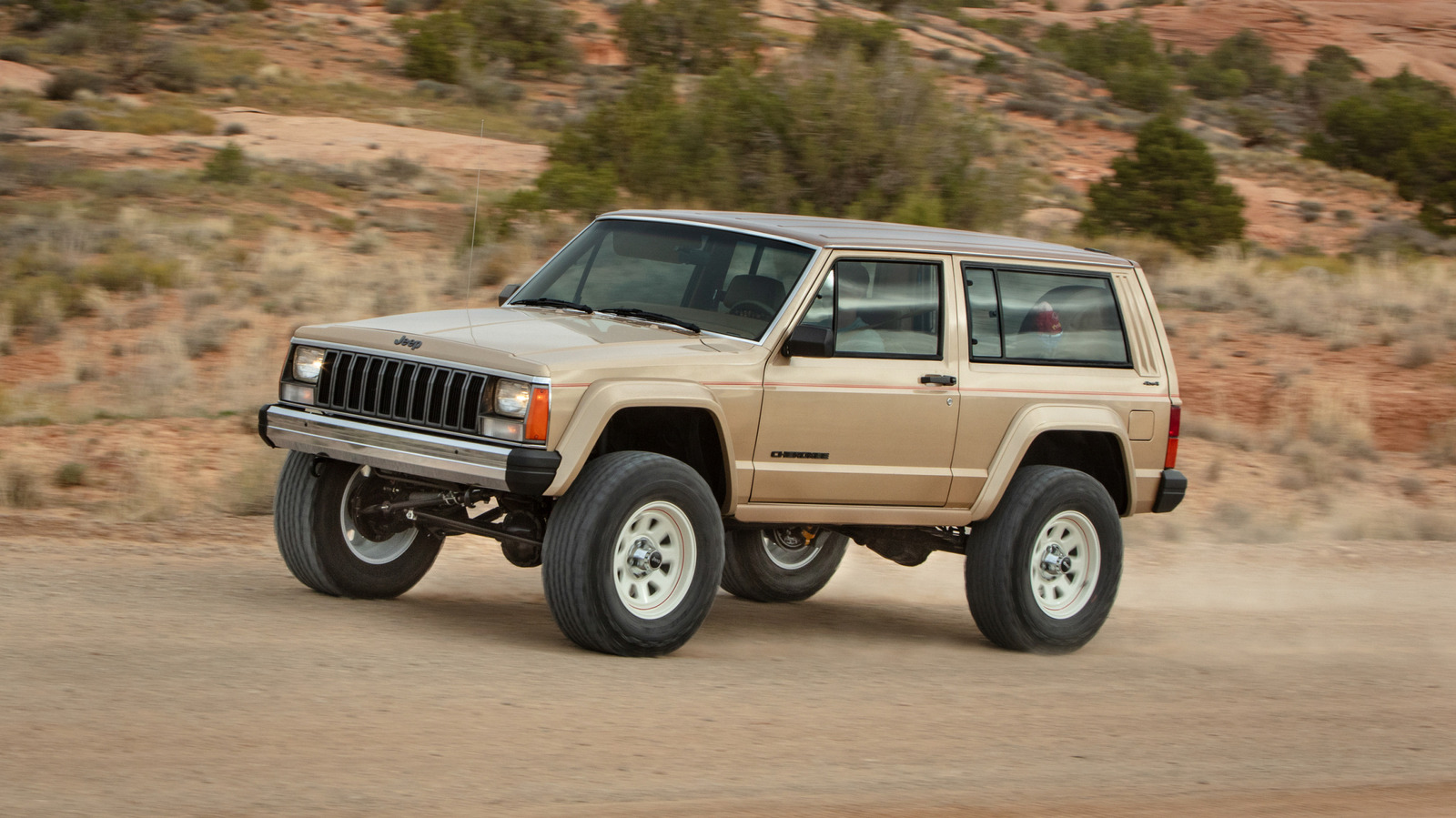
Jeep usually brings some neat concept vehicles to the Easter Jeep Safari, and this year was no exception. But what caught my eye the most wasn’t one of the gonzo Wrangler concepts, nor the Grand Wagoneer Commander built for off-roading in style. It was the modest two-door XJ Cherokee, sporting slightly larger wheels and tires than stock, but otherwise looking strikingly original. Jeep’s press release has little to say about it beyond this one line: “The Jeep XJ Pioneer concept marks the moment the original 1984 Cherokee changed the SUV landscape, tying that legacy to 85 years of Jeep heritage and the Cherokee nameplate’s 2026 return.”
But that severely understates what Jeep has done here. Road & Track got the back story from Chris Piscatelli, the lead design manager for the Wrangler and Gladiator.
“XJs, which is the original Cherokees, which came out in Eighty-Four, are particularly near and dear to us. Myself included, being a child of the Eighties and anybody a generation above me or below me has a story that involves an XJ—whether it was somebody’s sisters, mothers, brothers, best friends, their own first high school car, their car in college, something they, you know, got that when they couldn’t afford Wrangler to wheel with and turned it into their first real off-road rig. Everybody’s got that kind of special, special place in these cars.”
A blast from the past
Piscatelli is right. I learned to drive in my mom’s 1987 Cherokee Laredo, and it was the car I borrowed throughout high school until I got my first car. Minus the beaded seat covers, this was my view from behind the wheel at the beginning of my driving career. I haven’t seen an XJ interior that looked this good since my mom had hers.
Jeep has the means to restore even a worn-out XJ into this like-new condition, and that was the original plan. However, when the team found a one-owner 1986 model in Nevada with just 80,000 miles and a full service history, the project turned into more of a preservation project. It would’ve made sense to drop a hopped-up inline-6 under the hood, or even a modern V8. Instead, they kept the 2.8-liter V6 it came with, a less-desirable General Motors engine that we once called “garbage,” just to maintain this XJ’s originality.
Bigger wheels and tires were required for Moab (the suspension is refreshed, but stock), and are one of the few upgrades visible on XJ Pioneer. Much less obvious are the carbon-fiber fenders surrounding the enlarged wheel openings these tires required. The only way I could tell they weren’t original is that they cross the body crease just below the door handles, while the stock fenders stop a few inches below it. They look great, a whole lot better than the raw cuts I normally see on lifted XJs.
The XJ is one of the most important vehicles of the last 50 years. Many of us have had them, driven them, and used and abused them. They haven’t made them for 25 years, and there aren’t many examples left in good condition. I think Stellantis made the right call to abandon plans for a wild build on this one and use a light restomod approach instead, preserving its excellent condition as well as the off-road capability that made the XJ a legend in the first place.

